4,068 posters, 219 videos, 101 topics, 69 sessions, 14,365 authors, 6,128 institutions
ePostersLive by SciGen Technologies S.A. All rights reserved.
Alzheimer's Association International Conference 2026
July 12-15, 2026 | London, United Kingdom, and Online

4973
Synthetic Alzheimer’s Disease Patient Generation To Improve Clinical Trial Representativeness In The All-embraced Framework
Poster Presenter
Authors
Alberto Boccali, Claudio Crema, Claudio Demaria, Matteo Lupini, Ilaria Passeggia, Monica Almici, Cesare Michele Baronio, Silvia De Francesco, Damiano Archetti, Alberto Redolfi
Affiliations
Laboratory of Neuroinformatics, IRCCS Istituto Centro San Giovanni di Dio Fatebenefratelli, Brescia, Italy, Laboratory Alzheimer's Neuroimaging & Epidemiology, IRCCS Istituto Centro San Giovanni di Dio Fatebenefratelli, Brescia, Italy
Part of Topic
Video
INTRODUCTION
Clinical trials (CTs) results are frequently affected by suboptimal study designs or ineffective recruitment strategies,leading to discrepancies between enrolled participants and the intended target populations. The ALL-EMBRACED project (www.allembraced.eu) seeks to enhance inclusiveness and transparency in CTs through data-driven and AI-based methodologies. In this context, we investigated the application of synthetic data generation for Alzheimer’s disease (AD) using the open-source Synthea platform (Walonoski et al., 2018). The objective was to generate realistic synthetic cohorts with pathological markers across different disease stages, suitable for assessing how eligibility criteria relaxation impacts CTs outcomes and population representativeness.
METHODS
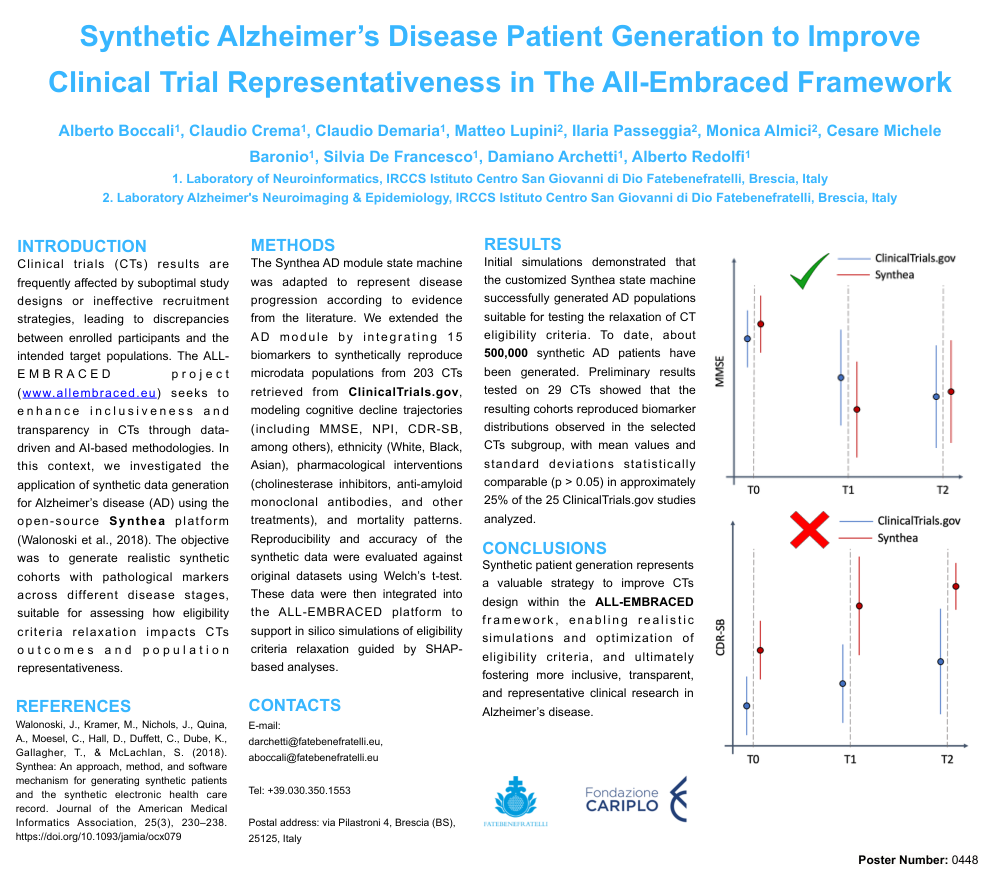
The Synthea AD module state machine was adapted to represent disease progression according to evidence from the literature. We extended the AD module by integrating 15 biomarkers to synthetically reproduce microdata populations from 203 CTs retrieved from ClinicalTrials.gov, modeling cognitive decline trajectories (including MMSE, NPI, CDR-SB, among others), ethnicity (White, Black, Asian), pharmacological interventions (cholinesterase inhibitors, anti-amyloid monoclonal antibodies, and other treatments), and mortality patterns. Reproducibility and accuracy of the synthetic data were evaluated against original datasets using Welch’s t-test. These data were then integrated into the ALL-EMBRACED platform to support in silico simulations of eligibility criteria relaxation guided by SHAP-based analyses.
RESULTS
Initial simulations demonstrated that the customized Synthea state machine successfully generated AD populations suitable for testing the relaxation of CT eligibility criteria. To date, about 500,000 synthetic AD patients have been generated. Preliminary results tested on 29 CTs showed that the resulting cohorts reproduced biomarker distributions observed in the selected CTs subgroup, with mean values and standard deviations statistically comparable (p > 0.05) in approximately 25% of the 25 ClinicalTrials.gov studies analyzed.
CONCLUSIONS
Synthetic patient generation represents a valuable strategy to improve CTs design within the ALL-EMBRACED framework, enabling realistic simulations and optimization of eligibility criteria, and ultimately fostering more inclusive, transparent, and representative clinical research in Alzheimer’s disease.
Comments
Email is required but is not shown publicly.
Loading comments...