4,068 posters, 219 videos, 101 topics, 69 sessions, 14,365 authors, 6,128 institutions
ePostersLive by SciGen Technologies S.A. All rights reserved.
Alzheimer's Association International Conference 2026
July 12-15, 2026 | London, United Kingdom, and Online

10456
Differences In Verbal Memory Performance On Neuropsychological Tests In Older Adults With Cognitive Impairment.
Poster Presenter
Authors
Part of Topic
Video
BACKGROUND
Prior studies have consistently shown different cognitive performances between sexes, where women perform better than men in verbal memory, while the opposite is seen in visuospatial tasks. However, most studies have been conducted in populations of high-income countries with high educational attainment.
METHODS
This is a cross-sectional study, conducted with data from the Cog-Aging cohort (2009-2025). Older adults (n=374) who underwent comprehensive clinical and neuropsychological assessment were included. They were categorized as Mild Cognitive Impairment (MCI; n=241) and Dementia of Alzheimer's Type (DAT; n=133). Linear regression models were employed to assess the influence of sex on verbal memory performance, controlling for age and years of schooling as covariates. Sections of immediate memory (A6) and delayed recall (A7) from the RAVLT were used in the analysis.
RESULTS
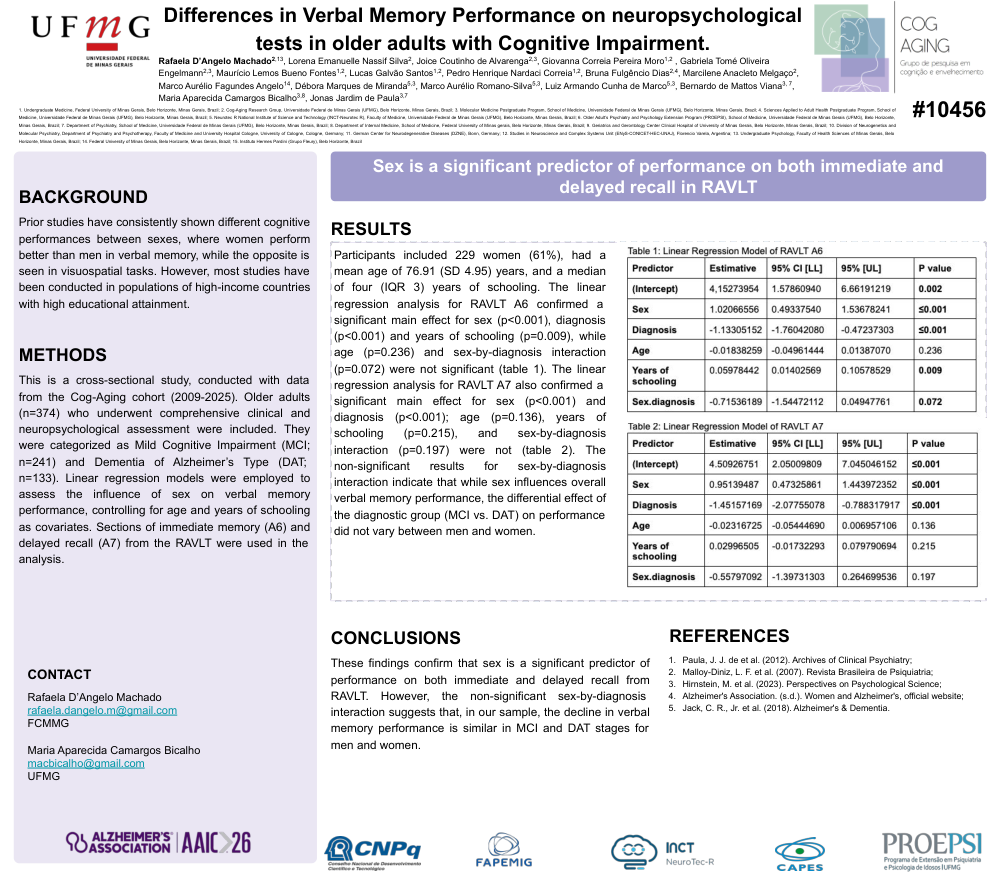
Participants included 229 women (61%), had a mean age of 76.91 (SD 4.95) years, and a median of four (IQR 3) years of schooling. The linear regression analysis for RAVLT A6 confirmed a significant main effect for sex (p<0.001), diagnosis (p<0.001) and years of schooling (p=0.009), while age (p=0.236) and sex-by-diagnosis interaction (p=0.072) were not significant (table 1). The linear regression analysis for RAVLT A7 also confirmed a significant main effect for sex (p<0.001) and diagnosis (p<0.001); age (p=0.136), years of schooling (p=0.215), and sex-by-diagnosis interaction (p=0.197) were not (table 2). The non-significant results for sex-by-diagnosis interaction indicate that while sex influences overall verbal memory performance, the differential effect of the diagnostic group (MCI vs. DAT) on performance did not vary between men and women.
CONCLUSIONS
These findings confirm that sex is a significant predictor of performance on both immediate and delayed recall from RAVLT. However, the non-significant sex-by-diagnosis interaction suggests that, in our sample, the decline in verbal memory performance is similar in MCI and DAT stages for men and women.
REFERENCES
-
Paula, J. J. de et al. (2012). Archives of Clinical Psychiatry;
-
Malloy-Diniz, L. F. et al. (2007). Revista Brasileira de Psiquiatria;
-
Hirnstein, M. et al. (2023). Perspectives on Psychological Science;
-
Alzheimer's Association. (s.d.). Women and Alzheimer's, official website;
-
Jack, C. R., Jr. et al. (2018). Alzheimer's & Dementia
Comments
Email is required but is not shown publicly.
Loading comments...