4,068 posters, 219 videos, 101 topics, 69 sessions, 14,365 authors, 6,128 institutions
ePostersLive by SciGen Technologies S.A. All rights reserved.
Alzheimer's Association International Conference 2026
July 12-15, 2026 | London, United Kingdom, and Online

6867
A Novel CSF EMTBR-tau243 Immunoassay For Detecting AD Tau Pathology And Assessing Etalanetug Pharmacodynamics In DIAD
Poster Presenter
Part of Topic
A Novel CSF EMTBR‑tau243 Immunoassay For Detecting AD Tau Pathology And Assessing Etalanetug Pharmacodynamics In DIAD
1Eisai Co., Ltd., Tsukuba, Japan, 2Eisai Inc., Nutley, NJ, USA, 3Eisai Co., Ltd., Kobe, Japan.
Abstract:
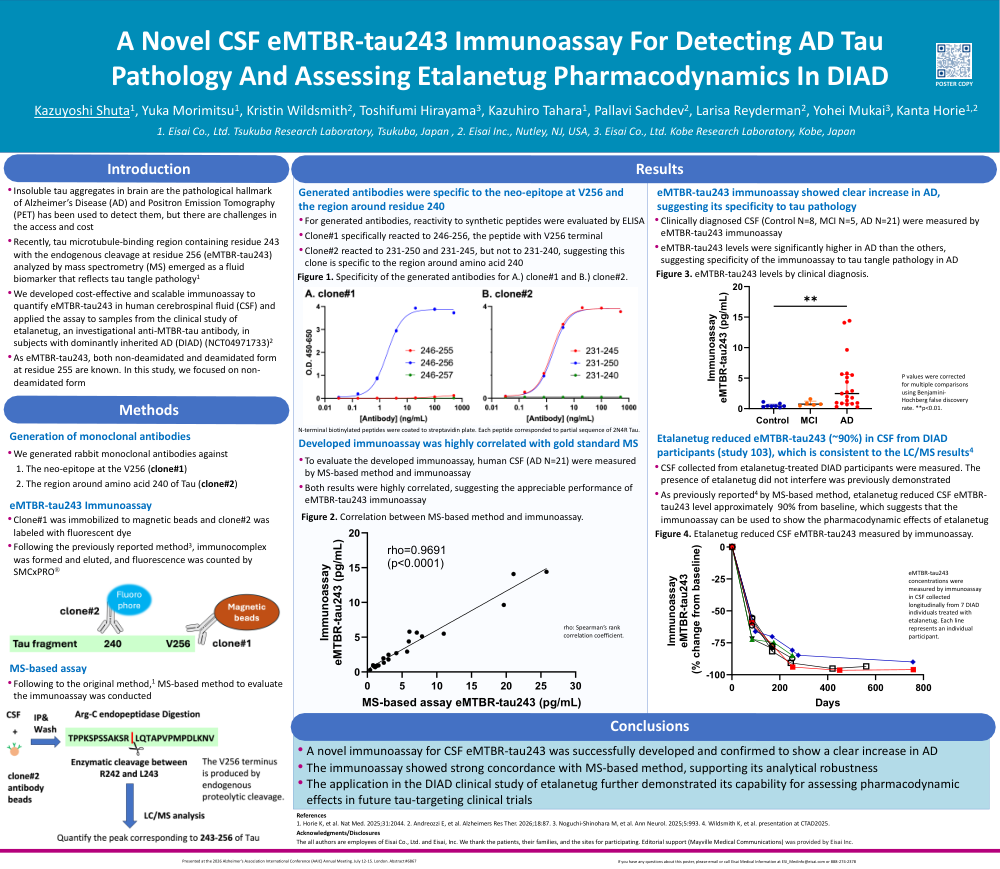
Background: Insoluble tau aggregates in brain are the pathological hallmark of Alzheimer’s Disease (AD). Positron Emission Tomography (PET) has been used to detect them, but there are challenges because of the limited access and high cost. Recently, tau microtubule-binding region containing residue 243 with the endogenous cleavage at the residue 256 (eMTBR-tau243) analyzed by mass spectrometry (MS) emerged as a fluid biomarker that reflects tau tangles pathology (Horie et al., Nat Med. 2025). In this study, we developed more cost-effective and scalable immunoassay to accurately quantify eMTBR-tau243 in human cerebrospinal fluid (CSF).
Methods: We generated two novel anti-tau antibodies with 1. a linear epitope around the residue 240 and 2. a neo-epitope specific to C-terminus at the residue 256. These antibodies were used on SMCxPRO platform (Merck KGaA) to develop an immunoassay that quantifies CSF eMTBR-tau243. The immunoassay performance was evaluated by analyzing CSF samples from the participants at various stages of AD (cognitively unimpaired normal [Control], mild cognitive Impairment [MCI], and AD) and further qualified by comparing with the data from the original MS method reported previously (Horie, Nat Med. 2025). Finally, the immunoassay was used to measure pharmacodynamic effect of etalanetug, an investigational anti-MTBR-tau antibody, in subjects with dominantly inherited AD (DIAD) (NCT04971733).
Results: The immunoassay clearly showed the increase of CSF eMTBR-tau243 in AD compared to Control and MCI. The immunoassay results were highly correlated with the original MS method (rho>0.95). Drug interference testing demonstrated that eMTBR-tau243 immunoassay performance was not impacted by the presence of etalanetug in CSF. In the DIAD clinical trial for etalanetug, the treatment exhibited an approximately 90% reduction of CSF eMTBR-tau243 compared to the baseline replicating results previously observed with MS-based method (Wildsmith et al., JPAD 2025).
Conclusion: A novel immunoassay for CSF eMTBR-tau243 was successfully developed, demonstrating high sensitivity, selectivity, and specificity for tau tangles pathology in AD. The assay showed strong concordance with the established MS-based method, supporting its analytical robustness. The application in the DIAD clinical study of etalanetug further demonstrated its suitability for assessing pharmacodynamic effects in future tau‑targeting clinical trials.
Comments
Email is required but is not shown publicly.
Loading comments...