4,068 posters, 219 videos, 101 topics, 69 sessions, 14,365 authors, 6,128 institutions
ePostersLive by SciGen Technologies S.A. All rights reserved.
Alzheimer's Association International Conference 2026
July 12-15, 2026 | London, United Kingdom, and Online

5841
Neuron-derived Cfdna Methylation For Blood-based Detection Of Neurodegeneration In Alzheimer's And Other Disorders
Poster Presenter
Authors
Chad Pollard, Ryan Miller, Isaac Sirland, Mykle Keni, Erin Saito, Jonathon Hill, Tim Jenkins
Affiliations
Part of Topic
Neuron-derived cfDNA methylation for blood-based detection of neurodegeneration in Alzheimer’s and other disorders
Background
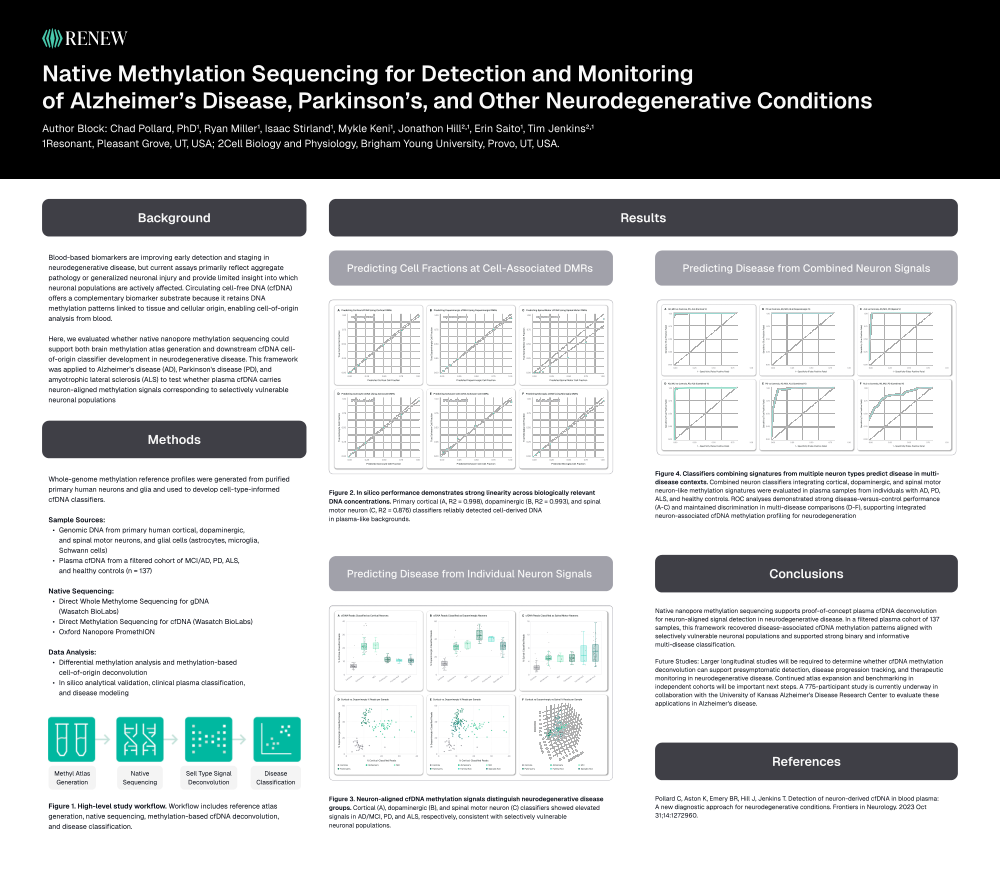
Blood-based biomarkers are improving early detection and staging in neurodegenerative disease, but current assays primarily reflect aggregate pathology or generalized neuronal injury and provide limited insight into which neuronal populations are actively affected. Circulating cell-free DNA (cfDNA) offers a complementary biomarker substrate because it retains DNA methylation patterns linked to tissue and cellular origin, enabling cell-of-origin analysis from blood.
Here, we evaluated whether native nanopore methylation sequencing could support both brain methylation atlas generation and downstream cfDNA cell-of-origin classifier development in neurodegenerative disease. This framework was applied to Alzheimer's disease (AD), Parkinson's disease (PD), and amyotrophic lateral sclerosis (ALS) to test whether plasma cfDNA carries neuron-aligned methylation signals corresponding to selectively vulnerable neuronal populations.
Methods
Whole-genome methylation reference profiles were generated from purified primary human neurons and glia and used to develop cell-type-informed cfDNA classifiers.
Sample Sources:
Genomic DNA from primary human cortical, dopaminergic, and spinal motor neurons, and glial cells (astrocytes, microglia, Schwann cells)
Plasma cfDNA from a filtered cohort of MCI/AD, PD, ALS, and healthy controls (n = 137)
Native Sequencing:
Direct Whole Methylome Sequencing for gDNA (Wasatch BioLabs)
Direct Methylation Sequencing for cfDNA (Wasatch BioLabs)
Oxford Nanopore PromethION
Data Analysis:
-
Differential methylation analysis and methylation-based cell-of-origin deconvolution
-
In silico analytical validation, clinical plasma classification, and disease modeling
Figure 1. High-level study workflow. Workflow includes reference atlas generation, native sequencing, methylation-based cfDNA deconvolution, and disease classification.
Predicting Cell Fractions at Cell-Associated DMRs
Figure 2. In silico performance demonstrates strong linearity across biologically relevant DNA concentrations. Primary cortical (A, R2 = 0.998), dopaminergic (B, R2 = 0.993), and spinal motor neuron (C, R2 = 0.876) classifiers reliably detected cell-derived DNA in plasma-like backgrounds.
Predicting Disease from Individual Neuron Signals
Figure 3. Neuron-aligned cfDNA methylation signals distinguish neurodegenerative disease groups. Cortical (A), dopaminergic (B), and spinal motor neuron (C) classifiers showed elevated signals in AD/MCI, PD, and ALS, respectively, consistent with selectively vulnerable neuronal populations.
Predicting Disease from Combined Neuron Signals
Figure 4. Classifiers combining signatures from multiple neuron types predict disease in multi-disease contexts. Combined neuron classifiers integrating cortical, dopaminergic, and spinal motor neuron-like methylation signatures were evaluated in plasma samples from individuals with AD, PD, ALS, and healthy controls. ROC analyses demonstrated strong disease-versus-control performance (A-C) and maintained discrimination in multi-disease comparisons (D-F), supporting integrated neuron-associated cfDNA methylation profiling for neurodegeneration.
Conclusions
Native nanopore methylation sequencing supports proof-of-concept plasma cfDNA deconvolution for neuron-aligned signal detection in neurodegenerative disease. In a filtered plasma cohort of 137 samples, this framework recovered disease-associated cfDNA methylation patterns aligned with selectively vulnerable neuronal populations and supported strong binary and informative multi-disease classification.
Future Studies: Larger longitudinal studies will be required to determine whether cfDNA methylation deconvolution can support presymptomatic detection, disease progression tracking, and therapeutic monitoring in neurodegenerative disease. Continued atlas expansion and benchmarking in independent cohorts will be important next steps. A 775-participant study is currently underway in collaboration with the University of Kansas Alzheimer's Disease Research Center to evaluate these applications in Alzheimer's disease.
References
Pollard C, Aston K, Emery BR, Hill J, Jenkins T. Detection of neuron-derived cfDNA in blood plasma: A new diagnostic approach for neurodegenerative conditions. Frontiers in Neurology. 2023 Oct 31;14:1272960.
Comments
Email is required but is not shown publicly.
Loading comments...