4,068 posters, 219 videos, 101 topics, 69 sessions, 14,365 authors, 6,128 institutions
ePostersLive by SciGen Technologies S.A. All rights reserved.
Alzheimer's Association International Conference 2026
July 12-15, 2026 | London, United Kingdom, and Online

7177
Enhancing Multi-omics Classification Of Alzheimer’S Disease Via Asymmetrical Graphformer Fusion
Poster Presenter
Authors
Camilo Pérez, Paola Ruiz Puentes, Pablo Arbeláez, Elliot Hong, Ram Mukunda
Affiliations
Part of Topic
Enhancing Multi-Omics Classification of Alzheimer’s Disease via Asymmetrical Graphformer Fusion
Camilo Pérez1, Paola Ruiz Puentes1, Pablo Arbeláez1, Elliot Hong2, Ram Mukunda1
1IGC Pharma Inc, 2UT Health McGovern Medical School
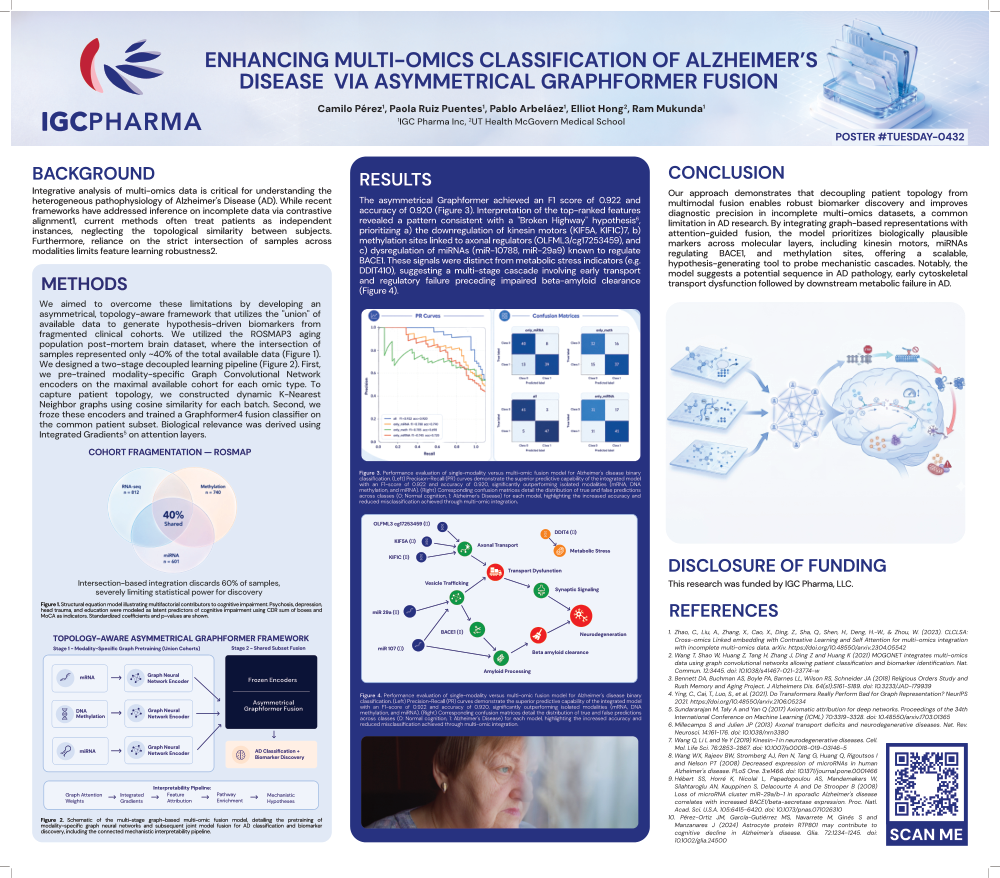
Background: Integrative analysis of multi-omics data is critical for understanding the heterogeneous pathophysiology of Alzheimer’s Disease (AD). While recent frameworks have addressed inference on incomplete data via contrastive alignment, current methods often treat patients as independent instances, neglecting the topological similarity between subjects. Furthermore, reliance on the strict intersection of samples across modalities limits feature learning robustness.
Methods: We aimed to overcome these limitations by developing an asymmetrical, topology-aware framework that utilizes the "union" of available data to generate hypothesis-driven biomarkers from fragmented clinical cohorts. We utilized the ROSMAP aging population post-mortem brain dataset, where the intersection of samples represented only ~40% of the total available data. We designed a two-stage decoupled learning pipeline. First, we pre-trained modality-specific Graph Convolutional Network encoders on the maximal available cohort for each omic type. To capture patient topology, we constructed dynamic K-Nearest Neighbor graphs using cosine similarity for each batch. Second, we froze these encoders and trained a Graphformer fusion classifier on the common patient subset. Biological relevance was derived using Integrated Gradients on attention layers.
Results: The asymmetrical Graphformer achieved an F1 score of 0.922 and accuracy of 0.920. Interpretation of the top-ranked features revealed a pattern consistent with a "Broken Highway" hypothesis, prioritizing a) the downregulation of kinesin motors (KIF5A, KIF1C), b) methylation sites linked to axonal regulators (OLFML3/cg17253459), and c) dysregulation of miRNAs (miR-107, miR-29a) known to regulate BACE1. These signals were distinct from metabolic stress indicators (e.g. DDIT4), suggesting a multi-stage cascade involving early transport and regulatory failure preceding impaired beta-amyloid clearance.
Conclusions: Our approach demonstrates that decoupling patient topological from multimodal fusion enables robust biomarker discovery and improves diagnostic precision in incomplete multi-omics datasets, a common limitation in AD research. By integrating graph-based representations with attention-guided fusion, the model prioritizes biologically plausible markers across molecular layers, including kinesin motors, miRNAs regulating BACE1, and methylation sites, offering a scalable, hypothesis-generating tool to probe mechanistic cascades. Notably, the model suggests a potential sequence in AD pathology, early cytoskeletal transport dysfunction followed by downstream metabolic failure in AD.
Comments
Email is required but is not shown publicly.
Loading comments...