4,068 posters, 219 videos, 101 topics, 69 sessions, 14,365 authors, 6,128 institutions
ePostersLive by SciGen Technologies S.A. All rights reserved.
Alzheimer's Association International Conference 2026
July 12-15, 2026 | London, United Kingdom, and Online

3437
Associations Of Plasma Biomarkers Of Alzheimer’S Disease Pathology With Cognitively Healthy Longevity
Poster Presenter
Authors
Affiliations
Part of Topic
Introduction
The aging of the population has been accompanied by an increase in the prevalence of Alzheimer’s disease (AD).
Plasma biomarkers of Alzheimer’s disease and related dementias (ADRD) have previously been investigated in relation to cognitive decline and dementia risk; however, their associations with cognitively healthy longevity remain unclear.
Objective
To evaluate whether plasma ADRD biomarkers were associated with:
Methods
2760 cognitively unimpaired women, born on or before February 28, 1934, enrolled into the Women’s Health Initiative Memory Study (WHIMS) in 1996-1999 and followed through 2024.
P-tau217, p-tau181, GFAP, NfL, and Ab42:Ab40 measured using Simoa assays
Outcomes included: 1) exceptional longevity (survival to age 90 vs death before age 90); 2) cognitively healthy longevity (survival to age 90 without cognitive impairment vs survival to age 90 with cognitive impairment)
We used cognitive assessments within 3 years of the 90th birth year to identify cognitive status at age 90
We used logistic regression models to examine associations of plasma ADRD biomarkers with the outcomes
Models were adjusted for age, race, ethnicity, education, hormone trial arm, smoking, physical activity, BMI, diabetes, cardiovascular disease, non-melanoma cancer, eGFR, total cholesterol, HDL cholesterol, and hypertension.
Results
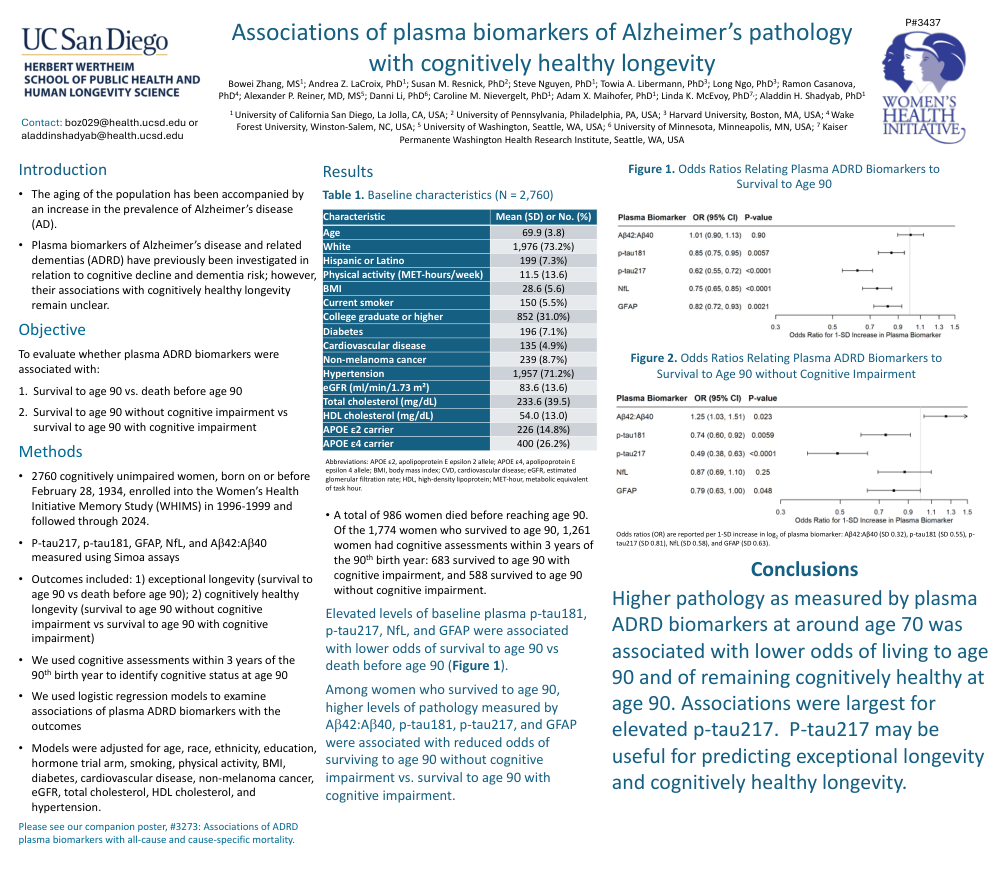
A total of 986 women died before reaching age 90. Of the 1,774 women who survived to age 90, 1,261 women had cognitive assessments within 3 years of the 90th birth year: 683 survived to age 90 with cognitive impairment, and 588 survived to age 90 without cognitive impairment.
Elevated levels of baseline plasma p-tau181, p-tau217, NfL, and GFAP were associated with lower odds of survival to age 90 vs death before age 90 (Figure 1).
Among women who survived to age 90, higher levels of pathology measured by Ab42:Ab40, p-tau181, p-tau217, and GFAP were associated with reduced odds of surviving to age 90 without cognitive impairment vs. survival to age 90 with cognitive impairment.
Conclusions
Higher pathology as measured by plasma ADRD biomarkers at around age 70 was associated with lower odds of living to age 90 and of remaining cognitively healthy at age 90. Associations were largest for elevated p-tau217. P-tau217 may be useful for predicting exceptional longevity and cognitively healthy longevity.
Comments
Email is required but is not shown publicly.
Loading comments...