4,068 posters, 219 videos, 101 topics, 69 sessions, 14,365 authors, 6,128 institutions
ePostersLive by SciGen Technologies S.A. All rights reserved.
Alzheimer's Association International Conference 2026
July 12-15, 2026 | London, United Kingdom, and Online

9756
Plasma P-tau 181 Positivity In A Brazilian Primary Care Population
Poster Presenter
Authors
Part of Topic
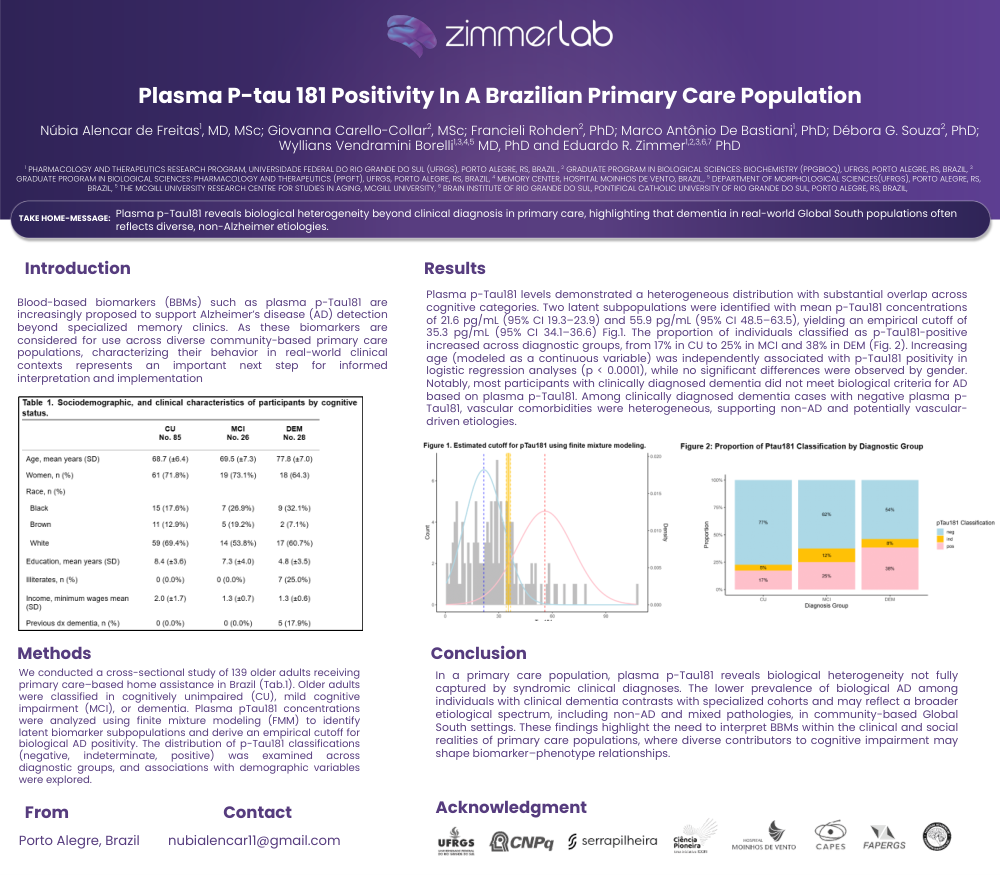
Background: Blood-based biomarkers (BBMs) such as plasma p-Tau181 are increasingly proposed to support Alzheimer’s disease (AD) detection beyond specialized memory clinics. As these biomarkers are considered for use across diverse community-based primary care populations, characterizing their behavior in real-world clinical contexts represents an important next step for informed interpretation and implementation. Methods: We conducted a cross-sectional study of 139 older adults receiving primary care–based home assistance in Brazil (Tab.1). Older adults were classified in cognitively unimpaired (CU), mild cognitive impairment (MCI), or dementia. Plasma pTau181 concentrations were analyzed using finite mixture modeling (FMM) to identify latent biomarker subpopulations and derive an empirical cutoff for biological AD positivity. The distribution of p-Tau181 classifications (negative, indeterminate, positive) was examined across diagnostic groups, and associations with demographic variables were explored. Results: Plasma p-Tau181 levels demonstrated a heterogeneous distribution with substantial overlap across cognitive categories. Two latent subpopulations were identified with mean p-Tau181 concentrations of 21.6 pg/mL (95% CI 19.3–23.9) and 55.9 pg/mL (95% CI 48.5–63.5), yielding an empirical cutoff of 35.3 pg/mL (95% CI 34.1–36.6) Fig.1. The proportion of individuals classified as p-Tau181-positive increased across diagnostic groups, from 17% in CU to 25% in MCI and 38% in DEM (Figure 2). Increasing age (modeled as a continuous variable) was independently associated with p-Tau181 positivity in logistic regression analyses (p < 0.0001), while no significant differences were observed by gender. Notably, most participants with clinically diagnosed dementia did not meet biological criteria for AD based on plasma p-Tau181. Among clinically diagnosed dementia cases with negative plasma p-Tau181, vascular comorbidities were heterogeneous, supporting non-AD and potentially vascular-driven etiologies. Conclusions: In a primary care population, plasma p-Tau181 reveals biological heterogeneity not fully captured by syndromic clinical diagnoses. The lower prevalence of biological AD among individuals with clinical dementia contrasts with specialized cohorts and may reflect a broader etiological spectrum, including non-AD and mixed pathologies, in community-based Global South settings. These findings highlight the need to interpret BBMs within the clinical and social realities of primary care populations, where diverse contributors to cognitive impairment may shape biomarker–phenotype relationships.
Comments
Email is required but is not shown publicly.
Loading comments...