4,068 posters, 219 videos, 101 topics, 69 sessions, 14,365 authors, 6,128 institutions
ePostersLive by SciGen Technologies S.A. All rights reserved.
Alzheimer's Association International Conference 2026
July 12-15, 2026 | London, United Kingdom, and Online

10902
Glial Fibrillary Acidic Protein And Ptau181 As Biomarkers Of Visuospatial And Visuomotor Ability In Down Syndrome
Part of Topic
Video
Glial Fibrillary Acidic Protein and pTau181 as Biomarkers of Visuospatial and Visuomotor Ability in Down Syndrome
Lindsay Jamieson, Au Ayat (Glenda) May, Anna Kiesewetter, Jennifer Bruno, PhD
Background:
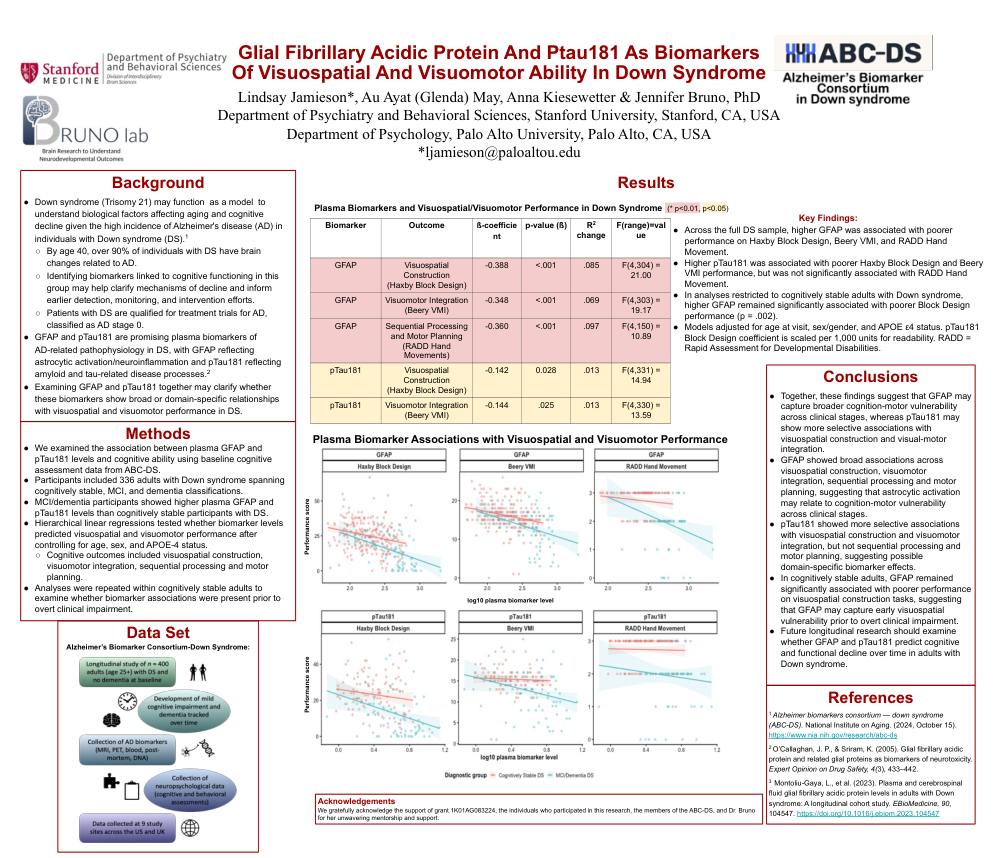
Down syndrome may function as a model to understand biological factors affecting aging and cognitive decline given the high incidence of Alzheimer’s disease in individuals with Down syndrome. GFAP and pTau181 are promising plasma biomarkers of Alzheimer’s disease-related pathophysiology in Down syndrome. GFAP reflects astrocytic activation and neuroinflammation, while pTau181 reflects tau-related disease processes. Examining GFAP and pTau181 together may clarify whether these biomarkers show broad or domain-specific relationships with visuospatial and visuomotor performance in Down syndrome.
Methods:
Baseline ABC-DS data were analyzed. Participants included 336 adults with Down syndrome spanning cognitively stable, mild cognitive impairment, and dementia classifications. Hierarchical linear regressions tested whether plasma GFAP and pTau181 levels predicted visuospatial and visuomotor performance after controlling for age, sex/gender, and APOE ε4 status. Cognitive outcomes included visuospatial construction, visuomotor integration, sequential processing, and motor planning. Analyses were repeated within cognitively stable adults to examine whether biomarker associations were present prior to overt clinical impairment.
Results:
Across the full Down syndrome sample, higher GFAP was associated with poorer performance on Haxby Block Design, Beery VMI, and RADD Hand Movement. Higher pTau181 was associated with poorer Haxby Block Design and Beery VMI performance, but was not significantly associated with RADD Hand Movement. In analyses restricted to cognitively stable adults with Down syndrome, higher GFAP remained significantly associated with poorer Block Design performance.
Conclusions:
GFAP showed broad associations across visuospatial construction, visuomotor integration, sequential processing, and motor planning, suggesting that astrocytic activation may relate to cognition-motor vulnerability across clinical stages. pTau181 showed more selective associations with visuospatial construction and visuomotor integration, but not sequential processing and motor planning, suggesting possible domain-specific biomarker effects. In cognitively stable adults, GFAP remained significantly associated with poorer performance on visuospatial construction tasks, suggesting that GFAP may capture early visuospatial vulnerability prior to overt clinical impairment. Future longitudinal research should examine whether GFAP and pTau181 predict cognitive and functional decline over time in adults with Down syndrome.
Comments
Email is required but is not shown publicly.
Loading comments...