4,068 posters, 219 videos, 101 topics, 69 sessions, 14,365 authors, 6,128 institutions
ePostersLive by SciGen Technologies S.A. All rights reserved.
Alzheimer's Association International Conference 2026
July 12-15, 2026 | London, United Kingdom, and Online

10566
Interleukin-18 As A Biomarker Of Neuroinflammation In Alzheimer's Disease: A Scoping Review
Poster Presenter
Authors
Samirah Cazorla, Joseph Viscomi, Sannidhi Sarvadhavabhatla, Shreya Vundela, Emily Cosio, Kavya Ganesham, Aylah Ghazal, Aishwi Patel, Harry Villanueva, Gabriel Almeida, Vito Evola, Mayur Parmar
Affiliations
Nova Southeastern University, Kiran C. Patel College of Osteopathic Medicine, Davie FL, USA
Part of Topic
Introduction:
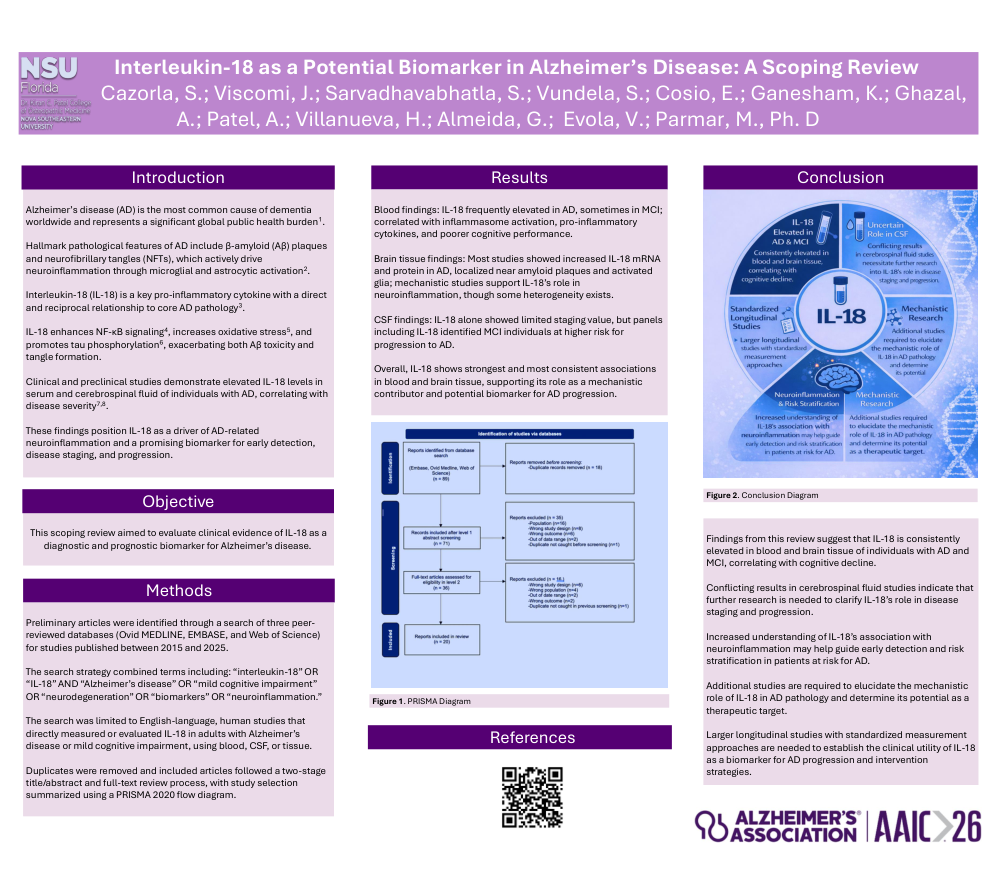
Alzheimer’s disease (AD) is the most common cause of dementia worldwide and represents a significant global public health burden. Hallmark pathological features of AD include β-amyloid (Aβ) plaques and neurofibrillary tangles (NFTs), which actively drive neuroinflammation through microglial and astrocytic activation. Interleukin-18 (IL-18) is a key pro-inflammatory cytokine with a direct and reciprocal relationship to core AD pathology. IL-18 enhances NF-κB signaling, increases oxidative stress, and promotes tau phosphorylation, exacerbating both Aβ toxicity and tangle formation. Clinical and preclinical studies demonstrate elevated IL-18 levels in serum and cerebrospinal fluid of individuals with AD, correlating with disease severity. These findings position IL-18 as a driver of AD-related neuroinflammation and a promising biomarker for early detection, disease staging, and progression.
Objective:
This scoping review aimed to evaluate clinical evidence of IL-18 as a diagnostic and prognostic biomarker for Alzheimer’s disease.
Methods:
Preliminary articles were identified through a search of three peer-reviewed databases (Ovid MEDLINE, EMBASE, and Web of Science) for studies published between 2015 and 2025. The search strategy combined terms including: “interleukin-18” OR “IL-18” AND “Alzheimer’s disease” OR “mild cognitive impairment” OR “neurodegeneration” OR “biomarkers” OR “neuroinflammation.” The search was limited to English-language, human studies that directly measured or evaluated IL-18 in adults with Alzheimer’s disease or mild cognitive impairment, using blood, CSF, or tissue. Duplicates were removed and included articles followed a two-stage title/abstract and full-text review process, with study selection summarized using a PRISMA 2020 flow diagram.
Results:
Blood findings: IL-18 frequently elevated in AD, sometimes in MCI; correlated with inflammasome activation, pro-inflammatory cytokines, and poorer cognitive performance.
Brain tissue findings: Most studies showed increased IL-18 mRNA and protein in AD, localized near amyloid plaques and activated glia; mechanistic studies support IL-18’s role in neuroinflammation, though some heterogeneity exists.
CSF findings: IL-18 alone showed limited staging value, but panels including IL-18 identified MCI individuals at higher risk for progression to AD.
Overall, IL-18 shows strongest and most consistent associations in blood and brain tissue, supporting its role as a mechanistic contributor and potential biomarker for AD progression.
Conclusion:
Findings from this review suggest that IL-18 is consistently elevated in blood and brain tissue of individuals with AD and MCI, correlating with cognitive decline. Conflicting results in cerebrospinal fluid studies indicate that further research is needed to clarify IL-18’s role in disease staging and progression. Increased understanding of IL-18’s association with neuroinflammation may help guide early detection and risk stratification in patients at risk for AD. Additional studies are required to elucidate the mechanistic role of IL-18 in AD pathology and determine its potential as a therapeutic target. Larger longitudinal studies with standardized measurement approaches are needed to establish the clinical utility of IL-18 as a biomarker for AD progression and intervention strategies.
Comments
Email is required but is not shown publicly.
Loading comments...