4,068 posters, 219 videos, 101 topics, 69 sessions, 14,365 authors, 6,128 institutions
ePostersLive by SciGen Technologies S.A. All rights reserved.
Alzheimer's Association International Conference 2026
July 12-15, 2026 | London, United Kingdom, and Online

9257
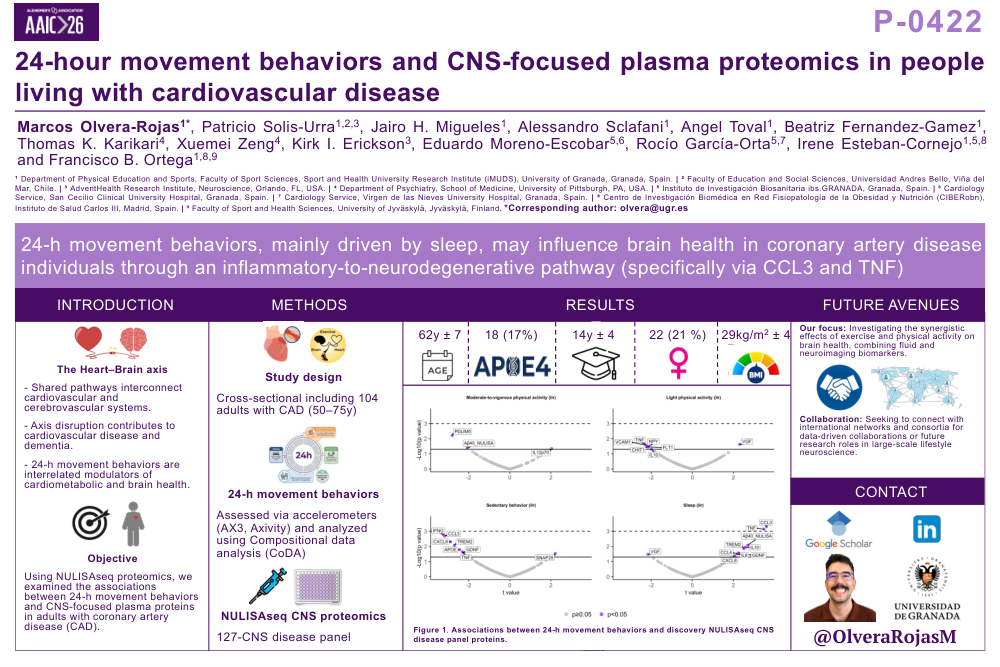
24-hour movement behaviors and CNS-focused plasma proteomics inpeople living with cardiovascular disease
Poster Presenter
Authors
Marcos Olvera-Rojas, Patricio Solis-Urra, Jairo H. Migueles, Alessandro Sclafani, Angel Toval, Beatriz Fernandez-Gamez, Thomas K. Karikari, Xuemei Zeng, Kirk I. Erickson, Eduardo Moreno-Escobar, Rocío Garcia-Orta, Irene Esteban-Cornejo, Francisco B. Ortega
Affiliations
¹ Department of Physical Education and Sports, Faculty of Sport Sciences, Sport and Health University Research Institute (iMUDS), University of Granada, Granada, Spain., ¹ Department of Physical Education and Sports, Faculty of Sport Sciences, Sport and Health University Research Institute (iMUDS), University of Granada, Granada, Spain. | ² Faculty of Education and Social Sciences, Universidad Andres Bello, Viña del Mar, Chile. | ³ AdventHealth Research Institute, Neuroscience, Orlando, FL, USA., ⁴ Department of Psychiatry, School of Medicine, University of Pittsburgh, PA, USA., ³ AdventHealth Research Institute, Neuroscience, Orlando, FL, USA., ⁵ Instituto de Investigación Biosanitaria ibs.GRANADA, Granada, Spain. | ⁶ Cardiology Service, San Cecilio Clinical University Hospital, Granada, Spain., ⁵ Instituto de Investigación Biosanitaria ibs.GRANADA, Granada, Spain. | ⁷ Cardiology Service, Virgen de las Nieves University Hospital, Granada, Spain, ¹ Department of Physical Education and Sports, Faculty of Sport Sciences, Sport and Health University Research Institute (iMUDS), University of Granada, Granada, Spain. | ⁵ Instituto de Investigación Biosanitaria ibs.GRANADA, Granada, Spain. |⁸ Centro de Investigación Biomédica en Red Fisiopatología de la Obesidad y Nutrición (CIBERobn), Instituto de Salud Carlos III, Madrid, Spain, ¹ Department of Physical Education and Sports, Faculty of Sport Sciences, Sport and Health University Research Institute (iMUDS), University of Granada, Granada, Spain. | ⁸ Centro de Investigación Biomédica en Red Fisiopatología de la Obesidad y Nutrición (CIBERobn), Instituto de Salud Carlos III, Madrid, Spain. | ⁹ Faculty of Sport and Health Sciences, University of Jyväskylä, Jyväskylä, Finland
Part of Topic
Background
Alzheimer’s disease (AD) is a progressive neurodegenerative disorder characterized by gradual cognitive decline and ultimately death. A range of shared pathophysiological pathways interconnect the cardiovascular and cerebrovascular systems, forming the heart–brain axis, whose disruption is thought to contribute to both cardiovascular disease and AD, two major chronic conditions of aging. 24-h movement behaviors, including moderate-to vigorous physical activity (PA), light PA, sedentary behavior and sleep, are increasingly recognized as key, interrelated modulators of cardiometabolic and brain health. However, the molecular mechanisms linking these behaviors to the heart–brain axis remain unclear. Using NULISAseq proteomics, we examined associations between 24-hour movement behaviors and CNS-focused plasma protein profiles in middle-aged and older adults with coronary artery disease.
Methods
104 coronary artery disease adults aged 50 to 75 years (NCT06214624) were included in this cross-sectional analysis from the Heart-Brain trial. PA, sedentary behavior, and sleep were assessed using AX3 from Axivity wrist-worn accelerometer, with raw accelerations processed with GGIR R package using harmonized procedures. CNS-related plasma proteins were quantified using the NULISAseq CNS disease panel, profiling over 120 plasma proteins across key pathological pathways of the brain, including vascular/metabolism, synuclein/synaptic, neurodegeneration, inflammation and amyloid/tau. Compositional data analysis explored the association of moderate-to-vigorous PA, light PA, sedentary behavior, and sleep with NULISAseq CNS plasma proteins adjusting for age, sex, education and body mass index.
Results
A total of twenty-eight associations between 24-h movement behaviors and CNS panel proteins were identified (t values ranging from –3.231 to 3.611; all unadjusted p < 0.05), with sleep accounting for the largest number of associations. However, only the sleep-related associations with CCL3 and TNF remained significant after FDR correction (FDR < 0.05). 24-h movement behaviors were most strongly associated with proteins involved in inflammatory pathways (n = 17), followed by neurodegeneration-related pathways (n = 5), with all pathways represented (n ≥ 1).
Conclusions
Our findings indicate that associations between 24-h movement behaviors and CNS plasma proteins are predominantly driven by inflammatory pathways, with secondary involvement of neurodegeneration-related processes. These results support a potential inflammatory-to-neurodegenerative pathway through which daily movement behaviors may influence brain health in adults with coronary artery disease.
Comments
Email is required but is not shown publicly.
Loading comments...