4,068 posters, 219 videos, 101 topics, 69 sessions, 14,365 authors, 6,128 institutions
ePostersLive by SciGen Technologies S.A. All rights reserved.
Alzheimer's Association International Conference 2026
July 12-15, 2026 | London, United Kingdom, and Online

1255
Loneliness As An Interface Between Alzheimer's Disease And Suicide
Part of Topic
Background: Loneliness is a widespread issue that impacts mental health across all demographics. It is associated with various mental disorders, including anxiety, depression, and feelings of despair, underscoring a significant public health concern as individuals become increasingly isolated in an interconnected world. This study aims to explore the relationship between loneliness, Alzheimer's disease (AD), and suicidal behavior.
Methods: This study was registered in protocols.io with the doi: dx.doi.org/10.17504/protocols.io.3byl4ze22vo5/v1 and followed the PRISMA statement methodology. Statistical data for a meta-analytic factor analysis (MAFA) were pooled using the webMASEM system to investigate the correlation between loneliness and suicidal behavior in individuals with AD. The analysis focused on studies with factor analysis and correlation matrices of loneliness. The MAFA aimed to identify correlates of loneliness, AD, and suicidal behavior, assessing quality with the Q coefficient, where p-values ≤ 0.05 were deemed adequate and correlations above 0.40 significant.
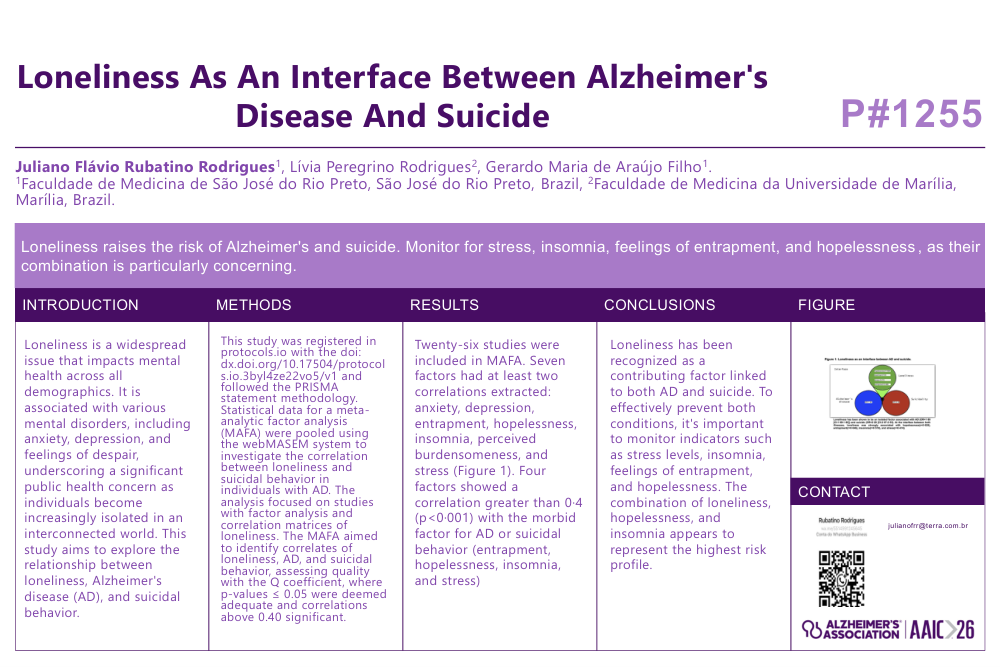
Results: Twenty-six studies were included in MAFA. Seven factors had at least two correlations extracted: anxiety, depression, entrapment, hopelessness, insomnia, perceived burdensomeness, and stress (Table 1 and Figure 1). Four factors showed a correlation greater than 0·4 (p<0·001) with the morbid factor for AD or suicidal behavior (entrapment, hopelessness, insomnia, and stress).
Conclusion: Loneliness has been recognized as a contributing factor linked to both AD and suicide. To effectively prevent both conditions, it's important to monitor indicators such as stress levels, insomnia, feelings of entrapment, and hopelessness. The combination of loneliness, hopelessness, and insomnia appears to represent the highest risk profile.
Comments
Email is required but is not shown publicly.
Loading comments...