4,068 posters, 219 videos, 101 topics, 69 sessions, 14,365 authors, 6,128 institutions
ePostersLive by SciGen Technologies S.A. All rights reserved.
Alzheimer's Association International Conference 2026
July 12-15, 2026 | London, United Kingdom, and Online

8764
Plasma P-tau217 Prevalence: Preliminary Results Of A Meta-analysis
Poster Presenter
Authors
Zoë Tuinman, Alina Solomon, Pieter Jelle Visser, Willemijn Jansen
Affiliations
Alzheimer Center Limburg, Department of Psychiatry and Neuropsychology, School for Mental Health and Neuroscience, Maastricht University, Maastricht, the Netherlands, Alzheimer Center Limburg, Department of Psychiatry and Neuropsychology, School for Mental Health and Neuroscience, Maastricht University, Maastricht, the Netherlands; Alzheimer Center Amsterdam, Department of Neurology, Amsterdam Neuroscience, Vrije Universiteit Amsterdam, Amsterdam University Medical Center (UMC), Amsterdam, the Netherlands, Department of Neurology, Institute of Clinical Medicine, University of Eastern Finland, Kuopio, Finland; The Ageing Epidemiology Research Unit, School of Public Health, Imperial College London, London, UK; Division of Clinical Geriatrics, Center for Alzheimer Research, Department of Neurobiology, Care Sciences and Society, Karolinska Institutet, Solna, Sweden, Alzheimer Center Limburg, Department of Psychiatry and Neuropsychology, School for Mental Health and Neuroscience, Maastricht University, Maastricht, the Netherlands Alzheimer Center Limburg, Department of Psychiatry and Neuropsychology, School for Mental Health and Neuroscience, Maastricht University, Maastricht, the Netherlands
Part of Topic
Introduction
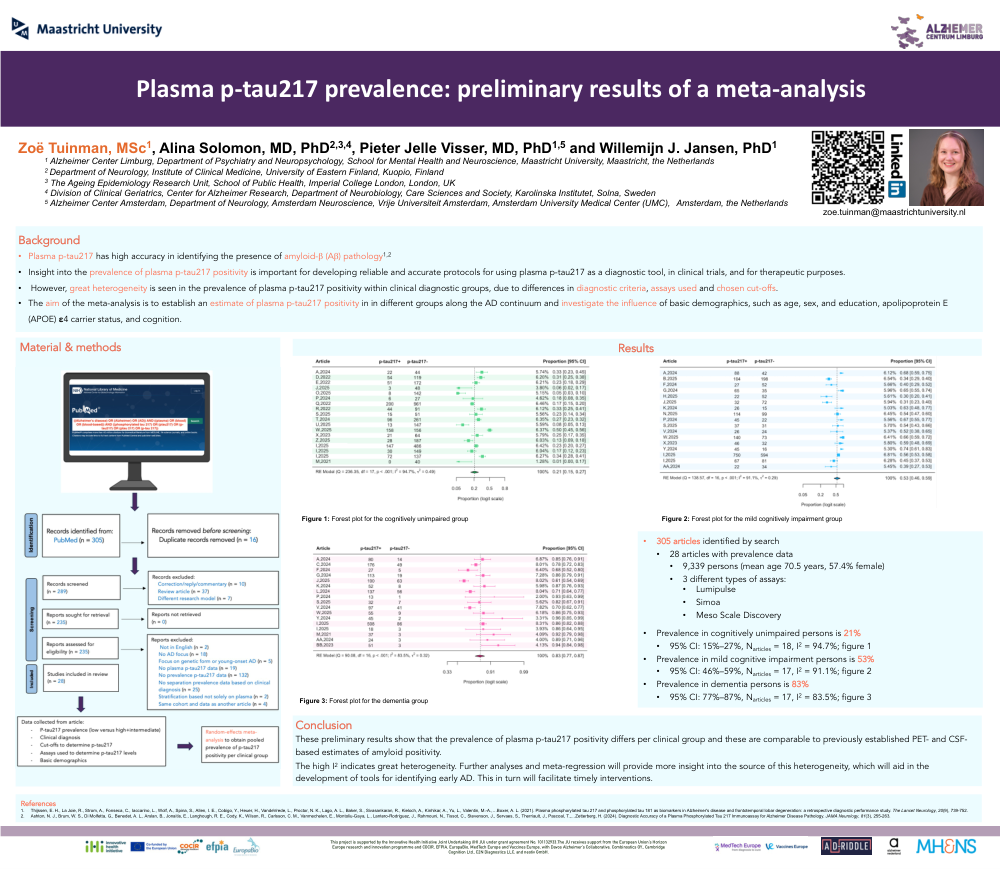
Recently, plasma p-tau217 has shown to have a high accuracy in distinguishing individuals with and without amyloid-b (Ab) pathology which is important for trial selection. However, there is great heterogeneity in the prevalence of plasma p-tau217 positivity within clinical diagnostic groups, due to differences in diagnostic criteria, assays used and chosen cut-offs. Gaining insight into the prevalence is important for developing reliable and accurate protocols for using plasma p-tau217 as a diagnostic tool, in clinical trials, and for therapeutic purposes. Therefore, this meta-analysis aims to gain more insight into the prevalence of plasma p-tau217 positivity across the AD clinical spectrum.
Methods
A literature search was done in PubMed with the search terms: “Alzheimer’s disease”, “blood”, “p-tau217”, and synonyms. Non-research articles were removed before screening, such as reviews and commentaries. Articles were included if they focused on sporadic, late-onset AD and had prevalence data for plasma p-tau217 positivity. After inclusion, data regarding plasma p-tau217 prevalence, clinical diagnosis, cut-offs, assays used, and basic demographics were extracted. Random-effects meta-analysis to obtain a pooled estimate of the prevalence of p-tau217 positivity per clinical group was performed in R.
Results
The literature search identified 305 articles, of which 21 had prevalence data per clinical group, with a total of 9,181 persons (mean age 64.04 years, 61.7% female). In these, the Lumipulse platform was used in 3 articles, a Simoa in 14, and a Meso Scale Discovery assay in 4. Preliminary results show that the prevalence of p-tau217 positivity was 20% (95% CI: 15%–26%, Narticles=12, I2 = 87.9%; figure 1) in cognitively unimpaired persons, 50% (95% CI: 41%-58%, Narticles=13, I2 = 88.5%; figure 2) in participants with MCI, and 83% (95% CI: 74%-89%, Narticles=15, I2 = 92.3%; figure 3) in persons with clinical AD dementia.
Conclusion
These preliminary results show that the prevalence of plasma p-tau217 positivity differs per clinical group and that these are comparable to previously established PET- and CSF-based estimates of amyloid positivity. In addition, the high I2 indicates great heterogeneity. Further analyses and meta-regression will provide more insight into sources of this heterogeneity, aiding in the development of tools for identifying early AD, facilitating timely intervention.
Comments
Email is required but is not shown publicly.
Loading comments...