4,068 posters, 219 videos, 101 topics, 69 sessions, 14,365 authors, 6,128 institutions
ePostersLive by SciGen Technologies S.A. All rights reserved.
Alzheimer's Association International Conference 2026
July 12-15, 2026 | London, United Kingdom, and Online

3731
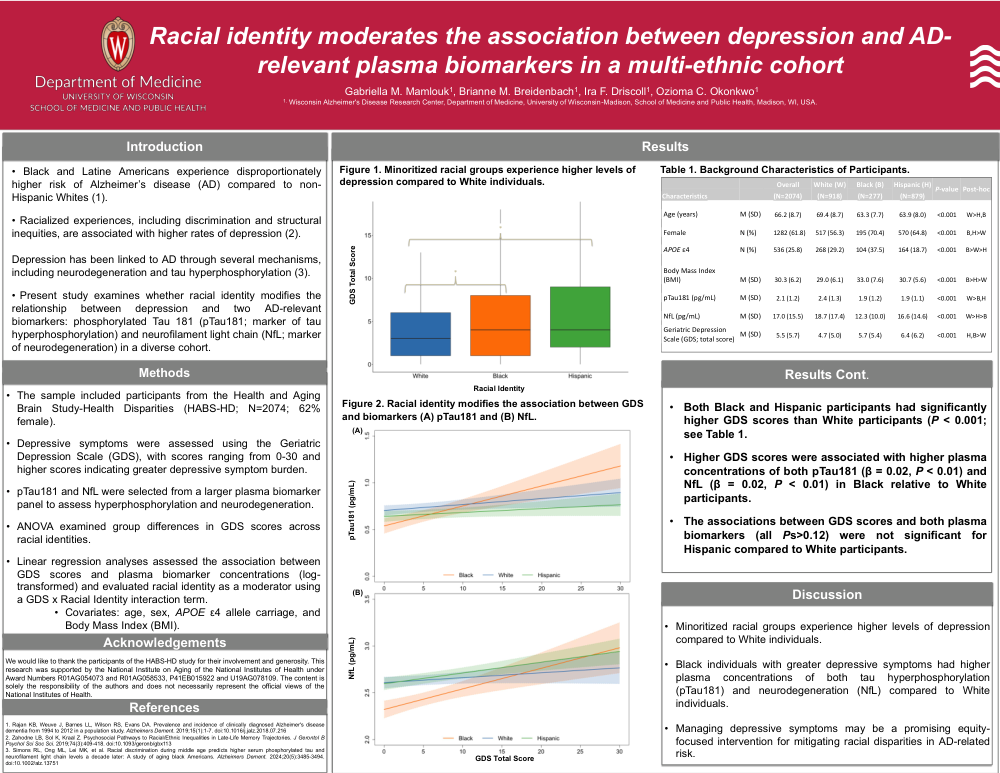
Racial Identity Moderates The Association Between Depression And AD-Relevant Plasma Biomarkers In A Multi-Ethnic Cohort
Poster Presenter
Authors
Part of Topic
Introduction
• Black and Latine Americans experience disproportionately
higher risk of Alzheimer’s disease (AD) compared to non-
Hispanic Whites (1).
• Racialized experiences, including discrimination and structural
inequities, are associated with higher rates of depression (2).
Depression has been linked to AD through several mechanisms,
including neurodegeneration and tau hyperphosphorylation (3).
• Present study examines whether racial identity modifies the
relationship between depression and two AD-relevant
biomarkers: phosphorylated Tau 181 (pTau181; marker of tau
hyperphosphorylation) and neurofilament light chain (NfL; marker
of neurodegeneration) in a diverse cohort.
Methods
• The sample included participants from the Health and Aging
Brain Study-Health Disparities (HABS-HD; N=2074; 62%
female).
• Depressive symptoms were assessed using the Geriatric
Depression Scale (GDS), with scores ranging from 0-30 and
higher scores indicating greater depressive symptom burden.
• pTau181 and NfL were selected from a larger plasma biomarker
panel to assess hyperphosphorylation and neurodegeneration.
• ANOVA examined group differences in GDS scores across
racial identities.
• Linear regression analyses assessed the association between
GDS scores and plasma biomarker concentrations (log-
transformed) and evaluated racial identity as a moderator using
a GDS x Racial Identity interaction term.
• Covariates: age, sex, APOE ε4 allele carriage, and
Body Mass Index (BMI).
Results Cont.
• Both Black and Hispanic participants had significantly
higher GDS scores than White participants (P< 0.001;
see Table 1.
• Higher GDS scores were associated with higher plasma
concentrations of both pTau181 (β = 0.02, P < 0.01) and
NfL (β = 0.02, P < 0.01) in Black relative to White
participants.
• The associations between GDS scores and both plasma
biomarkers (all Ps>0.12) were not significant for
Hispanic compared to White participants.
Discussion
• Minoritized racial groups experience higher levels of depression
compared to White individuals.
• Black individuals with greater depressive symptoms had higher
plasma concentrations of both tau hyperphosphorylation
(pTau181) and neurodegeneration (NfL) compared to White
individuals.
• Managing depressive symptoms may be a promising equity-
focused intervention for mitigating racial disparities in AD-related
risk. alteratio
Comments
Email is required but is not shown publicly.
Loading comments...