4,068 posters, 219 videos, 101 topics, 69 sessions, 14,365 authors, 6,128 institutions
ePostersLive by SciGen Technologies S.A. All rights reserved.
Alzheimer's Association International Conference 2026
July 12-15, 2026 | London, United Kingdom, and Online

9460
COMPADRE-CART Study: Room Transitions And Daily Steps Association With Cognitive Performance In Hispanic/Latinx Older Adults
Poster Presenter
Authors
Vanessa Young, Daniel MacCarthy, Chen-Pin Wang, Samantha Gates, Marialy Salinas Valdez, Nathaniel Rodrigues, Wan-Tai Au-Yeung, Kevin Cosgrove, Carlos Gaona, Layla Garcia, Luis Mendez, Denisse Garcia Cisneros, Carlos Vazquez, Ashley LaRoche, Luis Serrano-Rubio, Lyndsey Anderson, Cynthia Cornejo, Arash Salardini, Jeffrey Kaye, Sudha Seshadri, Tiffany Kautz, Zachary Beattie, Mitzi Gonzales
Affiliations
University of Texas Health Science Center at San Antonio, Oregon Health & Science Center, Texas Tech University, Vanderbilt University, Oregon Health & Science University
Part of Topic
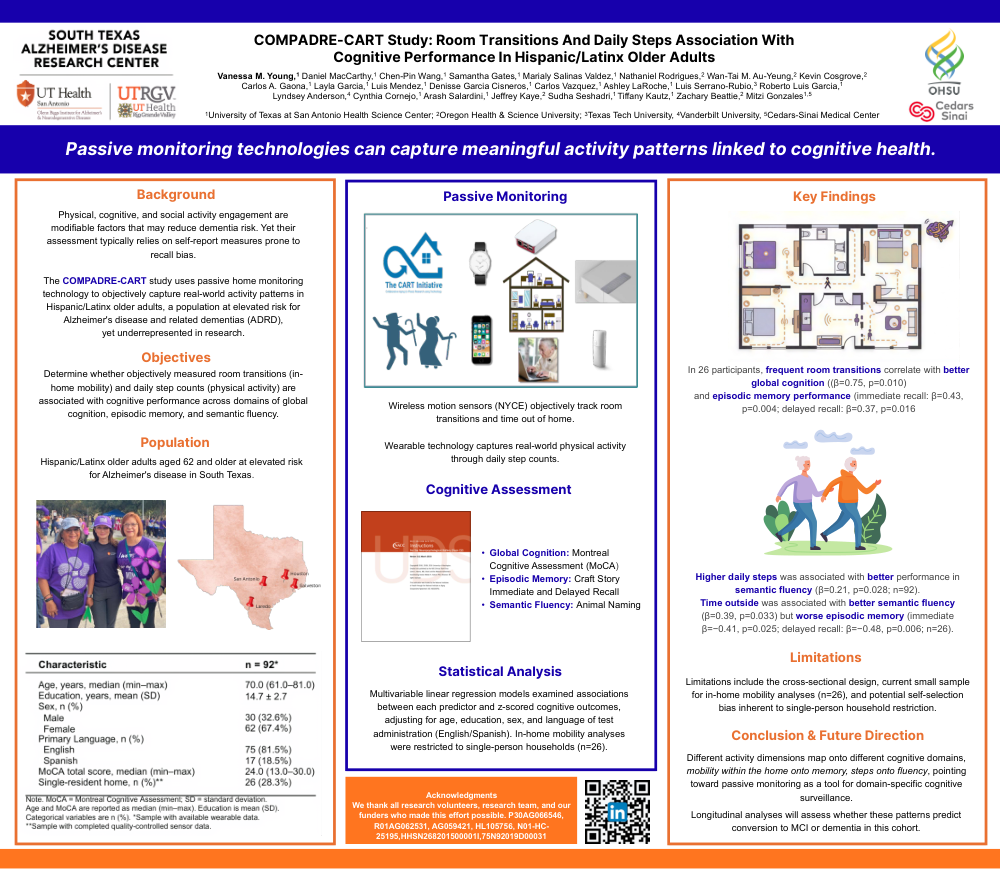
Physical, cognitive, and social activity engagement are modifiable factors that may reduce dementia risk. Yet their assessment typically relies on self-report measures prone to recall bias. The COMPADRE-CART study uses passive home monitoring technology to objectively capture real-world activity patterns in Hispanic/Latinx older adults, a population at elevated risk for Alzheimer's disease and related dementias (ADRD), yet underrepresented in research. Objectives: Determine whether objectively measured room transitions (inhome mobility) and daily step counts (physical activity) are associated with cognitive performance across domains of global cognition, episodic memory, and semantic fluency. Population: Hispanic/Latinx older adults aged 62 and older at elevated risk for Alzheimer's disease in South Texas. Methods: Passive Monitorig Wireless motion sensors (NYCE) objectively track room transitions and time out of home. Wearable technology captures real-world physical activity through daily step counts. Cognitive Assessment • Global Cognition: Montreal Cognitive Assessment (MoCA) • Episodic Memory: Craft Story Immediate and Delayed Recall • Semantic Fluency: Animal Naming Key Findings: In 26 participants, frequent room transitions correlate with better global cognition ((β=0.75, p=0.010) and episodic memory performance (immediate recall: β=0.43, p=0.004; delayed recall: β=0.37, p=0.016. Higher daily steps was associated with better performance in semantic fluency (β=0.21, p=0.028; n=92). Time outside was associated with better semantic fluency (β=0.39, p=0.033) but worse episodic memory (immediate β=−0.41, p=0.025; delayed recall: β=−0.48, p=0.006; n=26).
Limitations include the cross-sectional design, current small sample for in-home mobility analyses (n=26), and potential self-selection bias inherent to single-person household restriction. Different activity dimensions map onto different cognitive domains, mobility within the home onto memory, steps onto fluency, pointing toward passive monitoring as a tool for domain-specific cognitive surveillance. Longitudinal analyses will assess whether these patterns predict conversion to MCI or dementia in this cohort.
Acknowledgments We thank all research volunteers, research team, and our funders who made this effort possible. P30AG066546, R01AG062531, AG059421, HL105756, N01-HC25195,HHSN268201500001I,75N92019D00031.
Comments
Email is required but is not shown publicly.
Loading comments...