4,068 posters, 219 videos, 101 topics, 69 sessions, 14,365 authors, 6,128 institutions
ePostersLive by SciGen Technologies S.A. All rights reserved.
Alzheimer's Association International Conference 2026
July 12-15, 2026 | London, United Kingdom, and Online

1459
Inflammatory Cytokines And Mitochondrial Dysfunction Are Associated With Cognitive Impairment After Traumatic Brain Injury
Poster Presenter
Authors
Chanon Srihagulang, Nattayaporn Apaijai, Narueporn Pagowong, Saran Teera-apisakkul, Todsapon Praphanuwat, Jirapong Vongsfak, Chumpon Jetjumnong, Salita Angkurawaranon, Tanat Vaniyapong, Nipon Chattipakorn, Siriporn C. Chattipakorn
Affiliations
Neurophysiology Unit, Cardiac Electrophysiology Research and Training Center, Faculty of Medicine, Chiang Mai University, Chiang Mai, Thailand; Neurosurgery Unit, Department of Surgery, Faculty of Medicine, Chiang Mai University, Chiang Mai, Thailand, Neurophysiology Unit, Cardiac Electrophysiology Research and Training Center, Faculty of Medicine, Chiang Mai University, Chiang Mai, Thailand; Cardiac Electrophysiology Unit, Department of Physiology, Faculty of Medicine, Chiang Mai University, Chiang Mai, Thailand; Center of Excellence in Cardiac Electrophysiology, Chiang Mai University, Chiang Mai, Thailand, Neurosurgery Unit, Department of Surgery, Faculty of Medicine, Chiang Mai University, Chiang Mai, Thailand, Department of Radiology, Faculty of Medicine, Chiang Mai University, Chiang Mai, Thailand, Neurophysiology Unit, Cardiac Electrophysiology Research and Training Center, Faculty of Medicine, Chiang Mai University, Chiang Mai, Thailand; Cardiac Electrophysiology Unit, Department of Physiology, Faculty of Medicine, Chiang Mai University, Chiang Mai, Thailand; Center of Excellence in Cardiac Electrophysiology, Chiang Mai University, Chiang Mai, Thailand; The Academy of Science, The Royal Society of Thailand, Dusit, Bangkok, Thailand, Neurophysiology Unit, Cardiac Electrophysiology Research and Training Center, Faculty of Medicine, Chiang Mai University, Chiang Mai, Thailand; Center of Excellence in Cardiac Electrophysiology, Chiang Mai University, Chiang Mai, Thailand; Department of Oral Biology and Diagnostic Sciences, Faculty of Dentistry, Chiang Mai University, Chiang Mai, Thailand
Part of Topic
Inflammatory Cytokines and Mitochondrial Dysfunction Are Associated With Cognitive Impairment After Traumatic Brain Injury
Background:
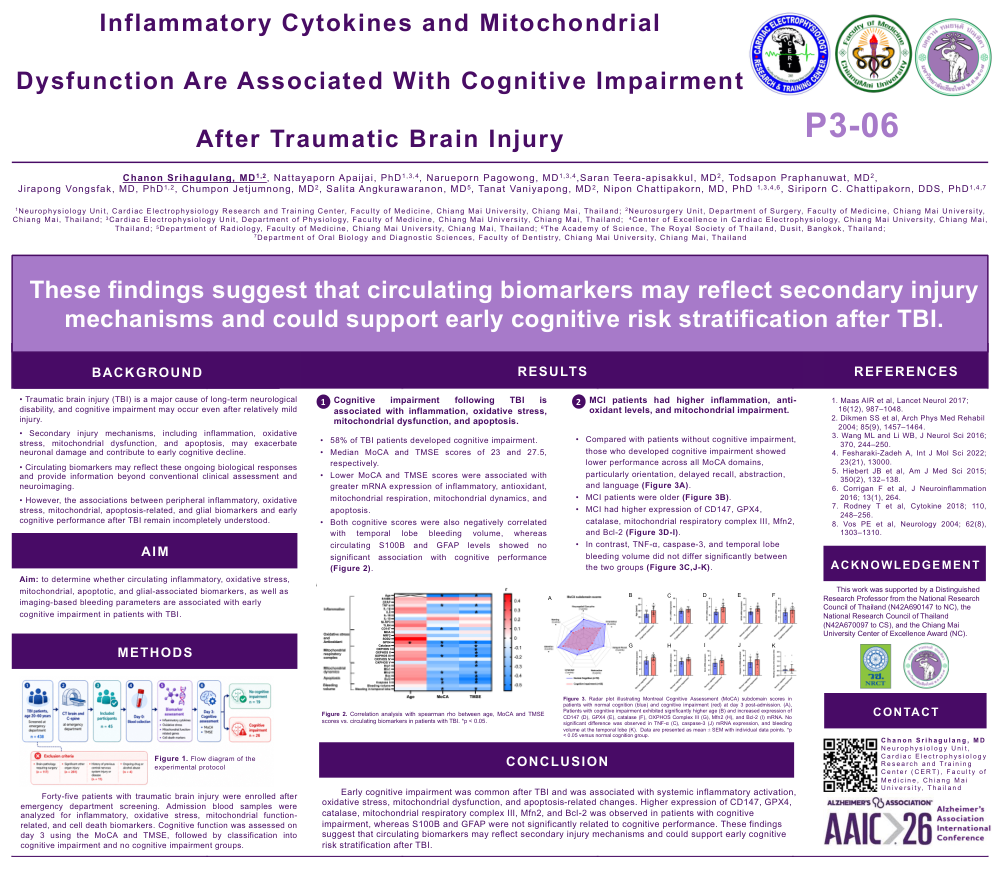
Traumatic brain injury (TBI) is a major cause of long-term neurological disability, and cognitive impairment may occur even after relatively mild injury. Secondary injury mechanisms, including inflammation, oxidative stress, mitochondrial dysfunction, and apoptosis, may contribute to early cognitive decline. This study investigated whether circulating biomarkers and imaging-based bleeding parameters were associated with early cognitive impairment after TBI.
Methods:
Forty-five patients with TBI were enrolled after emergency department screening. Admission blood samples were analyzed for inflammatory, oxidative stress, mitochondrial function-related, apoptosis-related, and glial biomarkers. Cognitive function was assessed on day 3 using the Montreal Cognitive Assessment (MoCA) and Thai Mental State Examination (TMSE). Patients were classified into cognitive impairment and no cognitive impairment groups.
Results:
Twenty-six of 45 patients developed cognitive impairment. The median MoCA and TMSE scores were 23 and 27.5, respectively. Lower cognitive scores were associated with greater mRNA expression of inflammatory, antioxidant, mitochondrial respiration, mitochondrial dynamics, and apoptosis-related markers. Both cognitive scores were negatively correlated with temporal lobe bleeding volume, whereas circulating S100B and GFAP levels were not significantly associated with cognitive performance. Patients with cognitive impairment were older and demonstrated higher expression of CD147, GPX4, catalase, mitochondrial respiratory complex III, Mfn2, and Bcl-2. TNF-alpha, caspase-3, and temporal lobe bleeding volume did not differ significantly between groups.
Conclusion:
Early cognitive impairment was common after TBI and was associated with systemic inflammatory activation, oxidative stress, mitochondrial dysfunction, and apoptosis-related changes. Circulating biomarkers may reflect secondary injury mechanisms and could support early cognitive risk stratification after TBI.
Comments
Email is required but is not shown publicly.
Loading comments...