4,068 posters, 219 videos, 101 topics, 69 sessions, 14,365 authors, 6,128 institutions
ePostersLive by SciGen Technologies S.A. All rights reserved.
Alzheimer's Association International Conference 2026
July 12-15, 2026 | London, United Kingdom, and Online

9080
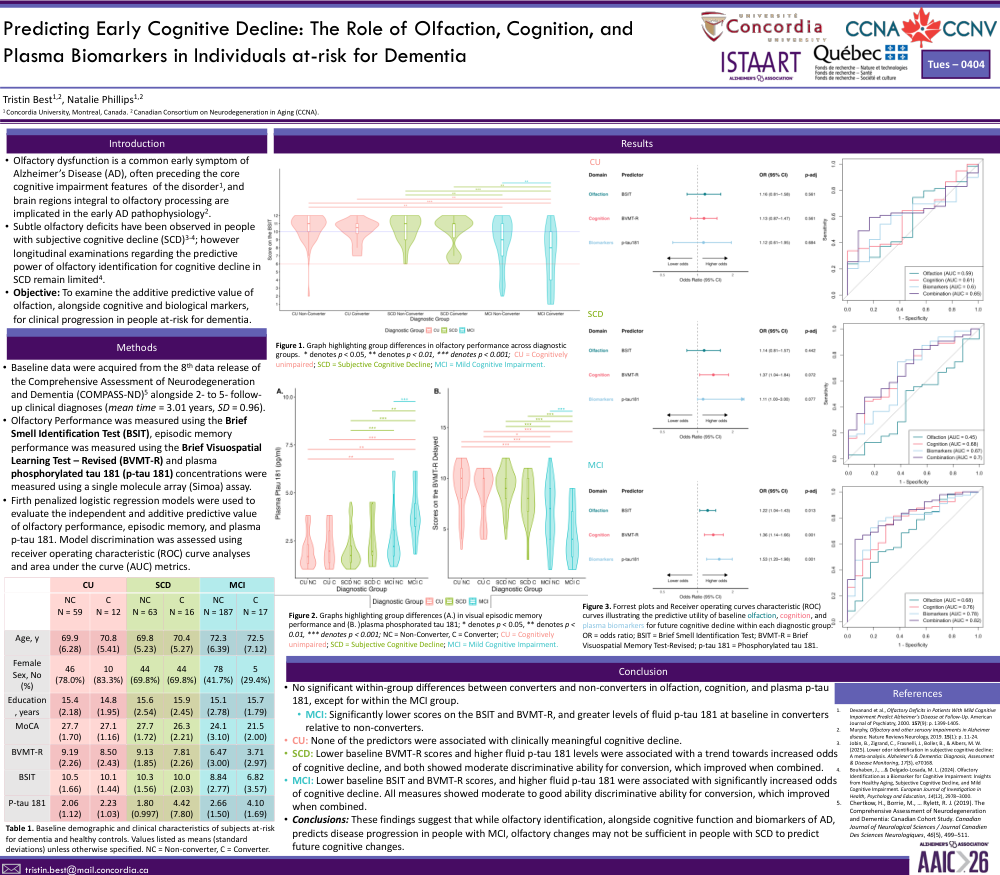
Predicting Early Cognitive Decline: The Role Of Olfaction, Cognition, And Plasma Biomarkers In Individuals At-risk For Dementia
Poster Presenter
Authors
Affiliations
Part of Topic
Introduction
•Olfactory dysfunction is a common early symptom of Alzheimer’s Disease (AD), often preceding the core cognitive impairment features of the disorder1, and brain regions integral to olfactory processing are implicated in the early AD pathophysiology2.
•Subtle olfactory deficits have been observed in people with subjective cognitive decline (SCD)3-4; however longitudinal examinations regarding the predictive power of olfactory identification for cognitive decline in SCD remain limited4.
•Objective: To examine the additive predictive value of olfaction, alongside cognitive and biological markers, for clinical progression in people at-risk for dementia.
Methods
•Baseline data were acquired from the 8th data release of the Comprehensive Assessment of Neurodegeneration and Dementia (COMPASS-ND)5 alongside 2- to 5- follow-up clinical diagnoses (mean time = 3.01 years, SD = 0.96).
•Olfactory Performance was measured using the Brief Smell Identification Test (BSIT), episodic memory performance was measured using the Brief Visuospatial Learning Test – Revised (BVMT-R) and plasma phosphorylated tau 181 (p-tau 181) concentrations were measured using a single molecule array (Simoa) assay.
•Firth penalized logistic regression models were used to evaluate the independent and additive predictive value of olfactory performance, episodic memory, and plasma p-tau 181. Model discrimination was assessed using receiver operating characteristic (ROC) curve analyses and area under the curve (AUC) metrics.
Discussion
•No significant within-group differences between converters and non-converters in olfaction, cognition, and plasma p-tau 181, except for within the MCI group.
•MCI: Significantly lower scores on the BSIT and BVMT-R, and greater levels of fluid p-tau 181 at baseline in converters relative to non-converters.
•CU: None of the predictors were associated with clinically meaningful cognitive decline.
•SCD: Lower baseline BVMT-R scores and higher fluid p-tau 181 levels were associated with a trend towards increased odds of cognitive decline, and both showed moderate discriminative ability for conversion, which improved when combined.
•MCI: Lower baseline BSIT and BVMT-R scores, and higher fluid p-tau 181 were associated with significantly increased odds of cognitive decline. All measures showed moderate to good ability discriminative ability for conversion, which improved when combined.
•Conclusions: These findings suggest that while olfactory identification, alongside cognitive function and biomarkers of AD, predicts disease progression in people with MCI, olfactory changes may not be sufficient in people with SCD to predict future cognitive changes.
Comments
Email is required but is not shown publicly.
Loading comments...