4,068 posters, 219 videos, 101 topics, 69 sessions, 14,365 authors, 6,128 institutions
ePostersLive by SciGen Technologies S.A. All rights reserved.
Alzheimer's Association International Conference 2026
July 12-15, 2026 | London, United Kingdom, and Online

5018
Cognitive Stability And Psychiatric Symptom Reduction In A Post‑Covid Cohort: Implications For Alzheimer’s‑ Related Monitoring
Poster Presenter
Part of Topic
Background: Long-term neuropsychiatric sequelae of COVID-19 have raised concerns regarding accelerated cognitive decline and increased vulnerability to neurodegenerative processes, including those related to Alzheimer’s disease. Cognitive domains typically affected in Alzheimer’s disease—such as memory and language — have been reported as potentially impaired following COVID-19. In parallel, persistent psychiatric symptoms may confound or mimic early neurodegenerative presentations. This study aimed to characterize longitudinal changes in cognitive performance and psychiatric symptoms in a cohort of COVID-19 survivors, with particular emphasis on metrics relevant to Alzheimer’s-related cognitive trajectories.
Methods: A total of 361 adults (162 females, 199 males; mean age 54.9 ± 13.4 years) previously hospitalized for COVID-19 in Brazil underwent repeated follow-up assessments between 2020 and 2024. Cognitive evaluation included standardized test of memory (CERAD battery), i.e., Immediate Memory and Verbal Recognition as well as three levels of language Boston Naming Tests. Psychiatric outcomes were assessed using Hospital Anxiety and Depression Scale (HADS), and post-traumatic stress symptoms (PTSS). Longitudinal changes were analysed using linear regression models, adjusting for age, sex, and severity of acute illness. Effect sizes and 95% confidence intervals were calculated to quantify within-subject change over time.
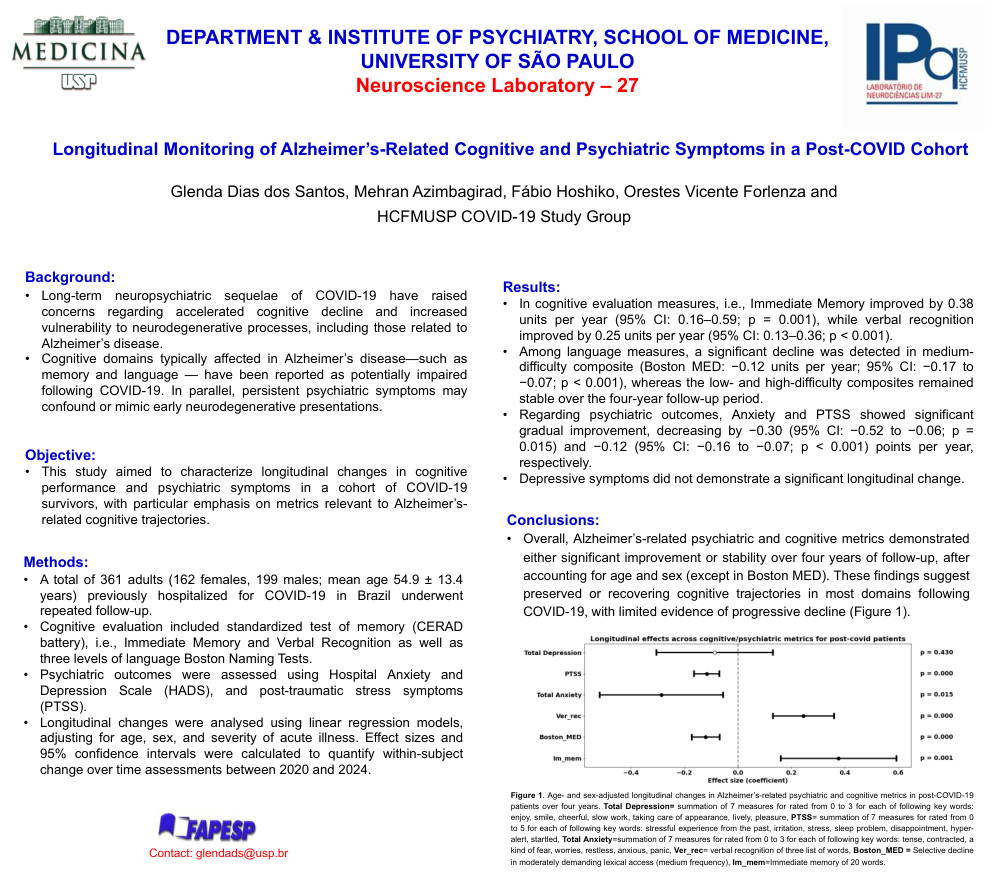
Results: In cognitive evaluation measures, i.e., Immediate Memory improved by 0.38 units per year (95% CI: 0.16–0.59; p = 0.001), while verbal recognition improved by 0.25 units per year (95% CI: 0.13–0.36; p < 0.001). Among language measures, a significant decline was detected in medium-difficulty composite (Boston MED: −0.12 units per year; 95% CI: −0.17 to −0.07; p < 0.001), whereas the low- and high-difficulty composites remained stable over the four-year follow-up period. Regarding psychiatric outcomes, Anxiety and PTSS showed significant gradual improvement, decreasing by −0.30 (95% CI: −0.52 to −0.06; p = 0.015) and −0.12 (95% CI: −0.16 to −0.07; p < 0.001) points per year, respectively. Depressive symptoms did not demonstrate a significant longitudinal change.
Conclusions: Overall, Alzheimer’s-related psychiatric and cognitive metrics demonstrated either significant improvement or stability over four years of follow-up, after accounting for age and sex (except in Boston MED). These findings suggest preserved or recovering cognitive trajectories in most domains following COVID-19, with limited evidence of progressive decline.
Comments
Email is required but is not shown publicly.
Loading comments...