4,068 posters, 219 videos, 101 topics, 69 sessions, 14,365 authors, 6,128 institutions
ePostersLive by SciGen Technologies S.A. All rights reserved.
Alzheimer's Association International Conference 2026
July 12-15, 2026 | London, United Kingdom, and Online

6908
TREM2 And CSF Biomarkers In The ADNI Cohort: Stage-specific Associations And Comparative Analysis Of The Two TREM2 ELISA Tests.
Poster Presenter
Authors
Affiliations
Part of Topic
While Alzheimer's Disease (AD) is characterized by the pathological accumulation of amyloid plaques and tau tangles, there is mounting evidence that these two hallmarks are insufficient to understand AD’s pathogenesis and pathological cascade1. Of particular importance is the role of the immune response, and the microglial response specifically.
In AD mice models, this response was characterized as a 2-step process: a TREM2-independent activation downregulates homeostatic checkpoints, followed by a TREM2-dependent activation which upregulates amyloid phagocytosis-related genes2. TREM2 is a membrane receptor expressed on the surface of microglia and its ectodomain can be released via proteolytic shedding or alternative splicing into a soluble form called sTREM2, cleared by the CSF3. Therefore, sTREM2 is used as a marker of microglial reactivity4.
Here, we investigate the relationship between CSF sTREM2, Aβ42, p-tau181 and t-tau during the different stages of the disease. Additionally, we observe how these results are impacted by the sTREM2 test used.
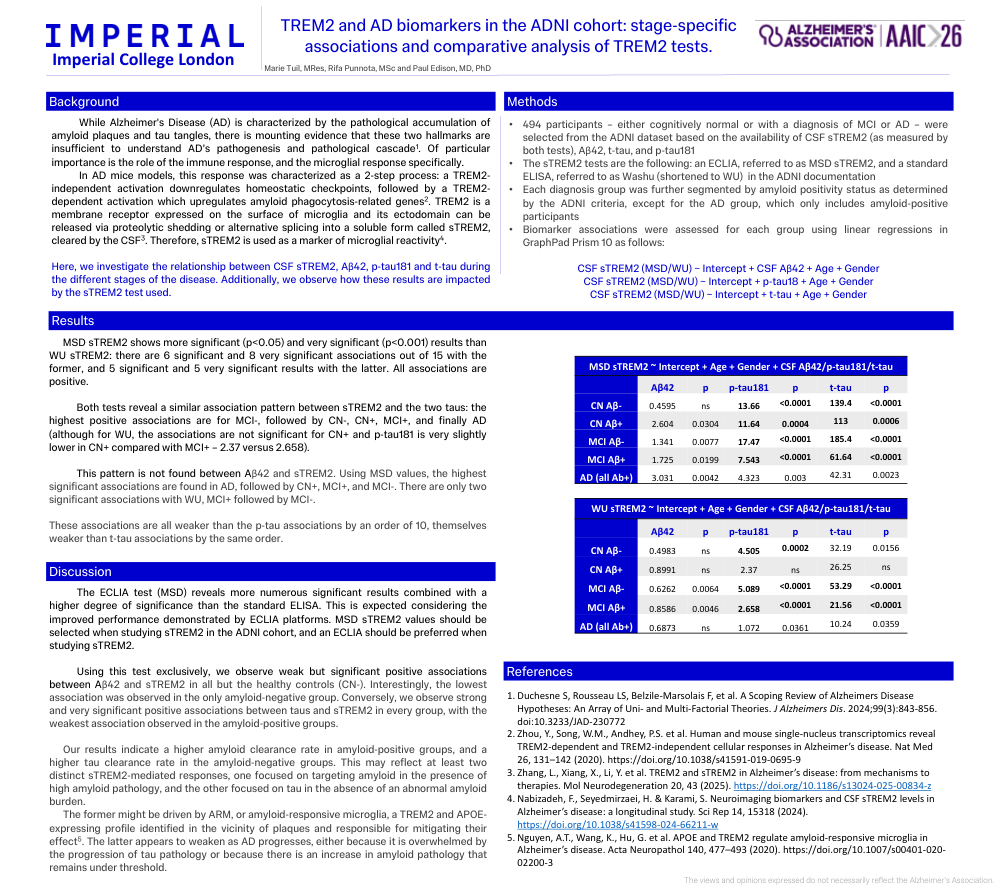
MSD sTREM2 shows more significant (p<0.05) and very significant (p<0.001) results than WU sTREM2: there are 6 significant and 8 very significant associations out of 15 with the former, and 5 significant and 5 very significant results with the latter. All associations are positive.
Both tests reveal a similar association pattern between sTREM2 and the two taus: the highest positive associations are for MCI-, followed by CN-, CN+, MCI+, and finally AD (although for WU, the associations are not significant for CN+ and p-tau181 is very slightly lower in CN+ compared with MCI+ – 2.37 versus 2.658).
This pattern is not found between Aβ42 and sTREM2. Using MSD values, the highest significant associations are found in AD, followed by CN+, MCI+, and MCI-. There are only two significant associations with WU, MCI+ followed by MCI-.
These associations are all weaker than the p-tau associations by an order of 10, themselves weaker than t-tau associations by the same order.
The ECLIA test (MSD) reveals more numerous significant results combined with a higher degree of significance than the standard ELISA. This is expected considering the improved performance demonstrated by ECLIA platforms. MSD sTREM2 values should be selected when studying sTREM2 in the ADNI cohort, and an ECLIA should be preferred when studying sTREM2.
Using this test exclusively, we observe weak but significant positive associations between Aβ42 and sTREM2 in all but the healthy controls (CN-). Interestingly, the lowest association was observed in the only amyloid-negative group. Conversely, we observe strong and very significant positive associations between taus and sTREM2 in every group, with the weakest association observed in the amyloid-positive groups.
Our results indicate a higher amyloid clearance rate in amyloid-positive groups, and a higher tau clearance rate in the amyloid-negative groups. This may reflect at least two distinct sTREM2-mediated responses, one focused on targeting amyloid in the presence of high amyloid pathology, and the other focused on tau in the absence of an abnormal amyloid burden.
The former might be driven by ARM, or amyloid-responsive microglia, a TREM2 and APOE-expressing profile identified in the vicinity of plaques and responsible for mitigating their effect5. The latter appears to weaken as AD progresses, either because it is overwhelmed by the progression of tau pathology or because there is an increase in amyloid pathology that remains under threshold.
Comments
Email is required but is not shown publicly.
Loading comments...