4,068 posters, 219 videos, 101 topics, 69 sessions, 14,365 authors, 6,128 institutions
ePostersLive by SciGen Technologies S.A. All rights reserved.
Alzheimer's Association International Conference 2026
July 12-15, 2026 | London, United Kingdom, and Online

10764
Lipid, Dopamine, And Amino Acid Derivatives Identified As Early Urinary Biomarkers In Alzheimer’S Disease Versus Lewy Body Dementia
Poster Presenter
Part of Topic
Lipid, Dopamine, and Amino Acid Derivatives Identified as Early Urinary Biomarkers in Alzheimer’s Disease versus Lewy Body Dementia:
Dany Mukesha1,2,3, Mélitine Dubray2, Floris Durand2, Stéphanie Boutillier1, David Halter2, ADDIA CONSORTIUM Members, Guillaume Sacco3,4, Hüseyin Firat1,2.
1Firalis SA, Huningue, France, 2Lodiag SA, Huningue, France, 3University of Cote d'Azur, Nice, France, 4IPMC – Institut de Pharmacologie Moléculaire et Cellulaire, Nice, France.
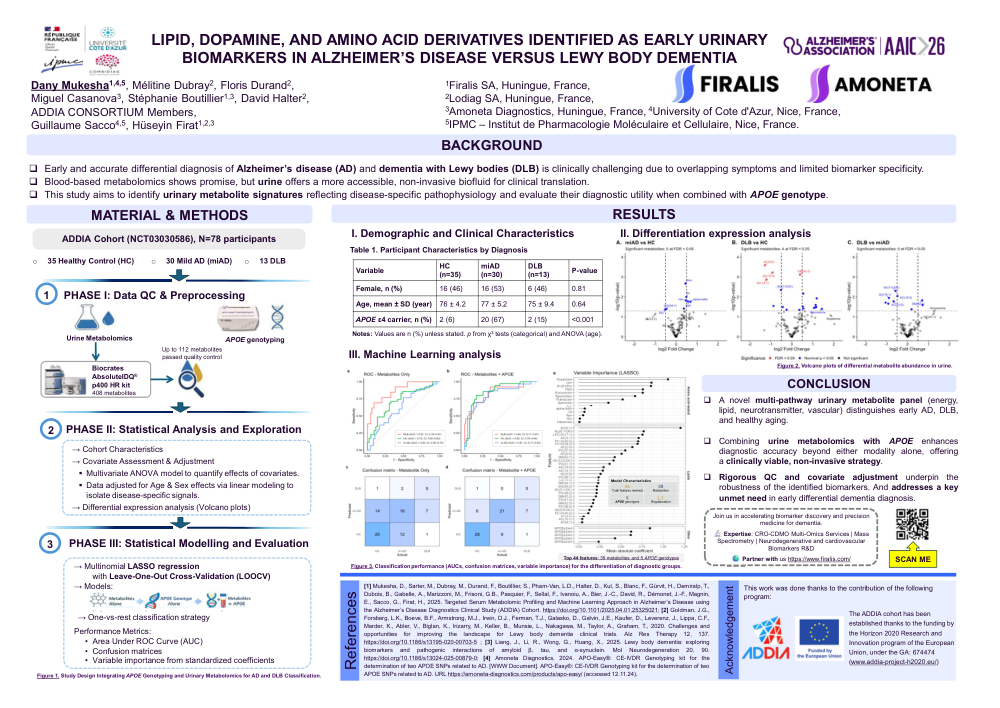
Background: Early differentiation of Alzheimer’s disease (AD) and dementia with Lewy bodies (DLB) remains challenging and partially understood, due to overlapping early clinical features and limited biomarker specificity. In response to this, we aimed to identify reliable and non-invasive urinary metabolite signatures reflecting disease-specific pathophysiology and evaluate their utility in combination with APOE genotype. While serum-based metabolomics shows promise (Mukesha et al., J Alzheimers Dis, 2025), urine represents an even more accessible biofluid for clinical translation.
Methods: Urine samples from ADDIA cohort (ClinicalTrials.gov NCT03030586) for 78 participants (35 healthy controls [HC], 30 mild AD [miAD], 13 DLB) were analyzed using the Biocrates AbsoluteIDQ® p400 HR kit. APOE genotyping was accurately determined with CE-IVDR APO-Easy® kits. After quality control, multinomial LASSO regression with Leave-One-Out Cross-Validation was applied to (i) metabolite profiles alone, (ii) APOE genotype alone, and (iii) combined models. A one-vs-rest classification strategy was used to evaluate how well each diagnostic group could be distinguished from the others. Classification performance was assessed by area under the receiver operating characteristic curves (AUC) values, and confusion matrices. Variable importance was derived from standardized regression coefficients.
Results: Metabolite-only models showed strong discrimination (AUC=0.87 for DLB, 0.72 for HC, 0.65 for miAD). Integrating APOE genotype substantially improved accuracy across AD and HC groups (AUCs of 0.81 and 0.85, respectively), reducing AD misclassification, while maintaining strong performance for DLB (AUC=0.84; Figure 1). Key discriminatory metabolites included acylcarnitines (C5:1, C8:1-OH) linked to mitochondrial energy metabolism, phosphatidylcholines and sphingomyelins associated with membrane and neurodegenerative processes, dopamine reflecting dopaminergic deficits in DLB 1, and ornithine and trans-4-hydroxyproline (t4-OH-Pro) indicating nitrogen and vascular remodeling pathways (Figure 2). APOE alone showed limited predictive power (AUC≤0.67).
Conclusion: This study identifies a novel multi-pathway urinary metabolite panel spanning energy, lipid, neurotransmitter, and vascular pathways; that distinguishes miAD, DLB, and HC. Combining metabolomics with APOE genotype enhances classification, highlighting a non-invasive strategy for early differential diagnosis. Importantly, this biomarker panel is currently undergoing independent extended validation in the large cohort, ensuring reproducibility and translational potential for clinical application.
Figure 1. Predictive performance of urine metabolomic biomarkers, with and without APOE genotype, for classifying Alzheimer’s disease (AD), dementia with Lewy bodies (DLB), and healthy controls (HC).Receiver Operating Characteristic(ROC) curves and confusion matrices illustrate model accuracy across three input types: metabolites alone, metabolites + APOE, and APOE alone. Metabolomic models showed strong diagnostic performance, especially for DLB vs. HC, with modest improvement from APOE.
Figure 2. Variable importance derived from LASSO multinomial regression coefficients. The plot displays the top 25 features ranked by the mean absolute value of their standardized coefficients across outcome classes. Feature importance reflects the strength and consistency of the contribution of each predictor to the model, highlighting key variables driving classification performance.
References:
1. Horsager J, Andersen KB, Okkels N, et al. Correlation between dopaminergic and metabolic asymmetry in Lewy body disease – A dual-imaging study. Parkinsonism & Related Disorders 2024; 127: 107117.
Comments
Email is required but is not shown publicly.
Loading comments...