4,068 posters, 219 videos, 101 topics, 69 sessions, 14,365 authors, 6,128 institutions
ePostersLive by SciGen Technologies S.A. All rights reserved.
Alzheimer's Association International Conference 2026
July 12-15, 2026 | London, United Kingdom, and Online

10393
Longitudinal Hippocampal-Amygdala Subfield And Functional Connectivity Changes In Alzheimer’s Disease Following Physical Activity
Poster Presenter
Authors
Ravi Dadsena, Ana S. Costa, Shari David, Luisa Haberl, Jörg B. Schulz, Kathrin Reetz, Alexa Haeger
Affiliations
¹ Centre for Dementia and Prevention Aachen (ZDPA), Department of Neurology, RWTH Aachen University, 52074, Aachen, Germany • ² JARA-BRAIN Institute Translational Neuroscience, Forschungszentrum Jülich GmbH and RWTH Aachen University, 52056, Aachen, Germany, ¹ Centre for Dementia and Prevention Aachen (ZDPA), Department of Neurology, RWTH Aachen University, 52074, Aachen, Germany
Part of Topic
Video
Physical Activity and Early Functional Brain Changes in Alzheimer’s Disease
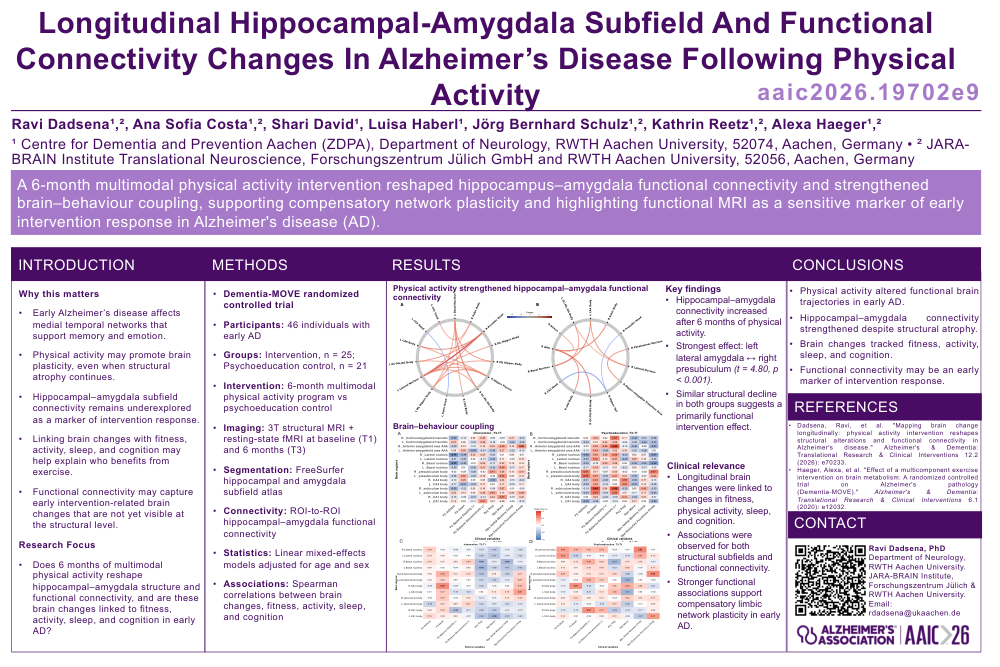
Can physical activity reveal early functional brain changes in Alzheimer’s disease? In the Dementia-MOVE randomized controlled trial, 46 individuals with early Alzheimer’s disease underwent structural MRI and resting-state fMRI before and after a 6-month intervention. Physical activity was associated with selective strengthening of hippocampal–amygdala functional connectivity, while structural atrophy progressed similarly across groups. Brain changes were linked to fitness, physical activity, sleep, attention, and executive function. These findings suggest that functional connectivity may be a sensitive marker of intervention-related brain plasticity and brain–behaviour coupling in early Alzheimer’s disease.
Comments
Email is required but is not shown publicly.
Loading comments...