4,068 posters, 219 videos, 101 topics, 69 sessions, 14,365 authors, 6,128 institutions
ePostersLive by SciGen Technologies S.A. All rights reserved.
Alzheimer's Association International Conference 2026
July 12-15, 2026 | London, United Kingdom, and Online

3836
Immunomagnetic Reduction Unveils Plasma Total Tau As A Pan-neurodegenerative Biomarker For Diagnosis And Dynamic Monitoring
Poster Presenter
Part of Topic
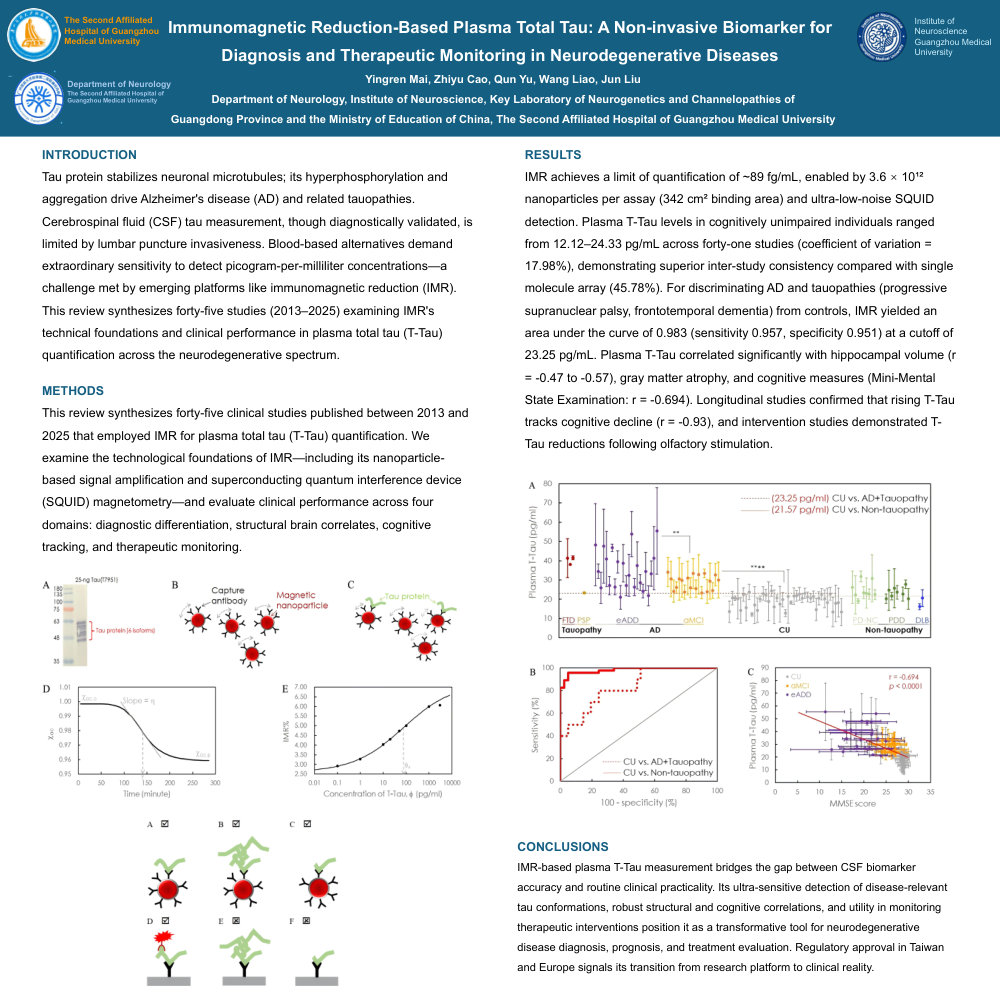
Background: Tau protein stabilizes neuronal microtubules; its hyperphosphorylation and aggregation drive Alzheimer's disease (AD) and related tauopathies. Cerebrospinal fluid (CSF) tau measurement, though diagnostically validated, is limited by lumbar puncture invasiveness. Blood-based alternatives demand extraordinary sensitivity to detect picogram-per-milliliter concentrations—a challenge met by emerging platforms like immunomagnetic reduction (IMR). This review synthesizes forty-five studies (2013–2025) examining IMR's technical foundations and clinical performance in plasma total tau (T-Tau) quantification across the neurodegenerative spectrum.
Methods: This review synthesizes forty-five clinical studies published between 2013 and 2025 that employed IMR for plasma total tau (T-Tau) quantification. We examine the technological foundations of IMR—including its nanoparticle-based signal amplification and superconducting quantum interference device (SQUID) magnetometry—and evaluate clinical performance across four domains: diagnostic differentiation, structural brain correlates, cognitive tracking, and therapeutic monitoring.
Results: IMR achieves a limit of quantification of ~89 fg/mL, enabled by 3.6 × 10¹² nanoparticles per assay (342 cm² binding area) and ultra-low-noise SQUID detection. Plasma T-Tau levels in cognitively unimpaired individuals ranged from 12.12–24.33 pg/mL across forty-one studies (coefficient of variation = 17.98%), demonstrating superior inter-study consistency compared with single molecule array (45.78%). For discriminating AD and tauopathies (progressive supranuclear palsy, frontotemporal dementia) from controls, IMR yielded an area under the curve of 0.983 (sensitivity 0.957, specificity 0.951) at a cutoff of 23.25 pg/mL. Plasma T-Tau correlated significantly with hippocampal volume (r = -0.47 to -0.57), gray matter atrophy, and cognitive measures (Mini-Mental State Examination: r = -0.694). Longitudinal studies confirmed that rising T-Tau tracks cognitive decline (r = -0.93), and intervention studies demonstrated T-Tau reductions following olfactory stimulation.
Conclusions: IMR-based plasma T-Tau measurement bridges the gap between CSF biomarker accuracy and routine clinical practicality. Its ultra-sensitive detection of disease-relevant tau conformations, robust structural and cognitive correlations, and utility in monitoring therapeutic interventions position it as a transformative tool for neurodegenerative disease diagnosis, prognosis, and treatment evaluation. Regulatory approval in Taiwan and Europe signals its transition from research platform to clinical reality.
Comments
Email is required but is not shown publicly.
Loading comments...