4,068 posters, 219 videos, 101 topics, 69 sessions, 14,365 authors, 6,128 institutions
ePostersLive by SciGen Technologies S.A. All rights reserved.
Alzheimer's Association International Conference 2026
July 12-15, 2026 | London, United Kingdom, and Online

4567
Are Cerebrovascular Factors Associated With Intrinsic Capacity Towards Dementia Prevention In African Populations?
Poster Presenter
Authors
Part of Topic
ARE CEREBROVASCULAR FACTORS ASSOCIATED WITH INTRINSIC CAPACITY TOWARDS DEMENTIA PREVENTION IN AFRICAN POPULATIONS?
Background and Objectives:
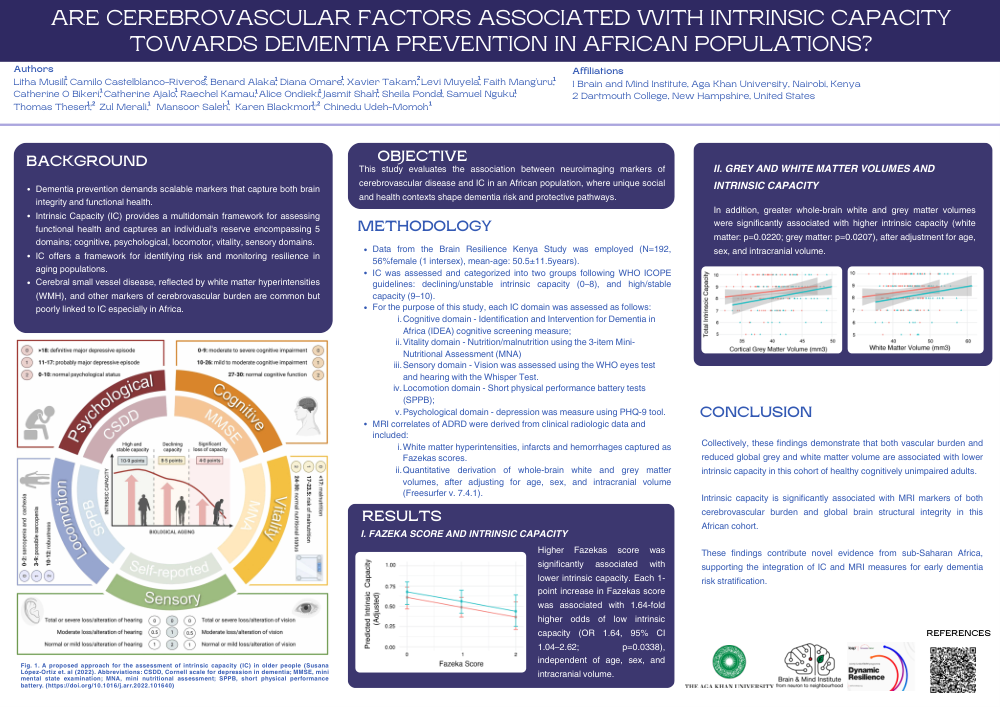
Dementia prevention is a global health priority, particularly early detection markers that capture both brain integrity and functional health. The World Health Organization’s concept of Intrinsic Capacity (IC) encompasses cognitive, locomotor, psychological, vitality, and sensory domains and offers a framework for identifying risk and monitoring resilience in aging populations. This study evaluates the association between neuroimaging markers of cerebral small vessel disease and IC in an African population, where unique social and health contexts shape dementia risk and protective pathways.
Methods:
Data from the Brain Resilience Kenya Study was employed (n=192, 56%female (1 intersex), mean-age: 50.5±11.5years). IC was assessed and categorized into two groups following WHO ICOPE guidelines: declining/unstable intrinsic capacity (0–8), and high/stable capacity (9–10). MRI correlates of ADRD were derived from clinical radiologic and included
- white matter hyperintensities, infarcts and hemorrhages captured as Fazekas scores,
- quantitative derivation of whole-brain white and gray matter volumes, after adjusting for age, sex, and intracranial volume.
Results:
Higher Fazekas score was significantly associated with lower intrinsic capacity. Each 1-point increase in Fazekas score was associated with 1.64-fold higher odds of low intrinsic capacity (OR 1.64, 95% CI 1.04–2.62; p=0.0338), independent of age, sex, and intracranial volume.
In addition, greater whole-brain grey and white matter volumes were significantly associated with higher intrinsic capacity (grey matter: p=0.0207; white matter: p=0.0220), after adjustment for age, sex, and intracranial volume.
Collectively, these findings demonstrate that both vascular burden and reduced global grey and white matter volume are associated with lower intrinsic capacity in this cohort.
Conclusions:
Intrinsic capacity is significantly associated with MRI markers of both cerebrovascular burden and global brain structural integrity in this African cohort. Higher small vessel disease burden and lower whole-brain grey and white matter volumes were independently associated with reduced intrinsic capacity. These findings contribute novel evidence from sub-Saharan Africa, supporting the integration of IC and MRI measures for early dementia risk stratification.
Comments
Email is required but is not shown publicly.
Loading comments...