4,068 posters, 219 videos, 101 topics, 69 sessions, 14,365 authors, 6,128 institutions
ePostersLive by SciGen Technologies S.A. All rights reserved.
Alzheimer's Association International Conference 2026
July 12-15, 2026 | London, United Kingdom, and Online

2861
Associations Between Metabolic Comorbidities And Plasma Biomarkers Across Neurodegenerative Disease
Poster Presenter
Authors
Jerry Tan, Dishaa Sinha, Sofia Toniolo, Sijia Zhao, John Broulidakis, Claudia Gendarini, Nishat Tahira, Andrew Fower, Cornelia van Duijn, Sian Thomson, Sanjay Manohar, Masud Husain, Ivan Koychev
Affiliations
Department of Psychiatry, University of Oxford, UK, Nuffield Department of Clinical Neurosciences, University of Oxford, UK, Department of Experimental Psychology, University of Oxford, UK, Nuffield Department of Population Health, University of Oxford, UK, Oxford Centre for Cognitive Disorders, John Radcliffe Hospital, Oxford, UK, Department of Brain Health Sciences, Imperial College London, UK
Part of Topic
INTRODUCTION: Plasma biomarkers have
demonstrated clinical
utility in the differential
diagnosis of Alzheimer’s
disease and are of
increasing importance in
other neurocognitive
disorders.
• AIM: to study the effect of
metabolic comorbidities
on plasma biomarker
concentrations in a
transdiagnostic research
cohort.
METHODS:
N=376 participants
recruited from the Oxford
Memory Clinic and the FAST
study (AD=90, LBD=16,
CBS=7, FTD=14, MCI=24,
SCD=36, controls=189).
• p-tau217, Aβ42/40 ratio,
GFAP, NFL, PRDX6 and
ACHE measured using the
Alamar NULISA CNS Panel.
• Hypertension, diabetes,
hyperlipidemia, chronic
kidney disease and
concurrent medication
coded from medical
records. BMI, blood
pressure, HbA1c, serum
creatinine and HDL
cholesterol were available
or imputed in a subset of
participants.
• Linear regression used to
study associations between
biomarkers and
comorbidities/clinical
parameters, controlling for
age, sex and education.
Sensitivity analyses
controlled for BMI and
concurrent medication
respectively.
RESULTS:
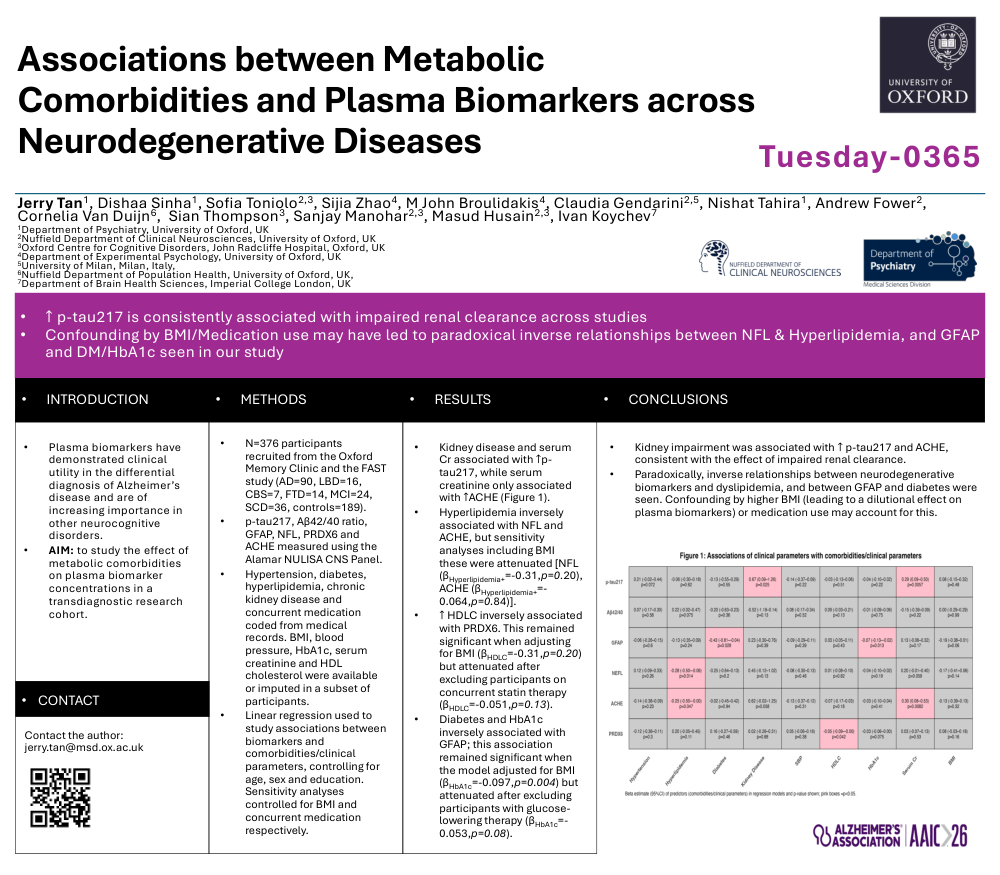
Kidney disease and serum
Cr associated with ↑p-
tau217, while serum
creatinine only associated
with ↑ACHE (Figure 1).
• Hyperlipidemia inversely
associated with NFL and
ACHE, but sensitivity
analyses including BMI
these were attenuated [NFL
(βHyperlipidemia+=-0.31,p=0.20),
ACHE (βHyperlipidemia+=-
0.064,p=0.84)].
• ↑ HDLC inversely associated
with PRDX6. This remained
significant when adjusting
for BMI (βHDLC=-0.31,p=0.20)
but attenuated after
excluding participants on
concurrent statin therapy
(βHDLC=-0.051,p=0.13).
• Diabetes and HbA1c
inversely associated with
GFAP; this association
remained significant when
the model adjusted for BMI
(βHbA1c=-0.097,p=0.004) but
attenuated after excluding
participants with glucose-
lowering therapy (βHbA1c=-
0.053,p=0.08). CONCLUSIONS:
Kidney impairment was associated with ↑ p-tau217 and ACHE,
consistent with the effect of impaired renal clearance.
• Paradoxically, inverse relationships between neurodegenerative
biomarkers and dyslipidemia, and between GFAP and diabetes were
seen. Confounding by higher BMI (leading to a dilutional effect on
plasma biomarkers) or medication use may account for this.
Comments
Email is required but is not shown publicly.
Loading comments...