4,068 posters, 219 videos, 101 topics, 69 sessions, 14,365 authors, 6,128 institutions
ePostersLive by SciGen Technologies S.A. All rights reserved.
Alzheimer's Association International Conference 2026
July 12-15, 2026 | London, United Kingdom, and Online

9804
Discordance Between Plasma P-tau217 And PET Imaging As A Prognostic Marker In Alzheimer’s Disease
Poster Presenter
Authors
Hanna Cho, Han-Kyeol Kim, Jae Hoon Lee, Joong-Hyun Chun, You Jin Kim, Mina Park, Rayeon Ha, Daniel Connell, Joel Braunstein, Young Hoon Ryu, Chul Hyoung Lyoo
Affiliations
Department of Neurology, Gangnam Severance Hospital, Yonsei University College of Medicine, Seoul, Korea, Department of Neurology, Wonju Severance Christian Hospital, Yonsei University Wonju College of Medicine, Gangwon-do, Korea, Department of Nuclear Medicine, Gangnam Severance Hospital, Yonsei University College of Medicine, Seoul, South Korea, Department of Nuclear Medicine, Severance Hospital, Yonsei University College of Medicine, Seoul, South Korea, Department of Radiology, Gangnam Severance Hospital, Yonsei University College of Medicine, Seoul, Korea, Department of Psychiatry, Seoul Bukbu Hospital, Seoul, Korea, C2N diagnostics, St Louis, Missouri, USA
Part of Topic
Discordance Between Plasma P-tau217 And PET Imaging As A Prognostic Marker In Alzheimer’s Disease:
Author Block:Hanna Cho1, Han-Kyeol Kim2, Jae Hoon Lee3, Joong-Hyun Chun4, You Jin Kim1, Mina Park5, Rayeon Ha6, Daniel Connell7, Joel Braunstein7, Young Hoon Ryu3, Chul Hyoung Lyoo1.
1Department of Neurology, Gangnam Severance Hospital, Yonsei University College of Medicine, Seoul, Korea, Republic of, 2Department of Neurology, Wonju Severance Christian Hospital, Yonsei University Wonju College of Medicine, Wonju, Korea, Republic of, 3Department of Nuclear Medicine, Gangnam Severance Hospital, Yonsei University College of Medicine, Seoul, Korea, Republic of, 4Department of Nuclear Medicine, Severance Hospital, Yonsei University College of Medicine, Seoul, Korea, Republic of, 5Department of Radiology, Gangnam Severance Hospital, Yonsei University College of Medicine, Seoul, Korea, Republic of, 6Department of Psychiatry, Seoul Bukbu Hospital, Seoul, Korea, Republic of, 7C2N Diagnostics, LLC, St Louis, MO, USA.
Abstract:
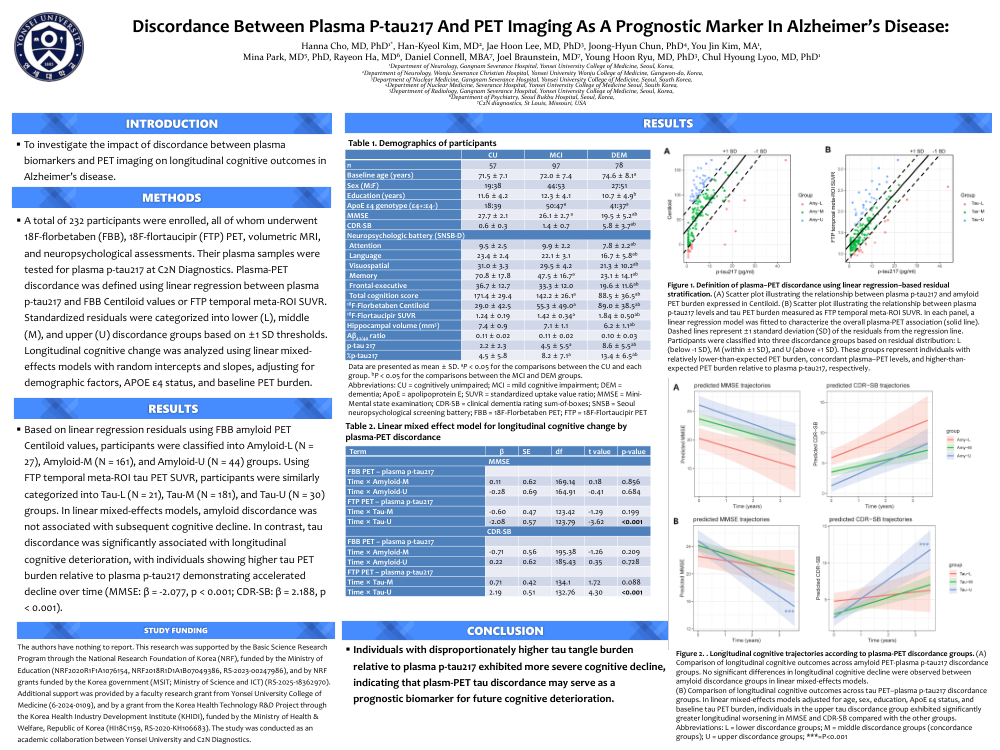
Background: To investigate the impact of discordance between plasma biomarkers and PET imaging on longitudinal cognitive outcomes in Alzheimer’s disease.
Methods: A total of 232 participants were enrolled, all of whom underwent 18F-florbetaben (FBB), 18F-flortaucipir (FTP) PET, volumetric MRI, and neuropsychological assessments. Their plasma samples were tested for plasma p-tau217 at C2N Diagnostics. Plasma-PET discordance was defined using linear regression between plasma p-tau217 and FBB Centiloid values or FTP temporal meta-ROI SUVR. Standardized residuals were categorized into lower (L), middle (M), and upper (U) discordance groups based on ±1 SD thresholds. Longitudinal cognitive change was analyzed using linear mixed-effects models with random intercepts and slopes, adjusting for demographic factors, APOE ε4 status, and baseline PET burden.
Results: Based on linear regression residuals using FBB amyloid PET Centiloid values, participants were classified into Amyloid-L (N = 27), Amyloid-M (N = 161), and Amyloid-U (N = 44) groups. Using FTP temporal meta-ROI tau PET SUVR, participants were similarly categorized into Tau-L (N = 21), Tau-M (N = 181), and Tau-U (N = 30) groups. In linear mixed-effects models, amyloid discordance was not associated with subsequent cognitive decline. In contrast, tau discordance was significantly associated with longitudinal cognitive deterioration, with individuals showing higher tau PET burden relative to plasma p-tau217 demonstrating accelerated decline over time (MMSE: β = -2.077, p < 0.001; CDR-SB: β = 2.188, p < 0.001).
Conclusion: Individuals with disproportionately higher tau tangle burden relative to plasma p-tau217 exhibited more severe cognitive decline, indicating that plasm-PET tau discordance may serve as a prognostic biomarker for future cognitive deterioration.
Comments
Email is required but is not shown publicly.
Loading comments...