4,068 posters, 219 videos, 101 topics, 69 sessions, 14,365 authors, 6,128 institutions
ePostersLive by SciGen Technologies S.A. All rights reserved.
Alzheimer's Association International Conference 2026
July 12-15, 2026 | London, United Kingdom, and Online

6077
Inflammatory Marker Profiles For Phosphorylated Tau 181, 217, And 231 In Cognitively Unimpaired Older Adults
Poster Presenter
Part of Topic
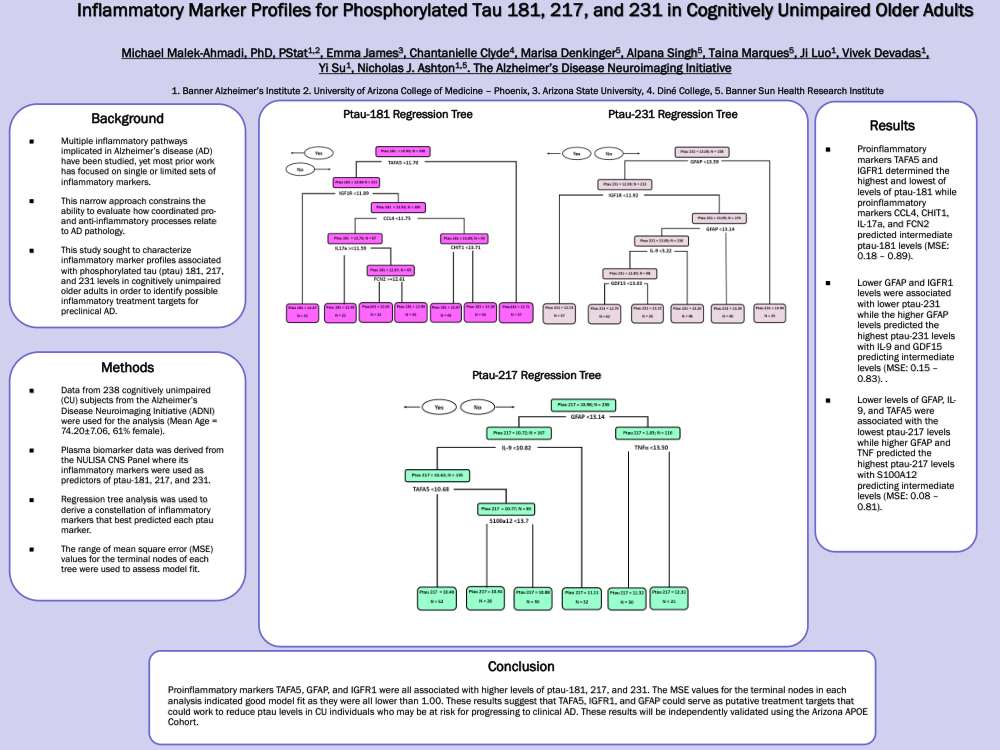
Background: Multiple inflammatory pathways implicated in Alzheimer’s disease (AD) have been studied, yet most prior work has focused on single or limited sets of inflammatory markers. This narrow approach constrains the ability to evaluate how coordinated pro- and anti-inflammatory processes relate to AD pathology. This study sought to characterize inflammatory marker profiles associated with phosphorylated tau (ptau) 181, 217, and 231 levels in cognitively unimpaired older adults in order to identify possible inflammatory treatment targets for preclinical AD.
Methods: Data from 238 cognitively unimpaired (CU) subjects from the Alzheimer’s Disease Neuroimaging Initiative (ADNI) were used for the analysis (Mean Age = 74.20±7.06, 61% female). Plasma biomarker data was derived from the NULISA CNS Panel where its inflammatory markers were used as predictors of ptau-181, 217, and 231. Regression tree analysis was used to derive a constellation of inflammatory markers that best predicted each ptau marker. The range of mean square error (MSE) values for the terminal nodes of each tree were used to assess model fit.
Results: Proinflammatory markers TAFA5 and IGFR1 determined the highest and lowest of levels of ptau-181 while proinflammatory markers CCL4, CHIT1, IL-17a, and FCN2 predicted intermediate ptau-181 levels (MSE: 0.18 – 0.89). Lower levels of GFAP, IL-9, and TAFA5 were associated with the lowest ptau-217 levels while higher GFAP and TNF predicted the highest ptau-217 levels with S100A12 predicting intermediate levels (MSE: 0.08 – 0.81). Lower GFAP and IGFR1 levels were associated with lower ptau-231 while the higher GFAP levels predicted the highest ptau-231 levels with IL-9 and GDF15 predicting intermediate levels (MSE: 0.15 – 0.83).
Conclusion: Proinflammatory markers TAFA5, GFAP, and IGFR1 were all associated with higher levels of ptau-181, 217, and 231. The MSE values for the terminal nodes in each analysis indicated good model fit as they were all lower than 1.00. These results suggest that TAFA5, IGFR1, and GFAP could serve as putative treatment targets that could work to reduce ptau levels in CU individuals who may be at risk for progressing to clinical AD. These results will be independently validated using the Arizona APOE Cohort.
Comments
Email is required but is not shown publicly.
Loading comments...