4,068 posters, 219 videos, 101 topics, 69 sessions, 14,365 authors, 6,128 institutions
ePostersLive by SciGen Technologies S.A. All rights reserved.
Alzheimer's Association International Conference 2026
July 12-15, 2026 | London, United Kingdom, and Online

4782
Rapid Reduction Of Plasma Oligomeric Amyloid Beta As A Target Engagement Biomarker For Lecanemab Treatment
Poster Presenter
Authors
Part of Topic
Background:
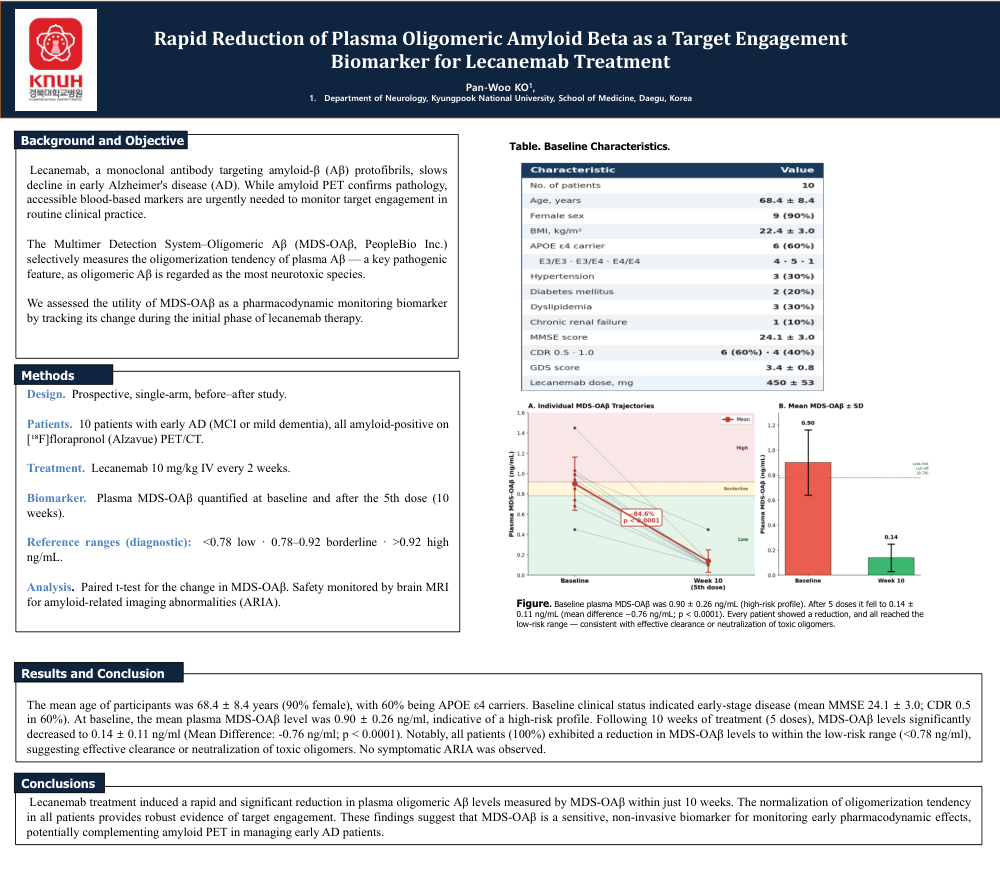
Lecanemab, a monoclonal antibody targeting amyloid-beta (Aβ) protofibrils, has demonstrated efficacy in early Alzheimer's disease (AD). While amyloid PET is the standard for confirming pathology, accessible blood-based biomarkers are urgently needed to monitor target engagement in clinical practice. The Multimer Detection System–Oligomeric Aβ (MDS-OAβ, PeopleBio Inc.) selectively measures the oligomerization tendency of Aβ in plasma, a key pathogenic feature. This study evaluated the utility of MDS-OAβ as a monitoring biomarker by assessing its changes during the initial phase of lecanemab treatment.
Methods:
We prospectively enrolled 10 patients with early AD (MCI or mild dementia) confirmed by amyloid PET using [18F]florapronol (Alzavue). All patients received lecanemab (10 mg/kg intravenously biweekly). Plasma MDS-OAβ levels were quantified using the MDS-OAβ kit at baseline and after the 5th dose (10 weeks). Reference categories, originally established for cross-sectional diagnostic discrimination, were defined as: <0.78 ng/ml (low), 0.78–0.92 ng/ml (borderline), and >0.92 ng/ml (high). Changes in MDS-OAβ levels were analyzed using a paired t-test. Safety assessments, including MRI for Amyloid-Related Imaging Abnormalities (ARIA), were performed.
Results:
The mean age of participants was 68.4 ± 8.4 years (90% female), with 60% being APOE ε4 carriers. Baseline clinical status indicated early-stage disease (mean MMSE 24.1 ± 3.0; CDR 0.5 in 60%). At baseline, the mean plasma MDS-OAβ level was 0.90 ± 0.26 ng/ml, corresponding to the high-risk reference range. Following 10 weeks of treatment (5 doses), MDS-OAβ levels significantly decreased to 0.14 ± 0.11 ng/ml (mean difference: −0.76 ng/ml, an 84.6% reduction; p < 0.0001). Every patient (100%) showed a reduction, with all levels falling within the low-risk reference range (<0.78 ng/ml), suggesting effective clearance or neutralization of toxic oligomers. As these thresholds were derived for diagnostic rather than longitudinal use, this categorical shift is presented as an exploratory pharmacodynamic observation. No symptomatic ARIA was observed.
Conclusion:
Lecanemab treatment induced a rapid and significant reduction in plasma oligomeric Aβ levels measured by MDS-OAβ within just 10 weeks. The consistent decrease in oligomerization tendency across all patients provides robust evidence of target engagement. These findings suggest that MDS-OAβ is a promising, sensitive, non-invasive biomarker for monitoring early pharmacodynamic effects, potentially complementing amyloid PET in managing early AD patients. Given the small, single-arm design, confirmation in larger controlled cohorts is warranted.
Comments
Email is required but is not shown publicly.
Loading comments...