4,068 posters, 219 videos, 101 topics, 69 sessions, 14,365 authors, 6,128 institutions
ePostersLive by SciGen Technologies S.A. All rights reserved.
Alzheimer's Association International Conference 2026
July 12-15, 2026 | London, United Kingdom, and Online

2257
Chronic Migraine Via Nitroglycerin Treatment Progresses Cognitive Decline And Amyloid Pathology In The 3xTG Mouse Model
Poster Presenter
Authors
Part of Topic
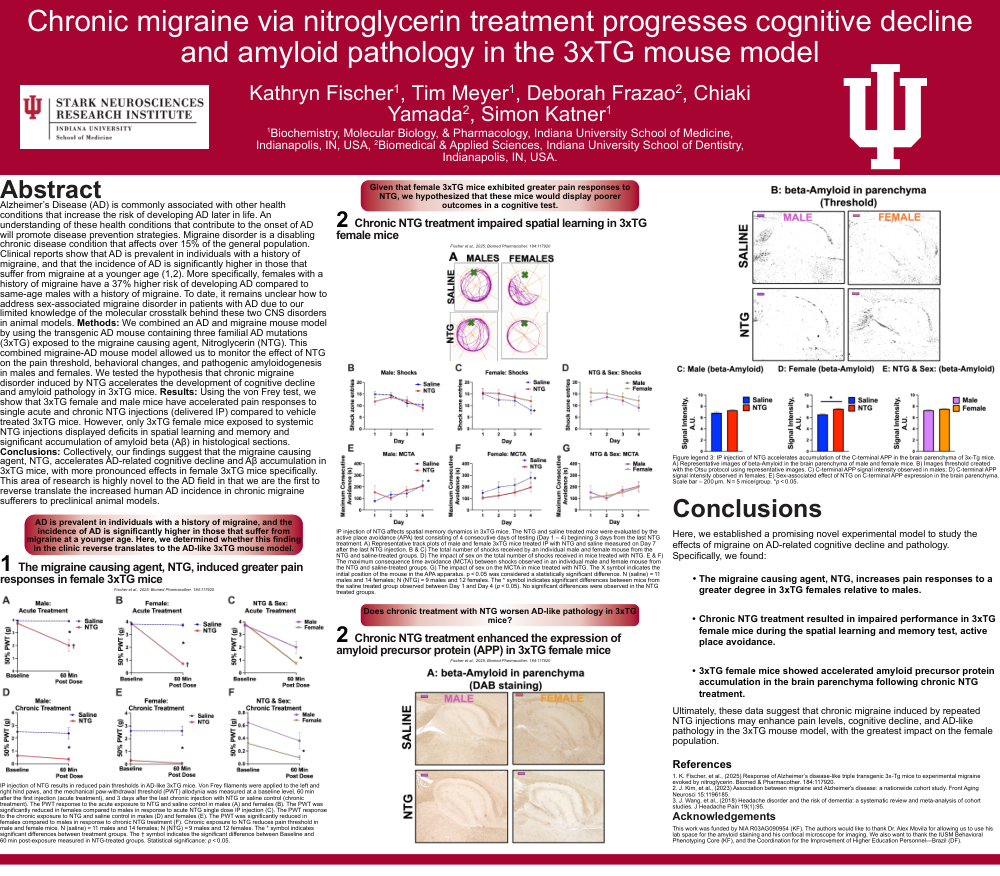
Alzheimer’s Disease (AD) is commonly associated with other health conditions that increase the risk of developing AD later in life. An understanding of these health conditions that contribute to the onset of AD will promote disease prevention strategies. Migraine disorder is a disabling chronic disease condition that affects over 15% of the general population. Clinical reports show that AD is prevalent in individuals with a history of migraine, and that the incidence of AD is significantly higher in those that suffer from migraine at a younger age. More specifically, females with a history of migraine have a 37% higher risk of developing AD compared to same-age males with a history of migraine. To date, it remains unclear how to address sex-associated migraine disorder in patients with AD due to our limited knowledge of the molecular crosstalk behind these two CNS disorders in animal models. Methods: We combined an AD and migraine mouse model by using the transgenic AD mouse containing three familial AD mutations (3xTG) exposed to the migraine causing agent, Nitroglycerin (NTG). This combined migraine-AD mouse model allowed us to monitor the effect of NTG on the pain threshold, behavioral changes, and pathogenic amyloidogenesis in males and females. We tested the hypothesis that chronic migraine disorder induced by NTG accelerates the development of cognitive decline and amyloid pathology in 3xTG mice. Results: Using the Von Frey test, we show that 3xTG female and male mice have accelerated pain responses to single acute and chronic NTG injections (delivered IP) compared to vehicle treated 3xTG mice. However, only 3xTG female mice exposed to systemic NTG injections displayed deficits in spatial learning and memory and significant accumulation of amyloid beta (Aβ) in histological sections. Conclusions: Collectively, our findings suggest that the migraine causing agent, NTG, accelerates AD-related cognitive decline and Aβ accumulation in 3xTG mice, with more pronounced effects in female 3xTG mice specifically. This area of research is highly novel to the AD field in that we are the first to reverse translate the increased human AD incidence in chronic migraine sufferers to preclinical animal models.
Comments
Email is required but is not shown publicly.
Loading comments...