4,068 posters, 219 videos, 101 topics, 69 sessions, 14,365 authors, 6,128 institutions
ePostersLive by SciGen Technologies S.A. All rights reserved.
Alzheimer's Association International Conference 2026
July 12-15, 2026 | London, United Kingdom, and Online

10760
MCLENA-1: A Phase II Trial of Lenalidomide in Mild Cognitive Impairment: Preliminary Data on Plasma Inflammatory Markers
Poster Presenter
Authors
Boris Decourt, Jeffrey R. Wilson, Liliana Dumitrescu, Katia Azarfar, Ellie M. Reyna, Jessica M. Kennedy, Marwan N. Sabbagh
Affiliations
Barrow Neurological Institute, Phoenix, AZ, USA, Texas Tech University Health Sciences Center, Lubbock, TX, USA, Arizona State University, Tempe, AZ, USA, Cleveland Clinic Lou Ruvo Center for Brain Health, Las Vegas NV, USA
Part of Topic
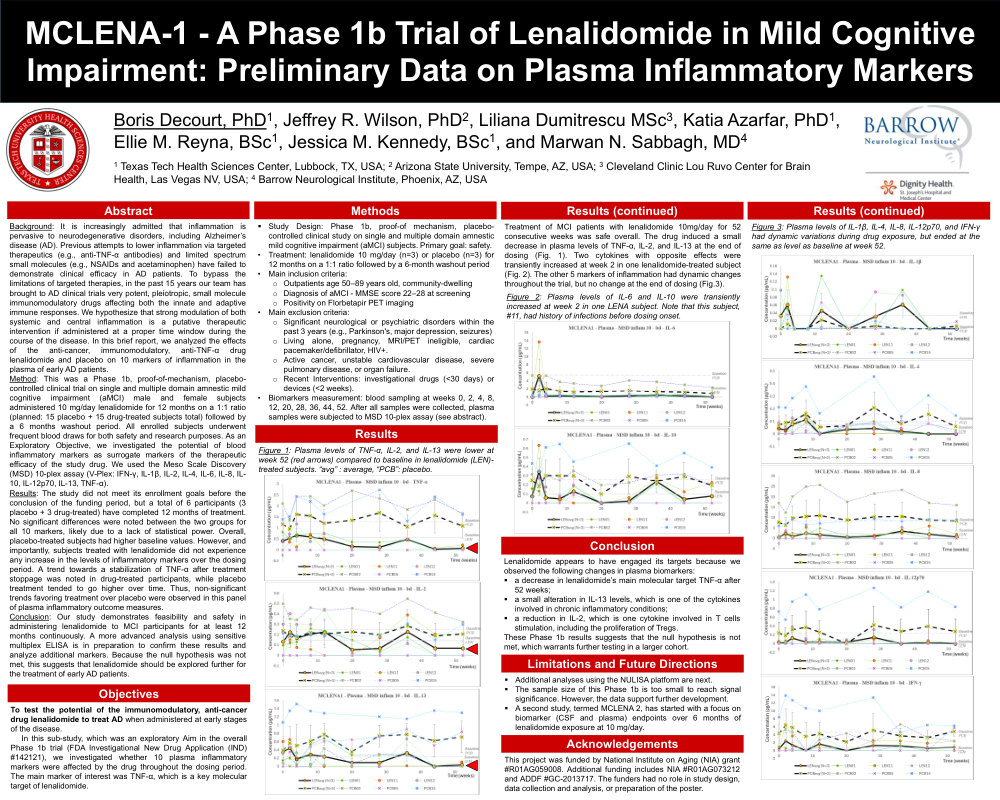
Background: It is increasingly admitted that inflammation is pervasive to neurodegenerative disorders, including Alzheimer’s disease (AD). Previous attempts to lower inflammation via targeted therapeutics (e.g., anti-TNF-α antibodies) and limited spectrum small molecules (e.g., NSAIDs and acetaminophen) have failed to demonstrate clinical efficacy in AD patients. To bypass the limitations of targeted therapies, in the past 15 years our team has brought to AD clinical trials very potent, pleiotropic, small molecule immunomodulatory drugs affecting both the innate and adaptive immune responses. We hypothesize that strong modulation of both systemic and central inflammation is a putative therapeutic intervention if administered at a proper time window during the course of the disease. In this brief report, we analyzed the effects of the anti-cancer, immunomodulatory, anti-TNF-α drug lenalidomide and placebo on 10 markers of inflammation in the plasma of early AD patients.
Method: This was a Phase 1b, proof-of-mechanism, placebo-controlled clinical trial on single and multiple domain amnestic mild cognitive impairment (aMCI) male and female subjects administered 10 mg/day lenalidomide for 12 months on a 1:1 ratio (planned: 15 placebo + 15 drug-treated subjects total) followed by a 6 months washout period. All enrolled subjects underwent frequent blood draws for both safety and research purposes. As an Exploratory Objective, we investigated the potential of blood inflammatory markers as surrogate markers of the therapeutic efficacy of the study drug. We used the Meso Scale Discovery (MSD) 10-plex assay (V-Plex: IFN-γ, IL-1β, IL-2, IL-4, IL-6, IL-8, IL-10, IL-12p70, IL-13, TNF-α).
Results: The study did not meet its enrollment goals before the conclusion of the funding period, but a total of 6 participants (3 placebo + 3 drug-treated) have completed 12 months of treatment. No significant differences were noted between the two groups for all 10 markers, likely due to a lack of statistical power. Overall, placebo-treated subjects had higher baseline values. However, and importantly, subjects treated with lenalidomide did not experience any increase in the levels of inflammatory markers over the dosing period. A trend towards a stabilization of TNF-α after treatment stoppage was noted in drug-treated participants, while placebo treatment tended to go higher over time. Thus, non-significant trends favoring treatment over placebo were observed in this panel of plasma inflammatory outcome measures.
Conclusion: Our study demonstrates feasibility and safety in administering lenalidomide to MCI participants for at least 12 months continuously. A more advanced analysis using sensitive multiplex ELISA is in preparation to confirm these results and analyze additional markers. Because the null hypothesis was not met, this suggests that lenalidomide should be explored further for the treatment of early AD patients.
Comments
Email is required but is not shown publicly.
Loading comments...