Loading...

4,068 posters, 219 videos, 101 topics, 69 sessions, 14,365 authors, 6,128 institutions

ePostersLive by SciGen Technologies S.A. All rights reserved.

Alzheimer's Association International Conference 2026

July 12-15, 2026 | London, United Kingdom, and Online

Alzheimer's Association International Conference 2026 banner

9774

A Plasma Biomarker-based Cognitive Reserve Predicts Progression In Alzheimer's Disease
Part of Topic

A Plasma Biomarker–based Cognitive Reserve Predicts Progression in Alzheimer’s Disease

Yeshin Kim1, Jae-Won Jang2, Sangjae Lee3, Sang Won Seo4, Geon Ha Kim5, Jee Hyang Jeong1 and Hyemin Jang6 — on behalf of the K-ROAD Study Group

1Department of Neurology, Ewha W. University Seoul Hospital, Ewha W. University College of Medicine, Seoul, Republic of Korea. 2Department of Neurology, Konkuk University Medical Center, Konkuk University School of

Medicine, Seoul, Republic of Korea, 3Department of Neurology, Kangwon National University Hospital, Chuncheon, Republic of Korea, 4Department of Neurology, Samsung Medical Center, Sungkyunkwan University School of Medicine, Seoul, Republic of Korea, Department of Neurology, Ewha W. University Mokdong Hospital, Ewha W. University, College of Medicine, Seoul, Republic of Korea 5Department of Neurology, Asan Medical Center, University of Ulsan College of Medicine, Seoul, Republic of Korea

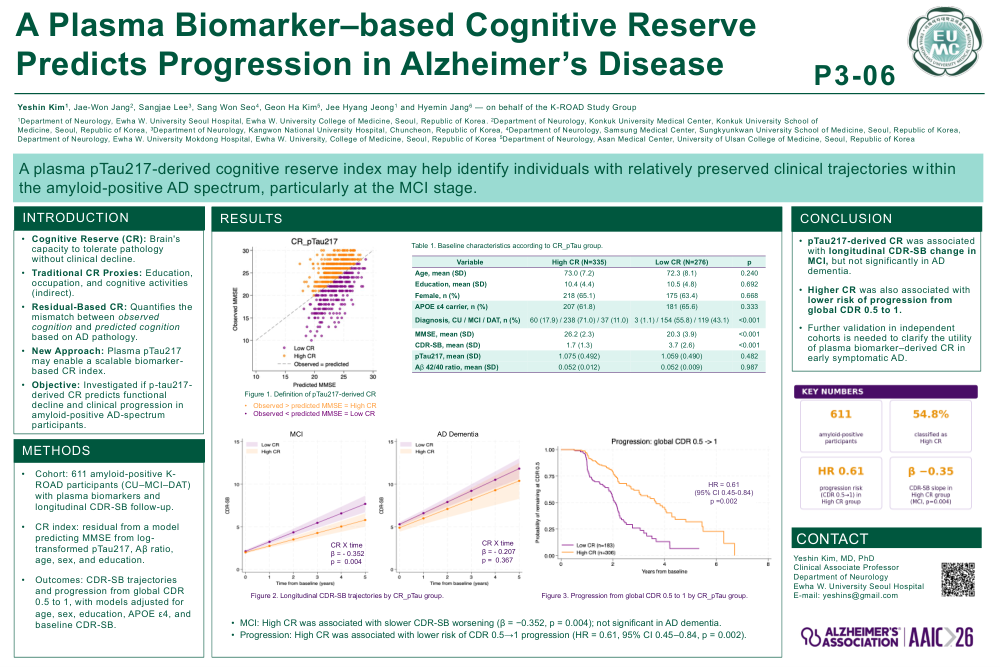
Key take away: A plasma pTau217-derived cognitive reserve index may help identify individuals with relatively preserved clinical trajectories within the amyloid-positive AD spectrum, particularly at the MCI stage.

Introduction

•Cognitive Reserve (CR): Brain's capacity to tolerate pathology without clinical decline.
•Traditional CR Proxies: Education, occupation, and cognitive activities (indirect).
•Residual-Based CR: Quantifies the mismatch between observed cognition and predicted cognition based on AD pathology.
•New Approach: Plasma pTau217 may enable a scalable biomarker-based CR index.
•Objective: Investigated if p-tau217-derived CR predicts functional decline and clinical progression in amyloid-positive AD-spectrum participants.
 
Methods
•Cohort: 611 amyloid-positive K-ROAD participants (CU–MCI–DAT) with plasma biomarkers and longitudinal CDR-SB follow-up.
•CR index: residual from a model predicting MMSE from log-transformed pTau217, Aβ ratio, age, sex, and education.
•Outcomes: CDR-SB trajectories and progression from global CDR 0.5 to 1, with models adjusted for age, sex, education, APOE ε4, and baseline CDR-SB.
 
Results
•MCI: High CR was associated with slower CDR-SB worsening (β = −0.352, p = 0.004); not significant in AD dementia.
•Progression: High CR was associated with lower risk of CDR 0.5→1 progression (HR = 0.61, 95% CI 0.45–0.84, p = 0.002).
 
Conclusion
•pTau217-derived CR was associated with longitudinal CDR-SB change in MCI, but not significantly in AD dementia.
•Higher CR was also associated with lower risk of progression from global CDR 0.5 to 1.
•Further validation in independent cohorts is needed to clarify the utility of plasma biomarker–derived CR in early symptomatic AD.

Comments

Email is required but is not shown publicly.

Loading comments...

aaic2026 banner
Copyright © 2015-2026, ePostersLive® SciGen is a registered trademark of SciGen Technologies S.A. Patent pending.

This website and third-party tools we use rely on cookies for the best user experience. By selecting "I agree", you agree to cookie usage as described in our Privacy Policy.