Loading...

4,068 posters, 219 videos, 101 topics, 69 sessions, 14,365 authors, 6,128 institutions

ePostersLive by SciGen Technologies S.A. All rights reserved.

Alzheimer's Association International Conference 2026

July 12-15, 2026 | London, United Kingdom, and Online

Alzheimer's Association International Conference 2026 banner

2682

Multimodal Markers Of Early Alzheimer's Disease-related Change In Adults With Down Syndrome
Part of Topic

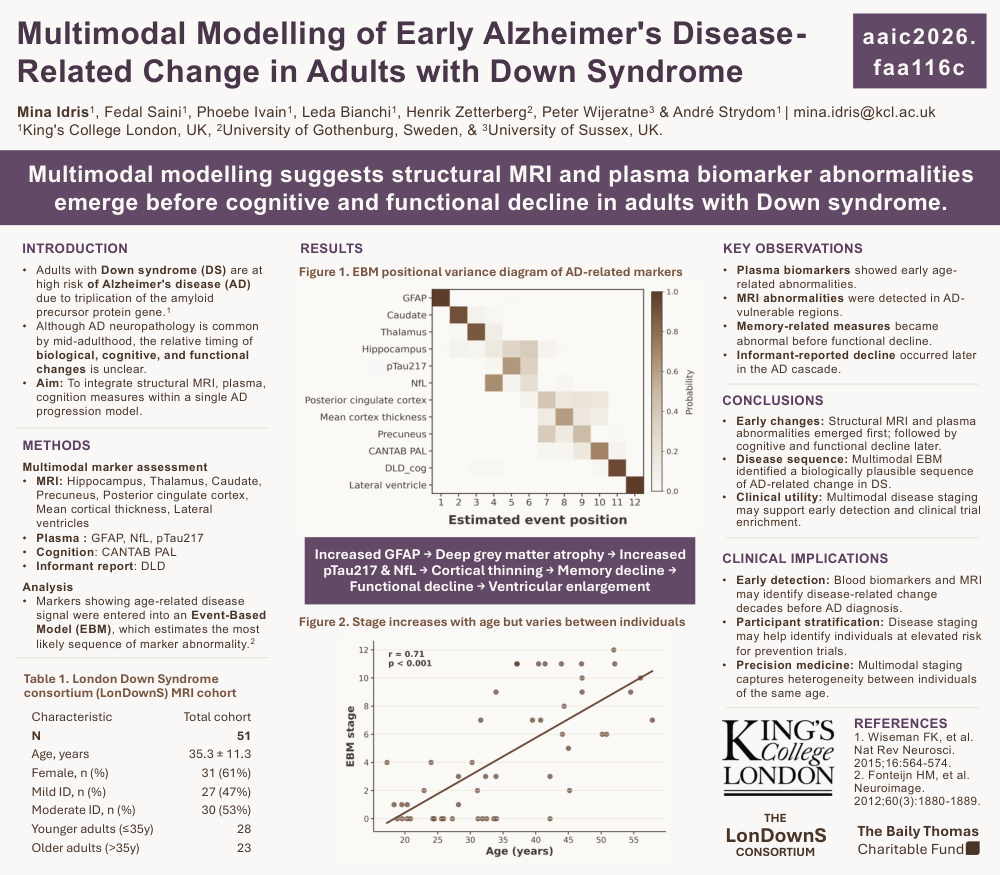
Multimodal Modelling of Early Alzheimer's Disease-Related Change in Adults with Down Syndrome

Mina Idris1, Fedal Saini1, Phoebe Ivain1, Leda Bianchi1, Henrik Zetterberg2, Peter Wijeratne3 & André Strydom1 | mina.idris@kcl.ac.uk

1King's College London, UK, 2University of Gothenburg, Sweden, & 3University of Sussex, UK.

Multimodal modelling suggests structural MRI and plasma biomarker abnormalities emerge before cognitive and functional decline in adults with Down syndrome.


INTRODUCTION 

 
•Adults with Down syndrome (DS) are at high risk of Alzheimer's disease (AD) due to triplication of the amyloid precursor protein gene.1
•Although AD neuropathology is common by mid-adulthood, the relative timing of biological, cognitive, and functional changes is unclear.
•Aim: To integrate structural MRI, plasma, cognition measures within a single AD progression model.
 

METHODS


Multimodal marker assessment

•MRI: Hippocampus, Thalamus, Caudate, Precuneus, Posterior cingulate cortex, Mean cortical thickness, Lateral ventricles
•Plasma : GFAP, NfL, pTau217
•Cognition: CANTAB PAL
•Informant report: DLD


Analysis

•Markers showing age-related disease signal were entered into an Event-Based Model (EBM), which estimates the most likely sequence of marker abnormality.2
 

RESULTS

Table 1. London Down Syndrome consortium (LonDownS) MRI cohort

Figure 1. EBM positional variance diagram of AD-related markers

Increased GFAP → Deep grey matter atrophy → Increased pTau217 & NfL → Cortical thinning → Memory decline → Functional decline → Ventricular enlargement

Figure 2. Stage increases with age but varies between individuals


KEY OBSERVATIONS


•Plasma biomarkers showed early age-related abnormalities.
•MRI abnormalities were detected in AD-vulnerable regions.
•Memory-related measures became abnormal before functional decline.
•Informant-reported decline occurred later in the AD cascade.
 

CONCLUSIONS

 
•Early changes: Structural MRI and plasma abnormalities emerged first; followed by cognitive and functional decline later.
•Disease sequence: Multimodal EBM identified a biologically plausible sequence of AD-related change in DS.
•Clinical utility: Multimodal disease staging may support early detection and clinical trial enrichment.
 

CLINICAL IMPLICATIONS


•Early detection: Blood biomarkers and MRI may identify disease-related change decades before AD diagnosis.
•Participant stratification: Disease staging may help identify individuals at elevated risk for prevention trials.
•Precision medicine: Multimodal staging captures heterogeneity between individuals of the same age.
 

REFERENCES

1. Wiseman FK, et al. Nat Rev Neurosci. 2015;16:564-574.

2. Fonteijn HM, et al. Neuroimage. 2012;60(3):1880-1889.

 
King's College London, The LonDownS Consortium, The Baily Thomas Charitible Fund.

Comments

Email is required but is not shown publicly.

Loading comments...

aaic2026 banner
Copyright © 2015-2026, ePostersLive® SciGen is a registered trademark of SciGen Technologies S.A. Patent pending.

This website and third-party tools we use rely on cookies for the best user experience. By selecting "I agree", you agree to cookie usage as described in our Privacy Policy.