4,068 posters, 219 videos, 101 topics, 69 sessions, 14,365 authors, 6,128 institutions
ePostersLive by SciGen Technologies S.A. All rights reserved.
Alzheimer's Association International Conference 2026
July 12-15, 2026 | London, United Kingdom, and Online

10682
Plasma P Tau217 Measurements In Cerebral Amyloid Angiopathy
Poster Presenter
Authors
Waad Alshammari, Lama Rayyis, Hans Frykman, Pankaj Kumar, Ali Mousavi, Veronica Hirsch-Reinshagen, Ian R. A. Mackenzie, Ging-Yuek R. Hsiung
Affiliations
Division of Neurology, University of British Columbia, Vancouver, BC, Canada, Department of Pathology & Laboratory Medicine, University of British Columbia, Vancouver, BC, Canada
Part of Topic
Plasma p-tau217 measurements in Cerebral Amyloid Angiopathy
Waad Alshammari1, Lama Rayyis1, Hans Frykman, Pankaj Kumar, Ali Mousavi, Veronica Hirsch-Reinshagen2, Ian R. A. Mackenzie2, Ging-Yuek R. Hsiung1
1 Division of Neurology, University of British Columbia, Vancouver, BC, Canada
2 Department of Pathology & Laboratory Medicine, University of British Columbia, Vancouver, BC, Canada
Background
Cerebral amyloid angiopathy (CAA) commonly co-occurs with Alzheimer’s disease (AD), but it is unclear whether CAA is associated with plasma biomarkers. Using autopsy neuropathologic staging and plasma collected during life, we examine whether plasma p-tau217 in levels are affected by CAA severity vs. AD neuropathological change (ADNC) using two p-tau217 assays.
Methods
We analyzed the plasma p-tau217 levels using 2 assays (ALZpath and Lumipulse) in patients from the UBC Hospital Clinic for Alzheimer and Related Disorders (UBCH CARD) who had final autopsy confirmation of their diagnosis (n=115). CAA severity was semi-quantitatively staged as 0 none, 1 mild, 2 moderate, and 3 severe, and ADNC was scored as none, low, intermediate, and high. We used linear regression models with logarithmic transformation of the plasma levels to normalize the distribution. ADNC, CAA, and their interaction terms were compared using stepwise linear regression models.
Results
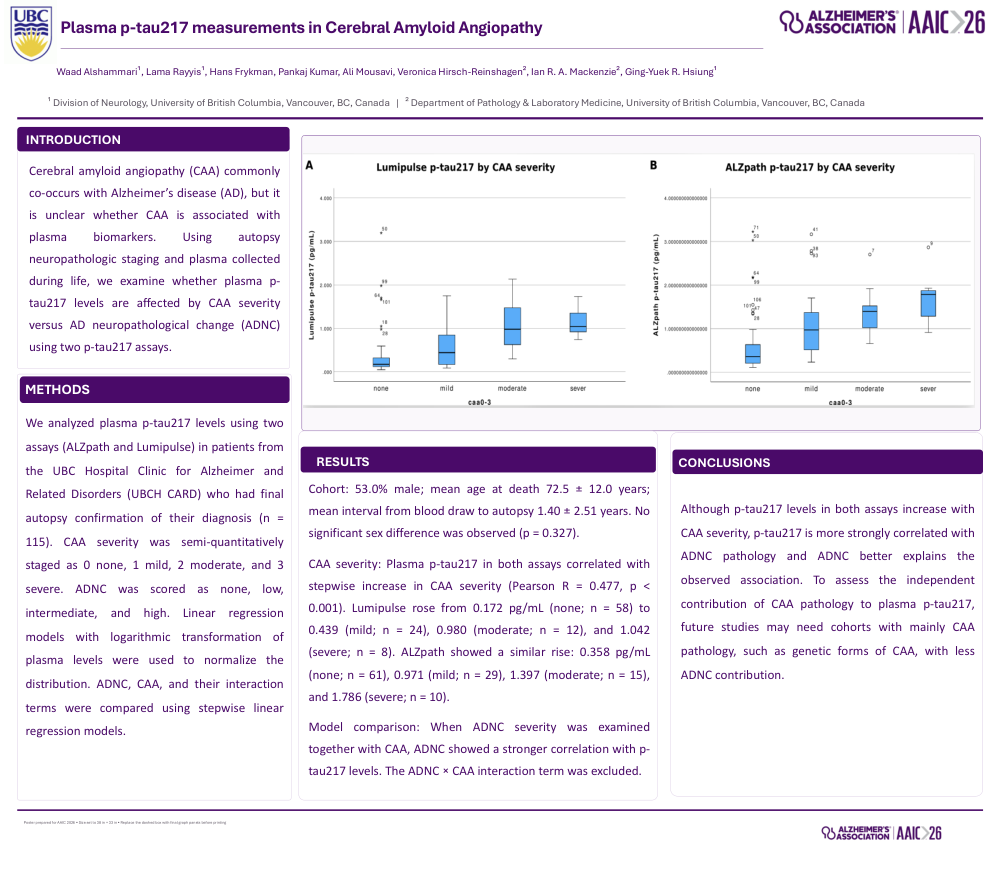
In this cohort, 53.0% were male with a mean age at death 72.5 ± 12.0 years. The mean interval from blood draw to autopsy was 1.40 ± 2.51 years. There is no significant differences between the sexes (p=0.327). Plasma p-tau217 in both assays were significantly correlated with stepwise increase in CAA severity (Pearson R =0.477, p<0.001). Lumipulse p-tau217 rose from 0.172 pg/mL (CAA none; n=58) to 0.439 (mild; n=24), 0.980 (moderate; n=12), and 1.042 (severe; n=8). ALZpath showed a similar graded rise: 0.358 pg/mL (none; n=61), 0.971 (mild; n=29), 1.397 (moderate; n=15), and 1.786 (severe; n=10). However, when ADNC severity were examined together with CAA, it provides a stronger correlation to p-tau217 levels, and the interaction term of ADNC by CAA was excluded.
Conclusion
While the p-tau217 levels in both assays increase with CAA severity, it is more strongly correlated with ADNC pathology and explains the correlation better. In order to assess the independent contribution of CAA pathology to plasma p-tau level, it may need to be examined in a cohort with mainly CAA pathology (i.e. genetic forms of CAA) with less ADNC contribution.
Comments
Email is required but is not shown publicly.
Loading comments...