4,068 posters, 219 videos, 101 topics, 69 sessions, 14,365 authors, 6,128 institutions
ePostersLive by SciGen Technologies S.A. All rights reserved.
Alzheimer's Association International Conference 2026
July 12-15, 2026 | London, United Kingdom, and Online

762
Explainable Machine Learning For Early Detection Of Mild Cognitive Impairment Via Self-administered Smartphone Assessment
Poster Presenter
Authors
Part of Topic
BACKGROUND AND OBJECTIVES
The earliest stages of cognitive impairment most the crucial points for intervention and careplanning, but also the hardest to detect. Up to 90% of MCI cases go unrecognized in primary care, the setting where the majority of older adults receive their healthcare. Primary care settings face logistical constraints that hinder routine screening practices--these settings lack well validated tools that are sensitive enough to detect early impairment yet fit seamlessly into clinical workflows.Longer cognitive assessments improve detection precision but increase patient burden and reduce completion, creating a trade-off between accuracy and feasibility. MyCog Mobile, an NIH-funded smartphone screener, was designed to address this gap: patients complete it on their own before a primary care visit, and results are delivered directly to the electronic health record (EHR). This study had two aims. The first was to develop and validate a parsimonious, clinically interpretable model that detects MCI from MyCog Mobile. The second was to reduce patient burden further through adaptive task administration without sacrificing accuracy.
SAMPLE AND MEASURES
The validation sample included 277 adults aged 65 and older. Of these, 100 had EHR-confirmed MCI, with advanced dementia excluded, and 177 were classified as normal cognitive aging on the basis of a Mini-Cog score of 3 or higher. All participants completed the assessment on study iPhones in a standardized environment. The battery comprised three task families: MySorting, a measure of executive function; MyFaces, a measure of associative memory administered in First Letter and Matching formats; and MyPictures, a measure of episodic memory administered as a practice trial followed by Trial 1 and Trial 2. Education was also included as a candidate predictor.
METHODS
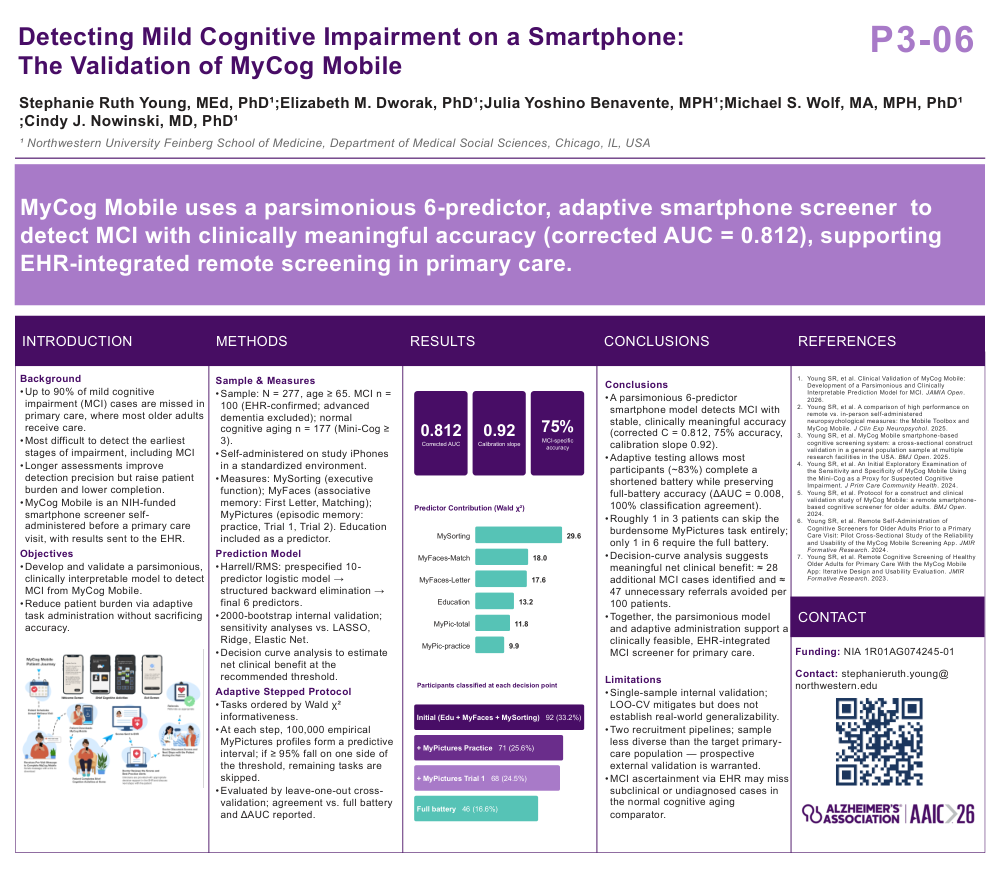
To build the prediction model, we began with a prespecified 10-predictor logistic model fit with the Harrell/RMS approach and reduced it through structured backward elimination to a final set of 6 predictors. The model was internally validated using 2,000 bootstrap resamples, with sensitivity analyses comparing performance against LASSO, Ridge, and Elastic Net, and decision curve analysis was used to estimate net clinical benefit at the recommended threshold. On top of this model, we developed an adaptive stepped protocol in which tasks are ordered by their Wald chi-square informativeness. At each step, 100,000 empirical MyPictures profiles form a predictive interval; if 95% or more of that interval falls on one side of the decision threshold, the remaining tasks are skipped. The adaptive protocol was evaluated using leave-one-out cross-validation, with agreement against the full battery and the change in AUC reported.
RESULTS
The final 6-predictor model performed well, achieving a corrected AUC of 0.812, a calibration slope of 0.92, and 75% MCI-specific accuracy. The predictors contributing most to the model, ranked by Wald chi-square, were MySorting (29.6%), MyFaces-Match (18.0%), and MyFaces-Letter (17.6%), followed by Education (13.2%), MyPictures-total (11.8%), and MyPictures-practice (9.9%). The adaptive protocol substantially reduced testing burden while preserving accuracy. Roughly one third of patients (33.2%) were classified after only the initial tasks (Education, Faces, and Sorting), and progressively fewer required additional steps: 25.6% after adding the practice trial, 24.5% after Trial 1, and only 16.6% needing the full battery. Across the sample, sensitivity, specificity, and accuracy under the adaptive protocol were identical to those of the full battery.
CONCLUSIONS
Taken together, these findings show that a simple, six-predictor smartphone model can detect MCI remotely with strong discrimination and calibration (corrected C = 0.812, 75% accuracy, calibration slope 0.92). Adaptive testing allows the majority of patients, about 83%, to complete a shortened battery while preserving full-battery accuracy, with a change in AUC of just 0.008 and 100% classification agreement. In practical terms, roughly 1 in 3 patients can skip the final task entirely and only 1 in 6 require the complete battery. Together, the parsimonious model and adaptive administration support a clinically feasible, EHR-integrated MCI screener suited to the realities of primary care.
LIMITATIONS
These results should be interpreted in light of two limitations. The study relied on single-sample internal validation drawn from two recruitment pipelines, so prospective external validation is warranted before broad deployment. In addition, because MCI was ascertained through the EHR, some subclinical or undiagnosed cases may have been missed in the normal cognitive aging comparator.
FUNDING AND CONTACT
This work was supported by NIA grant 1R01AG074245-01 and is described in further detail in JAMIA Open. Correspondence: stephanieruth.young@northwestern.edu.
Comments
Email is required but is not shown publicly.
Loading comments...