4,068 posters, 219 videos, 101 topics, 69 sessions, 14,365 authors, 6,128 institutions
ePostersLive by SciGen Technologies S.A. All rights reserved.
Alzheimer's Association International Conference 2026
July 12-15, 2026 | London, United Kingdom, and Online

3669
Correlations Between Alzheimer’s Disease And Inflammatory Plasma Biomarkers In Virologically Suppressed Older People With HIV
Poster Presenter
Authors
Akarin Hiransuthikul, Poosanu Thanapornsangsuth, Win Min Han, Watayuth Luechaipanit, Thanaporn Haethaisong, Sasiwimol Ubolyam, Tanakorn Apornpong, Stephen Kerr, Anchalee Avihingsanon
Affiliations
Department of Preventive and Social Medicine, Faculty of Medicine, Chulalongkorn University, Bangkok, Thailand, Thai Red Cross Emerging Infectious Diseases Health Science Centre, World Health Organization Collaborating Centre for Research and Training on Viral Zoonoses, King Chulalongkorn Memorial Hospital The Thai Red Cross Society, Bangkok, Thailand, Kirby Institute, UNSW Sydney, Sydney, Australia, HIVNAT, Thai Red Cross AIDS and Infectious Diseases Research Centre, Bangkok, Thailand, Biostatistics Excellence Centre, Faculty of Medicine, Chulalongkorn University, Bangkok, Thailand
Part of Topic
Background: Plasma-based biomarkers offer a promising and accessible approach for detecting Alzheimer’s disease (AD), including in older people with HIV (PWH). Emerging evidence in the general population suggests that systemic inflammation may contribute to AD-related biomarker changes, but data in PWH remain limited. We previously demonstrated that elevated plasma p-tau217 and GFAP predict cognitive decline in this population. Given the persistence of immune activation despite viral suppression in PWH, we aimed to examine correlations between AD-related and inflammatory plasma biomarkers among older PWH.
Method: PWH aged ≥50 years with plasma HIV RNA <50 copies/mL from the HIV-NAT 006 cohort, an ongoing cohort of adults living with HIV in Bangkok, Thailand, were included. Plasma AD biomarkers (p-tau217, GFAP, and NfL) and inflammatory biomarkers (CXCL-9, hs-CRP, IL-6, sCD14, and TNFR1) were measured cross-sectionally using samples collected at the same study visit as cognitive assessments. All biomarker values were log-transformed. Cognitive function was assessed using the Thai-validated Montreal Cognitive Assessment (MoCA), with scores ≥25 considered normal.
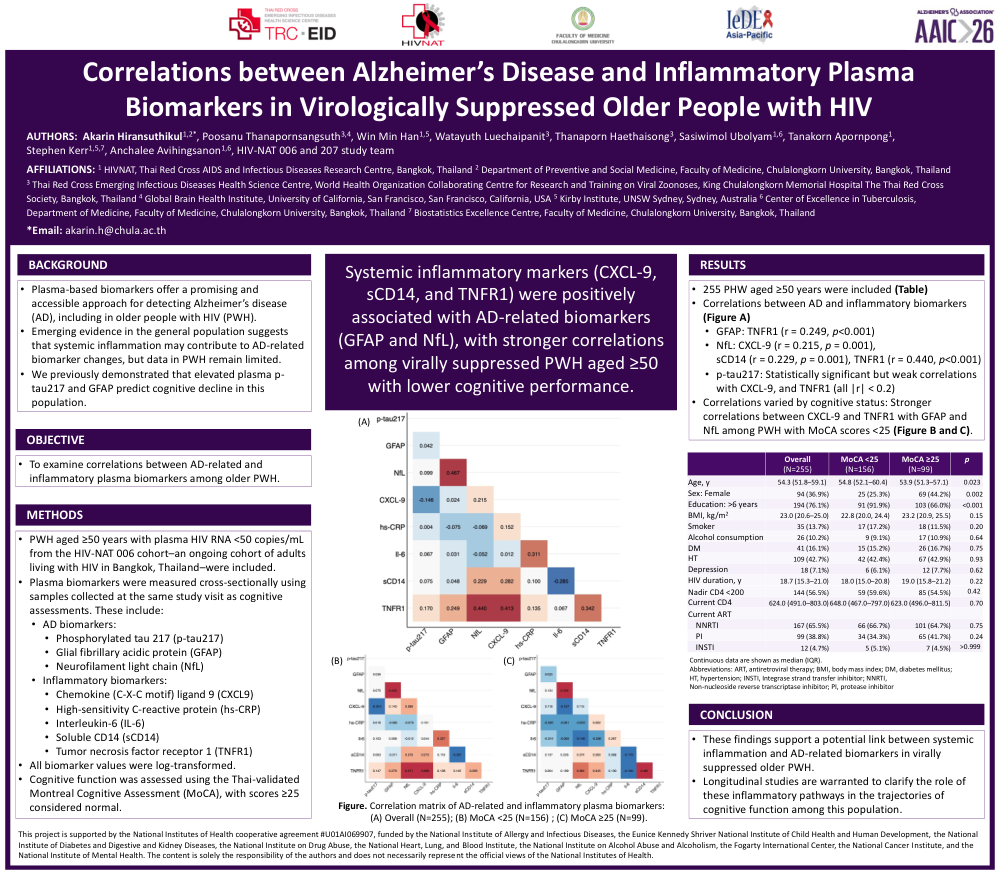
Result: Among 255 participants (36.9% female; mean [SD] age, 55.9 [5.2] years; 76.1% had >6 years of education; mean duration of HIV infection, 17.9 [4.8] years), 61.2% had MoCA scores <25. Among AD biomarkers, GFAP was positively correlated with NfL (r = 0.467, p<0.001). CXCL-9 (r = 0.215, p = 0.001) and sCD14 (r = 0.229, p = 0.001) were positively correlated with NfL. TNFR1 was positively correlated with both GFAP (r = 0.249, p<0.001) and NfL (r = 0.440, p<0.001). P-tau217 showed statistically significant but weak correlations with NfL, CXCL-9, and TNFR1 (all |r| < 0.2) (Figure). Stratified analyses suggested that the strength of correlations between AD and inflammatory markers varied by cognitive status, with stronger correlations between CXCL-9 and TNFR1 with GFAP and NfL among PWH with MoCA scores <25.
Conclusion: These findings support a potential link between systemic inflammation and AD-related biomarkers in virally suppressed older PWH. Longitudinal studies are warranted to clarify the role of these inflammatory pathways in the trajectories of cognitive function among this population.
Comments
Email is required but is not shown publicly.
Loading comments...