4,068 posters, 219 videos, 101 topics, 69 sessions, 14,365 authors, 6,128 institutions
ePostersLive by SciGen Technologies S.A. All rights reserved.
Alzheimer's Association International Conference 2026
July 12-15, 2026 | London, United Kingdom, and Online

2466
Plasma GFAP As A Predictor Of Mild Cognitive Impairment Progression In Cognitively Normal Older Adults
Poster Presenter
Authors
Jun Sung Kim, Dahyun Yi, Min Soo Byun, Hyejin Ahn, Gijung Jung, Yoonseok Oh, Woo-Jin Cha, Yura Choi, Jun-Young Lee, Koung Mi Kang, Chul-Ho Sohn, Yun-Sang Lee, Yu Kyeong Kim, Bo Kyung Sohn, Dong Young Lee, KBASE Research Group
Affiliations
, Institute of Human Behavioral Medicine, Seoul National University Medical Research Center, Seoul, 03082, Republic of Korea, Department of Neuropsychiatry, Seoul National University Hospital, Seoul, 03080, Republic of Korea, Interdisciplinary Program of Cognitive Science, Seoul National University College of Humanities, Seoul, 08826, Republic of Korea, Department of Psychiatry, Seoul National University College of Medicine, Seoul, 03082, Republic of Korea, Department of Radiology, Seoul National University Hospital, Seoul, 03080, Republic of Korea, Department of Nuclear Medicine, Seoul National University College of Medicine, Seoul, 03082, Republic of Korea, Department of Nuclear Medicine, SMG-SNU Boramae Medical Center, Seoul, 07061, Republic of Korea, Department of Psychiatry, Inje University Sanggye Paik Hospital, Seoul, 01757, Republic of Korea
Part of Topic
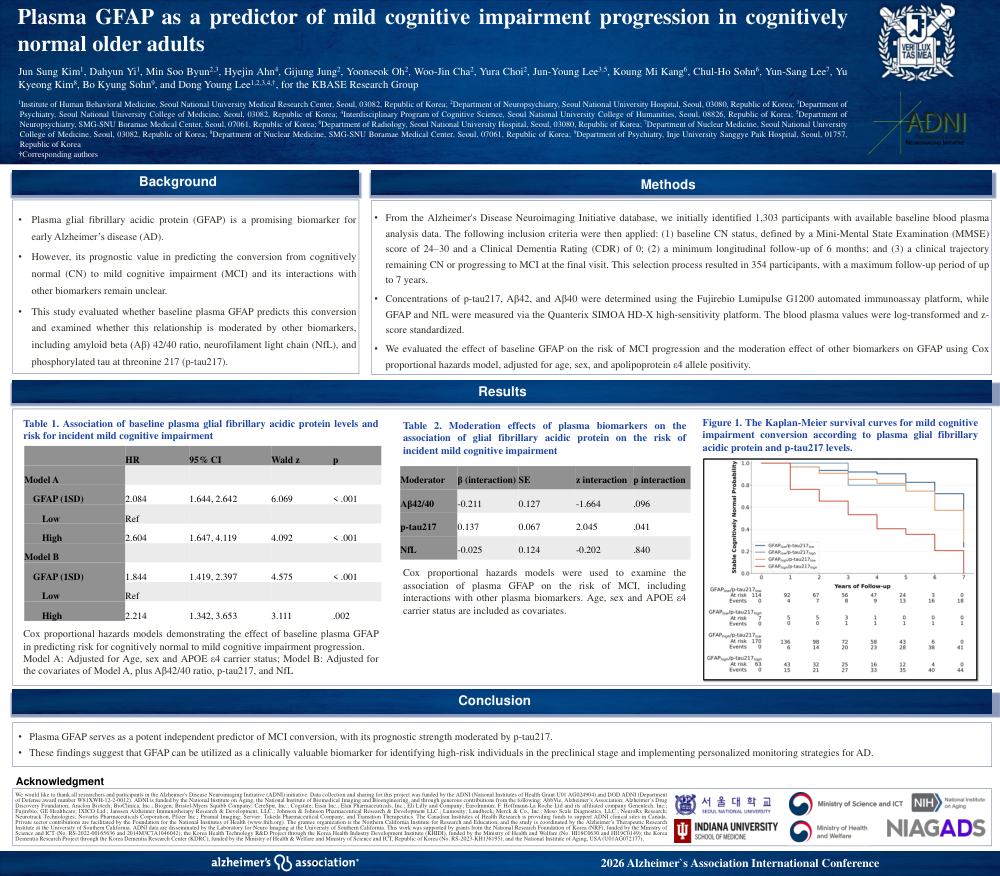
Background: While plasma glial fibrillary acidic protein (GFAP) is a promising biomarker for early Alzheimer’s disease (AD), its prognostic value in predicting the conversion from cognitively normal (CN) to mild cognitive impairment (MCI) and its interactions with other biomarkers remain unclear. This study evaluated whether baseline plasma GFAP predicts this conversion and examined whether this relationship is moderated by other biomarkers, including amyloid beta (Aβ) 42/40 ratio, neurofilament light chain (NfL), and phosphorylated tau at threonine 217 (p-tau217).
Methods: From the Alzheimer's Disease Neuroimaging Initiative database, we initially identified 1,303 participants with available baseline blood plasma analysis data. The following inclusion criteria were then applied: (1) a minimum follow-up period of 6 months with annually collected longitudinal data available; (2) a clinical diagnosis of CN at baseline; and (3) a clinical status that either remained CN at the final follow-up or progressed to MCI. This selection process resulted in 366 participants, with a maximum follow-up period of up to 15 years. The plasma samples were analyzed using Fujirebio and Quanterix assays. The blood plasma values were log-transformed and z-score standardized. We evaluated the effect of baseline GFAP on the risk of MCI progression and the moderation effect of other biomarkers on GFAP using Cox proportional hazards model, adjusted for age, sex, and apolipoprotein ε4 allele positivity.
Results: Baseline GFAP significantly predicted MCI conversion; each 1 SD increase was associated with a 90% higher risk (HR=1.904, 95% CI 1.527-2.373). These associations remained robust (HR=1.689, 95% CI 1.394-2.045) after adjusting for Aβ42/40 ratio, p-tau217, and NfL. Moreover, high GFAP levels (median split) were associated with a 2.2-fold higher risk compared with low GFAP. Notably, p-tau217 positively moderated the GFAP-MCI association (p=.033). In contrast, the plasma NfL and Aβ42/40 ratio did not moderate the association.
Conclusions: Plasma GFAP serves as a potent independent predictor of MCI conversion, with its prognostic strength moderated by p-tau217. These findings suggest that GFAP can be utilized as a clinically valuable biomarker for identifying high-risk individuals in the preclinical stage and implementing personalized monitoring strategies for AD.
Comments
Email is required but is not shown publicly.
Loading comments...