4,068 posters, 219 videos, 101 topics, 69 sessions, 14,365 authors, 6,128 institutions
ePostersLive by SciGen Technologies S.A. All rights reserved.
Alzheimer's Association International Conference 2026
July 12-15, 2026 | London, United Kingdom, and Online

4638
Advancing Global Health Equity: A Systematic Evaluation Of Ubiquitous AI Models For Prodromal AD Detection
Poster Presenter
Authors
Vinu Sherimon, Abraham Varghese, Sherimon P.C., Nandana Sheri
Affiliations
Department of Computing and Information Sciences, University of Technology and Applied Sciences, Muscat, Sultanate of Oman, Department of Supporting Requirements, University of Technology and Applied Sciences, Muscat, Sultanate of Oman, Faculty of Computer Studies, Arab Open University, Muscat, Sultanate of Oman, Computer Science and Engineering, University of Michigan, Ann Arbor, MI, USA
Part of Topic
Advancing Global Health Equity: A Systematic Evaluation of Ubiquitous AI Models for Prodromal AD Detection
Background
Despite Alzheimer’s disease is a global health problem, approximately 75% of cases remain undiagnosed worldwide. Current diagnosis such as PET scans are often invasive, and unavailable in rural areas lacking advanced clinical infrastructure. This disparity affects the prodromal stage of detection, when the early intervention is most effective. Ubiquitous devices equipped with advanced sensors can capture the behavioral changes in speech, movement, and ocular health of suspected AD patients. This review addresses the technical feasibility of using ubiquitous AI models to synthesize multi-modal sensor data and to fill the gap between the high-cost clinical infrastructure and accessible, high-impact care.
Method
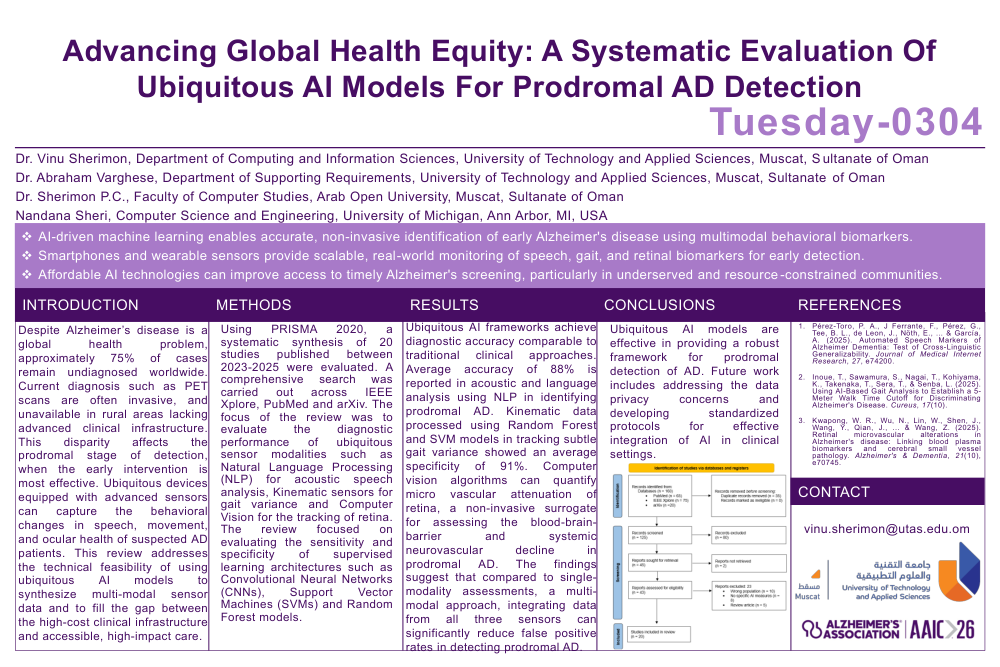
Using PRISMA 2020 (Figure 1), a systematic synthesis of 20 studies published between 2023-2025 were evaluated. A comprehensive search was carried out across IEEE Xplore, PubMed and arXiv. The focus of the review was to evaluate the diagnostic performance of ubiquitous sensor modalities such as Natural Language Processing (NLP) for acoustic speech analysis, Kinematic sensors for gait variance and Computer Vision for the tracking of retina. The review focused on evaluating the sensitivity and specificity of supervised learning architectures such as Convolutional Neural Networks (CNNs), Support Vector Machines (SVMs) and Random Forest models.
Results
Ubiquitous AI frameworks achieve diagnostic accuracy comparable to traditional clinical approaches. Average accuracy of 88% is reported in acoustic and language analysis using NLP in identifying prodromal AD. Kinematic data processed using Random Forest and SVM models in tracking subtle gait variance showed an average specificity of 91%. Computer vision algorithms can quantify micro-vascular attenuation of retina, a non-invasive surrogate for assessing the blood-brain-barrier and systemic neurovascular decline in prodromal AD. The findings suggest that compared to single-modality assessments, a multi-modal approach, integrating data from all three sensors can significantly reduce false-positive rates in detecting prodromal AD.
Conclusion
Ubiquitous AI models are effective in providing a robust framework for prodromal detection of AD. This type of approach directly advances Global Health Equity, requiring a scalable framework essential for quality care in underserved communities worldwide. Future work includes addressing the data privacy concerns and developing standardized protocols for effective integration of AI in clinical settings.
References
Pérez-Toro, P. A., J Ferrante, F., Pérez, G., Tee, B. L., de Leon, J., Nöth, E., ... & García, A. (2025). Automated Speech Markers of Alzheimer Dementia: Test of Cross-Linguistic Generalizability. Journal of Medical Internet Research, 27, e74200.
Inoue, T., Sawamura, S., Nagai, T., Kohiyama, K., Takenaka, T., Sera, T., & Senba, L. (2025). Using AI-Based Gait Analysis to Establish a 5-Meter Walk Time Cutoff for Discriminating Alzheimer's Disease. Cureus, 17(10).
Kwapong, W. R., Wu, N., Lin, W., Shen, J., Wang, Y., Qian, J., ... & Wang, Z. (2025). Retinal microvascular alterations in Alzheimer's disease: Linking blood plasma biomarkers and cerebral small vessel pathology. Alzheimer's & Dementia, 21(10), e70745.
Comments
Email is required but is not shown publicly.
Loading comments...