4,068 posters, 219 videos, 101 topics, 69 sessions, 14,365 authors, 6,128 institutions
ePostersLive by SciGen Technologies S.A. All rights reserved.
Alzheimer's Association International Conference 2026
July 12-15, 2026 | London, United Kingdom, and Online

10114
Investigating The Impact Of Neutrophil Inhibition On ARIA Incidence Following 3D6 Administration In Mice
Poster Presenter
Authors
Daniel Rivera, Abigail Wallace, Jessica Chalk, Erica Weekman, Donna Wilcock
Affiliations
Part of Topic
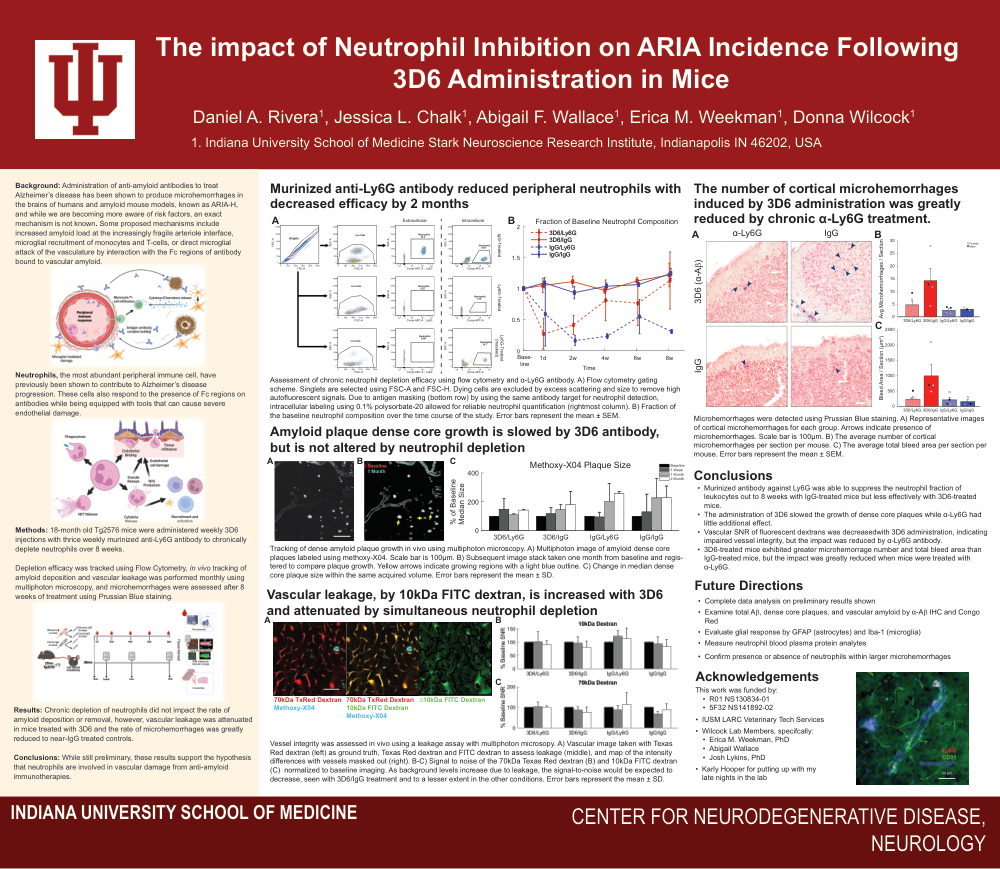
The impact of Neutrophil Inhibition on ARIA Incidence Following 3D6 Administration in Mice
Background: Administration of anti-amyloid antibodies to treat Alzheimer’s disease has been shown to produce microhemorrhages in the brains of humans and amyloid mouse models, known as ARIA-H, and while we are becoming more aware of risk factors, an exact mechanism is not known. Some proposed mechanisms include increased amyloid load at the increasingly fragile arteriole interface, microglial recruitment of monocytes and T-cells, or direct microglial attack of the vasculature by interaction with the Fc regions of antibody bound to vascular amyloid.
Neutrophils, the most abundant peripheral immune cell, have previously been shown to contribute to Alzheimer’s disease progression. These cells also respond to the presence of Fc regions on antibodies while being equipped with tools that can cause severe endothelial damage.
Methods: 18-month old Tg2576 mice were administered weekly 3D6 injections with thrice weekly murinized anti-Ly6G antibody to chronically deplete neutrophils over 8 weeks. Depletion efficacy was tracked using Flow Cytometry, in vivo tracking of amyloid deposition and vascular leakage was performed monthly using multiphoton microscopy, and microhemorrhages were assessed after 8 weeks of treatment using Prussian Blue staining.
Results: Chronic depletion of neutrophils did not impact the rate of amyloid deposition or removal, however, vascular leakage was attenuated in mice treated with 3D6 and the rate of microhemorrhages was greatly reduced to near-IgG treated controls.
Conclusions: While still preliminary, these results support the hypothesis that neutrophils are involved in vascular damage from anti-amyloid immunotherapies.
Comments
Email is required but is not shown publicly.
Loading comments...