4,068 posters, 219 videos, 101 topics, 69 sessions, 14,365 authors, 6,128 institutions
ePostersLive by SciGen Technologies S.A. All rights reserved.
Alzheimer's Association International Conference 2026
July 12-15, 2026 | London, United Kingdom, and Online

6388
Sex Differences In Fndc5/irisin-bdnf Levels And Correlations With Cognition And Alzheimer’S Biomarkers
Poster Presenter
Part of Topic
Sex Differences in FNDC5/Irisin-BDNF Levels and Correlations with Cognition and Alzheimer's Biomarkers
Fernanda G.Q. Barros-Aragão¹,², Felipe Ribeiro³, Bart Vanderborgh², Felipe Sudo², Mychael V. Lourenco³, Paulo Mattos², Sergio T. Ferreira²,³, Fernanda Tovar Moll², Fernanda De Felice¹,²
¹Queen's University, Kingston, Canada. ²D'Or Institute for Research and Education, Rio de Janeiro, Brazil. ³Federal University of Rio de Janeiro, Rio de Janeiro, Brazil.
Background & Rationale Women are disproportionately affected by Alzheimer's disease (AD) by mechanisms not fully understood. Physical exercise reduces AD risk partially by the upregulation of the peptide hormone FNDC5/irisin, which modulates inflammation and enhances Brain-Derived Neurotrophic Factor (BDNF) expression in the brain.
Main question: Do biological sex and menopause modulate this axis in the aging human brain?
Objective: Here, we compared cerebrospinal fluid (CSF) FNDC5/irisin and BDNF levels in aging post-menopausal women and men, and correlated them with cognitive outcomes and systemic inflammatory biomarkers.
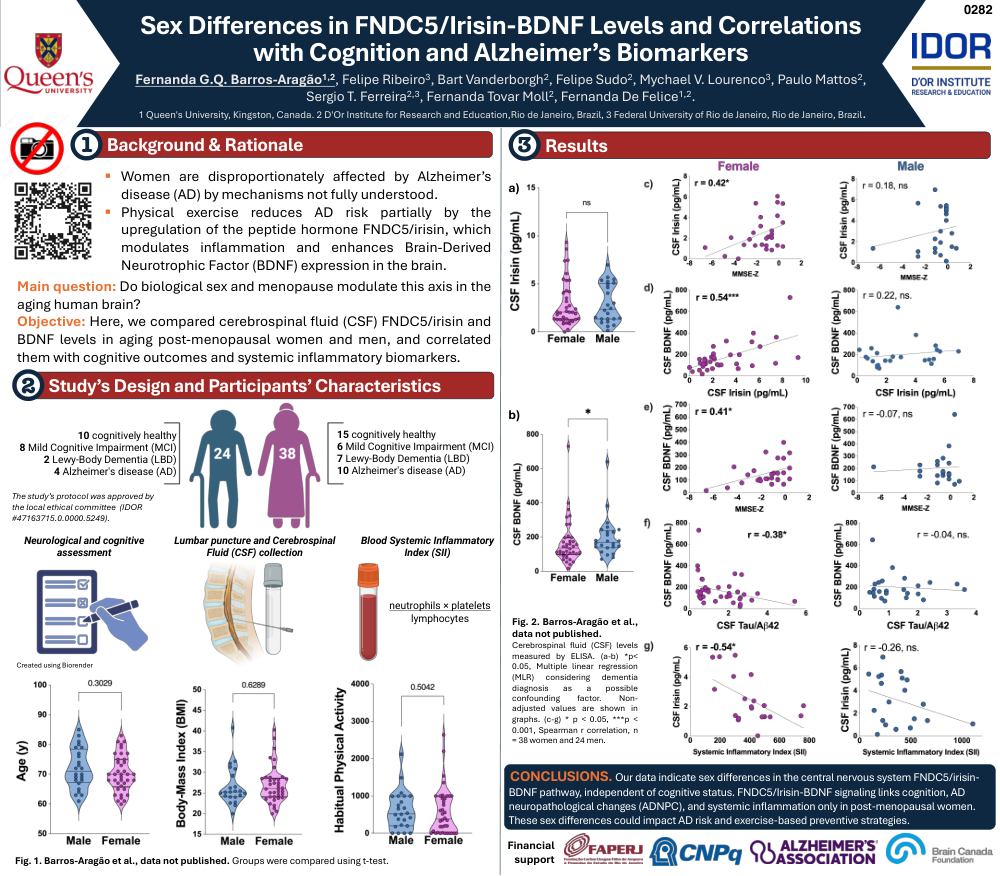
Study Design and Participants' Characteristics Participants underwent neurological and cognitive assessment, lumbar puncture for cerebrospinal fluid (CSF) collection, and blood collection for the Systemic Inflammatory Index (SII; neutrophils × platelets / lymphocytes).
Male group (n=24): 10 cognitively healthy, 8 Mild Cognitive Impairment (MCI), 2 Lewy-Body Dementia (LBD), 4 Alzheimer's disease (AD).
Female group (n=38): 15 cognitively healthy, 6 Mild Cognitive Impairment (MCI), 7 Lewy-Body Dementia (LBD), 10 Alzheimer's disease (AD).
No significant differences were found between groups in age, body-mass index (BMI), or habitual physical activity.
The study's protocol was approved by the local ethical committee (IDOR #47163715.0.0000.5249).
Results CSF levels were measured by ELISA. CSF BDNF levels were significantly higher in males compared to females, while CSF irisin levels did not differ significantly between sexes (multiple linear regression considering dementia diagnosis as a possible confounding factor).
In women, CSF irisin correlated positively with CSF BDNF (r = 0.54, p < 0.001), and with MMSE-Z scores (r = 0.42, p < 0.05). CSF BDNF also correlated positively with MMSE-Z (r = 0.41, p < 0.05) and negatively with CSF Tau/Aβ42 ratio (r = -0.38, p < 0.05). CSF irisin correlated negatively with the Systemic Inflammatory Index (SII) (r = -0.54, p < 0.05).
In men, none of these correlations reached statistical significance (CSF irisin vs. BDNF: r = 0.22, ns; CSF irisin vs. MMSE-Z: r = 0.18, ns; CSF BDNF vs. MMSE-Z: r = -0.07, ns; CSF BDNF vs. Tau/Aβ42: r = -0.04, ns; CSF irisin vs. SII: r = -0.26, ns).
Spearman r correlations, n = 38 women and 24 men.
Conclusions Our data indicate sex differences in the central nervous system FNDC5/irisin-BDNF pathway, independent of cognitive status. FNDC5/Irisin-BDNF signaling links cognition, AD neuropathological changes (ADNPC), and systemic inflammation only in post-menopausal women. These sex differences could impact AD risk and exercise-based preventive strategies.
Financial support: FAPERJ, CNPq, Alzheimer's Association, Brain Canada Foundation
Comments
Email is required but is not shown publicly.
Loading comments...