4,068 posters, 219 videos, 101 topics, 69 sessions, 14,365 authors, 6,128 institutions
ePostersLive by SciGen Technologies S.A. All rights reserved.
Alzheimer's Association International Conference 2026
July 12-15, 2026 | London, United Kingdom, and Online

5344
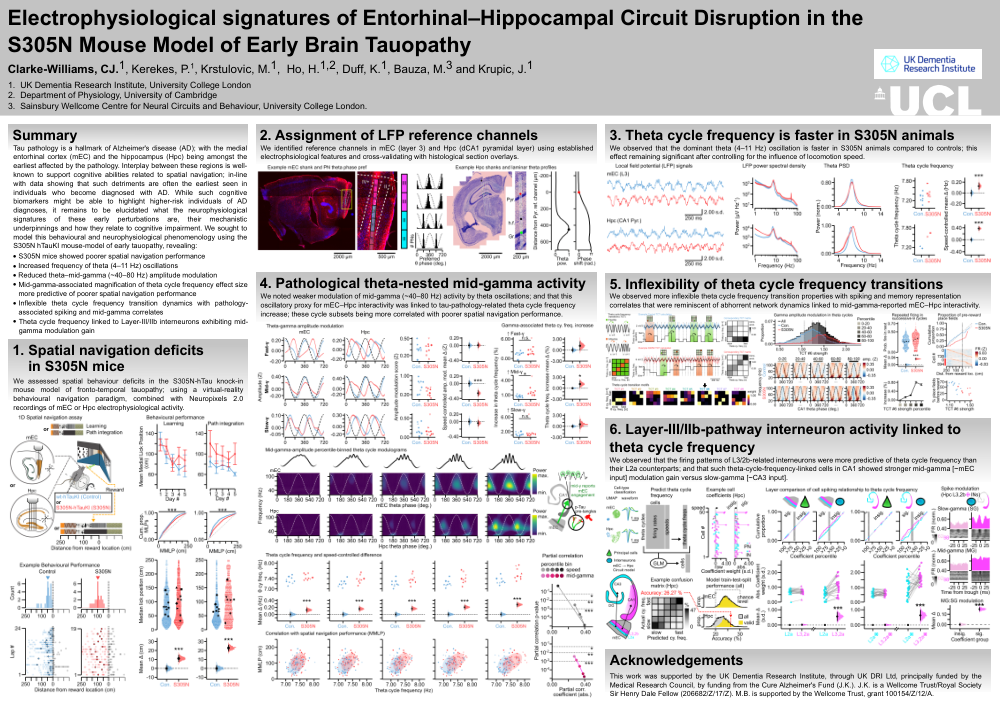
Electrophysiological Signatures Of Circuit-specific Disruption In The S305N Mouse Model Of Early Brain Tauopathy
Poster Presenter
Authors
Charlie Clarke-Williams, Pauline Kerekes, Marino Krstulovic, Hinze Ho, Karen Duff, Marius Bauza, Julija Krupic
Affiliations
UK Dementia Research Institute, UCL, Department of Physiology, University of Cambridge, UK Dementia Research Institute, UCL; Department of Physiology, University of Cambridge, Sainsbury Wellcome Centre for Neural Circuits and Behaviour, UCL
Part of Topic
Tau pathology is a hallmark of Alzheimer's disease (AD); with the medial entorhinal cortex (mEC) and the hippocampus (Hpc) being amongst the earliest affected by the pathology. Interplay between these regions is wellknown to support cognitive abilities related to spatial navigation; in-line with data showing that such detriments are often the earliest seen in individuals who become diagnosed with AD. While such cognitive biomarkers might be able to highlight higher-risk individuals of AD diagnoses, it remains to be elucidated what the neurophysiological signatures of these early perturbations are, their mechanistic underpinnings and how they relate to cognitive impairment. We sought to model this behavioural and neurophysiological phenomenology using the S305N hTauKI mouse-model of early tauopathy, revealing: • S305N mice showed poorer spatial navigation performance •Increased frequency of theta (4–11 Hz) oscillations • Reduced theta–mid-gamma (~40–80 Hz) amplitude modulation Mid-gamma-associated magnification of theta cycle frequency effect size more predictive of poorer spatial navigation performance • Inflexible theta cycle frequency transition dynamics with pathologyassociated spiking and mid-gamma correlates • Theta cycle frequency linked to Layer-III/IIb interneurons exhibiting midgamma modulation gain
Comments
Email is required but is not shown publicly.
Loading comments...