4,068 posters, 219 videos, 101 topics, 69 sessions, 14,365 authors, 6,128 institutions
ePostersLive by SciGen Technologies S.A. All rights reserved.
Alzheimer's Association International Conference 2026
July 12-15, 2026 | London, United Kingdom, and Online

765
Dementia Etiology Classification Using Nulisa Plasma Biomarkers And Machine Learning
Poster Presenter
Authors
Kelly N. DuBois, Subhamoy Pal, Amanda Cook Maher, Judith Heidebrink, Carol Persad, Bruno Giordani, Benjamin M. Hampstead, Kelly M. Bakulski, David G. Morgan, Nicholas M. Kanaan
Affiliations
Department of Translational Neuroscience, College of Human Medicine, Michigan State University; Michigan Alzheimer's Disease Research Center, University of Michigan, Michigan Alzheimer's Disease Research Center, University of Michigan, Michigan Alzheimer's Disease Research Center, University of Michigan; Department of Psychiatry, University of Michigan, Michigan Alzheimer's Disease Research Center, University of Michigan; Department of Neurology, University of Michigan, Department of Psychiatry, University of Michigan, Michigan Alzheimer's Disease Research Center, University of Michigan; Research Program on Cognition and Neuromodulation Based Interventions, Department of Psychiatry and Neurology, University of Michigan; VA Ann Arbor Healthcare System, Neuropsychology Section, Mental Health Services, Department of Translational Neuroscience, College of Human Medicine, Michigan State University; Michigan Alzheimer's Disease Research Center, University of Michigan; Neuroscience Program, Michigan State University
Part of Topic
Video
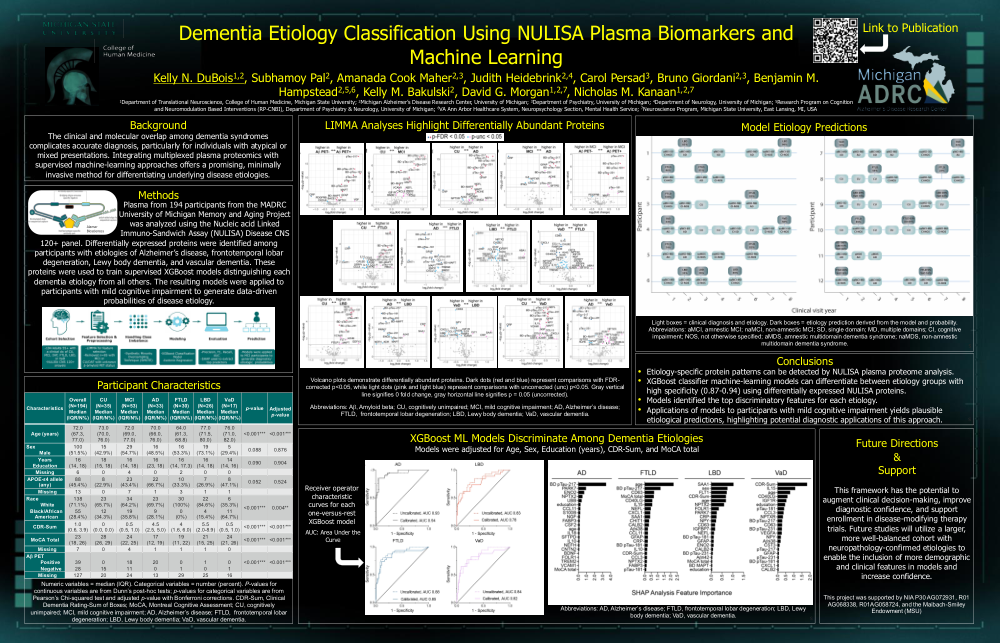
Background: Accurate antemortem differentiation among dementia etiologies remains challenging, particularly for atypical or mixed clinical presentations. Multiplexed plasma proteomics paired with supervised machine learning offers a minimally invasive and accessible approach for differential diagnosis.
Methods: Plasma from 194 participants was analyzed using the NULISA CNS 120+ plasma biomarker panel. Differentially abundant protein patterns associated with AD, frontotemporal lobar degeneration, Lewy body disease, and vascular disease were identified. These features were used to train supervised XGBoost classifier models. Models were then applied to participants with mild cognitive impairment to generate data-driven predictions of etiology.
Results: NULISA plasma biomarkers revealed disease-specific protein patterns. XGBoost classifiers differentiated disease etiologies with high specificity. Application of the models to participants with mild cognitive impairment yielded robust etiologic predictions.
Conclusion: These results support the feasibility of using multiplexed NULISA plasma proteomics, combined with machine learning, for differential diagnosis of complex neurodegenerative dementia etiologies.
Comments
Email is required but is not shown publicly.
Loading comments...