4,068 posters, 219 videos, 101 topics, 69 sessions, 14,365 authors, 6,128 institutions
ePostersLive by SciGen Technologies S.A. All rights reserved.
Alzheimer's Association International Conference 2026
July 12-15, 2026 | London, United Kingdom, and Online

5827
SAA Mice Exhibit Characteristics Of Cerebral Amyloid Angiopathy And Vascular Deficits Across Amyloid Progression
Poster Presenter
Authors
Affiliations
Part of Topic
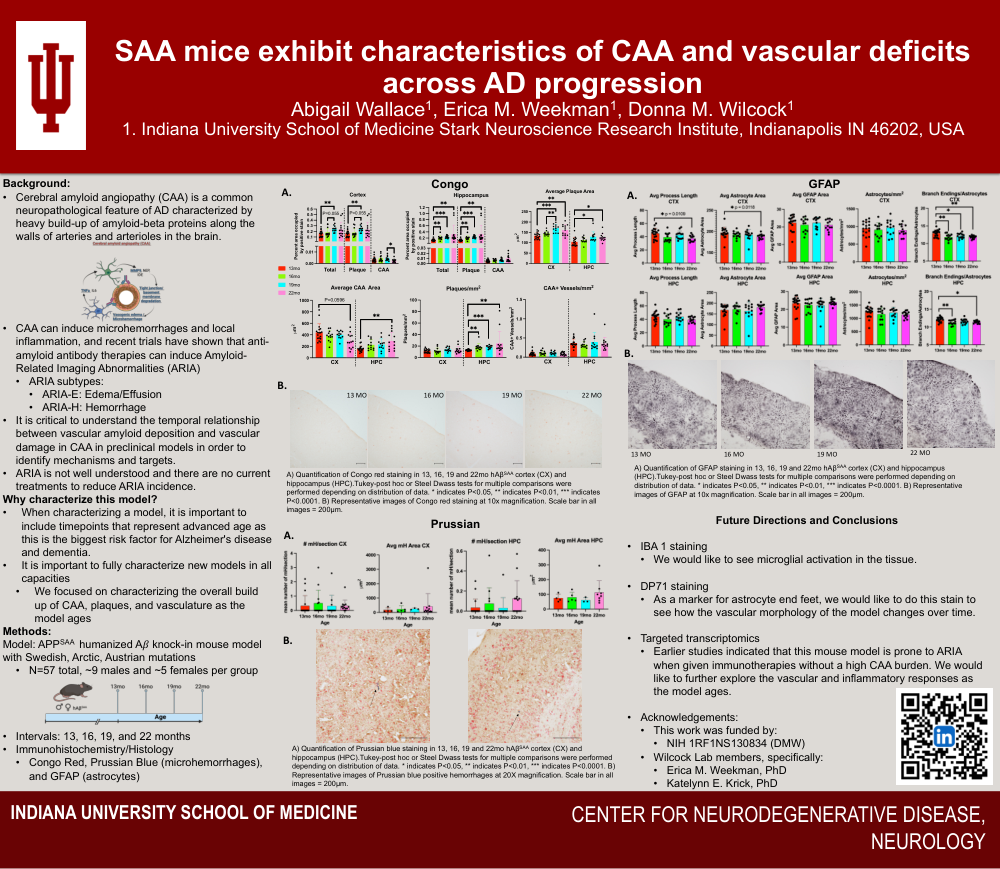
Background: Recent studies have implicated vascular contributions to cognitive impairment and dementia (VCID) as a critical pathological feature of Alzheimer's disease (AD) and dementia, highlighting the critical importance of understanding the mechanisms underlying vascular damage in AD. Important in the development of VCID in AD is cerebral amyloid angiopathy (CAA), a common neuropathological feature of AD characterized by heavy build-up of amyloid-beta proteins along the walls of arteries and arterioles in the brain. CAA can induce microhemorrhages and local inflammation, and recent trials have shown that anti-amyloid antibody therapies can induce Amyloid-Related Imaging Abnormalities (ARIA) with CAA being a significant risk factor for development of ARIA. It is critical to understand the temporal relationship between vascular amyloid deposition and vascular damage in CAA in preclinical models in order to identify mechanisms and targets. To attempt to achieve this goal, we assessed CAA progression at four time points in the hAβSAA KI mouse model.
Methods: A common contributing factor of ARIA is CAA, characterized by microhemorrhages and amyloid-beta plaque deposits surrounding the vasculature. In order to discern the longitudinal pathologies associated with CAA, we selected the hAβSAA KI mouse model. To create a clear timeline of the growth of CAA, we assessed microhemorrhages with Prussian blue and dense plaques with Congo red at 13, 16, 19, and 22 months of age with an N of 13-18 (male and female) per group.
Results: Preliminary results indicate an increase of dense plaques with advancing age with CAA present in the cortex. However, microhemorrhage occurrence in both the cortex and hippocampus does not increase with age. Ongoing work will identify associated glial and inflammatory changes associated with plaque and CAA deposition across middle to late amyloid pathology.
Conclusion: CAA is a critical component of AD and is associated with ARIA and VCID. However, how CAA develops and contributes to vascular damage across disease progression is unclear. Here we used a humanized amyloidogenic knock-in mouse model to characterize the growth of vascular deposition and microhemorrhages to provide a more robust timeline for the study of CAA in vivo.
Comments
Email is required but is not shown publicly.
Loading comments...