4,068 posters, 219 videos, 101 topics, 69 sessions, 14,365 authors, 6,128 institutions
ePostersLive by SciGen Technologies S.A. All rights reserved.
Alzheimer's Association International Conference 2026
July 12-15, 2026 | London, United Kingdom, and Online

9448
Convergent Proteomic Signatures Across Human Neuronal Models Of Alzheimer’s Disease
Poster Presenter
Part of Topic
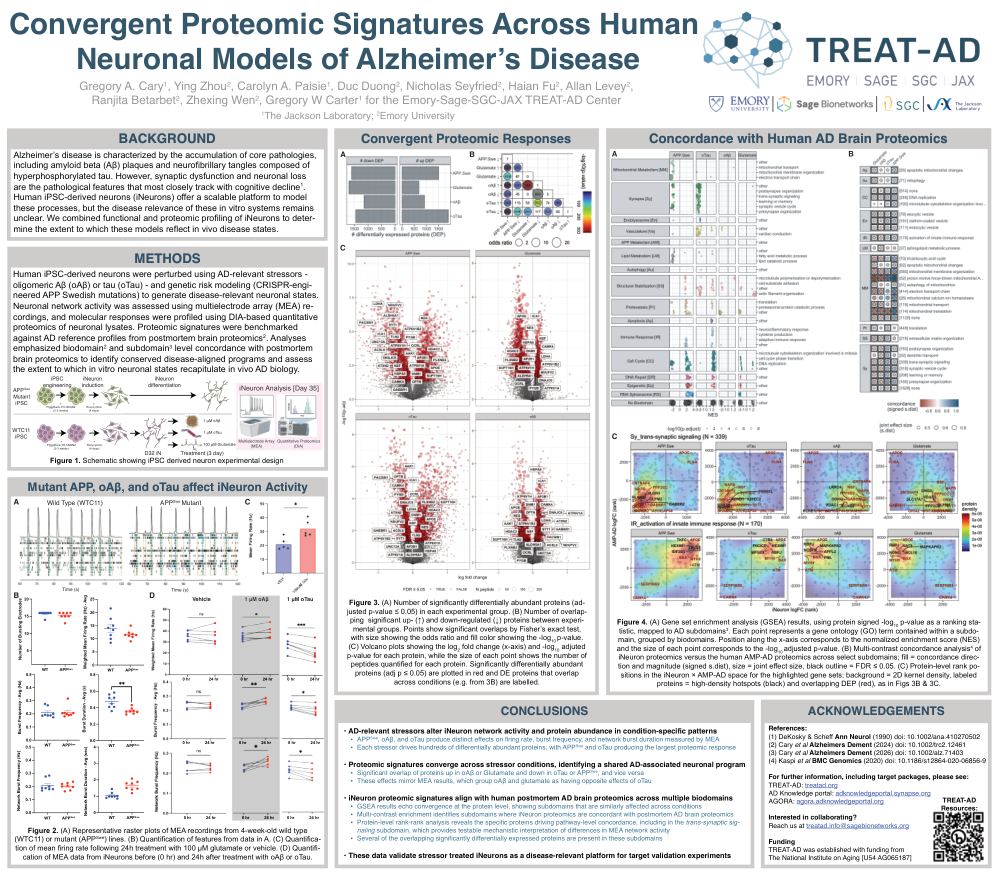
Background: Alzheimer’s disease is characterized by the accumulation of core pathologies, including amyloid beta (Aβ) plaques and neurofibrillary tangles composed of hyperphosphorylated tau. However, synaptic dysfunction and neuronal loss are the pathological features that most closely track with cognitive decline1. Human iPSC-derived neurons (iNeurons) offer a scalable platform to model these processes, but the disease relevance of these in vitro systems remains unclear. We combined functional and proteomic profiling of iNeurons to determine the extent to which these models reflect in vivo disease states.
Methods: Human iPSC-derived neurons were perturbed using AD-relevant stressors - oligomeric Aβ (oAβ) or tau (oTau) - and genetic risk modeling (CRISPR-engineered APP Swedish mutations) to generate disease-relevant neuronal states. Neuronal network activity was assessed using multielectrode array (MEA) recordings, and molecular responses were profiled using DIA-based quantitative proteomics of neuronal lysates. Proteomic signatures were benchmarked against AD reference profiles from postmortem brain proteomics2. Analyses emphasized biodomain2 and subdomain3 level concordance with postmortem brain proteomics to identify conserved disease-aligned programs and assess the extent to which in vitro neuronal states recapitulate in vivo AD biology.
Conclusions:
1. AD-relevant stressors alter iNeuron network activity and protein abundance in condition-specific patterns
- APPSwe, oAβ, and oTau produce distinct effects on firing rate, burst frequency, and network burst duration measured by MEA
- Each stressor drives hundreds of differentially abundant proteins, with APPSwe and oTau producing the largest proteomic response
2. Proteomic signatures converge across stressor conditions, identifying a shared AD-associated neuronal program
- Significant overlap of proteins up in oAβ or Glutamate and down in oTau or APPSwe, and vice versa
- These effects mirror MEA results, which group oAβ and glutamate as having opposite effects of oTau
3. iNeuron proteomic signatures align with human postmortem AD brain proteomics across multiple biodomains
- GSEA results echo convergence at the protein level, showing subdomains that are similarly affected across conditions
- Multi-contrast enrichment identifies subdomains where iNeuron proteomics are concordant with postmortem AD brain proteomics
- Protein-level rank-rank analysis reveals the specific proteins driving pathway-level concordance, including in the trans-synaptic signaling subdomain, which provides testable mechanistic interpretation of differences in MEA network activity
- Several of the overlapping significantly differentially expressed proteins are present in these subdomains
4. These data validate stressor treated iNeurons as a disease-relevant platform for target validation experiments
Comments
Email is required but is not shown publicly.
Loading comments...