4,068 posters, 219 videos, 101 topics, 69 sessions, 14,365 authors, 6,128 institutions
ePostersLive by SciGen Technologies S.A. All rights reserved.
Alzheimer's Association International Conference 2026
July 12-15, 2026 | London, United Kingdom, and Online

10980
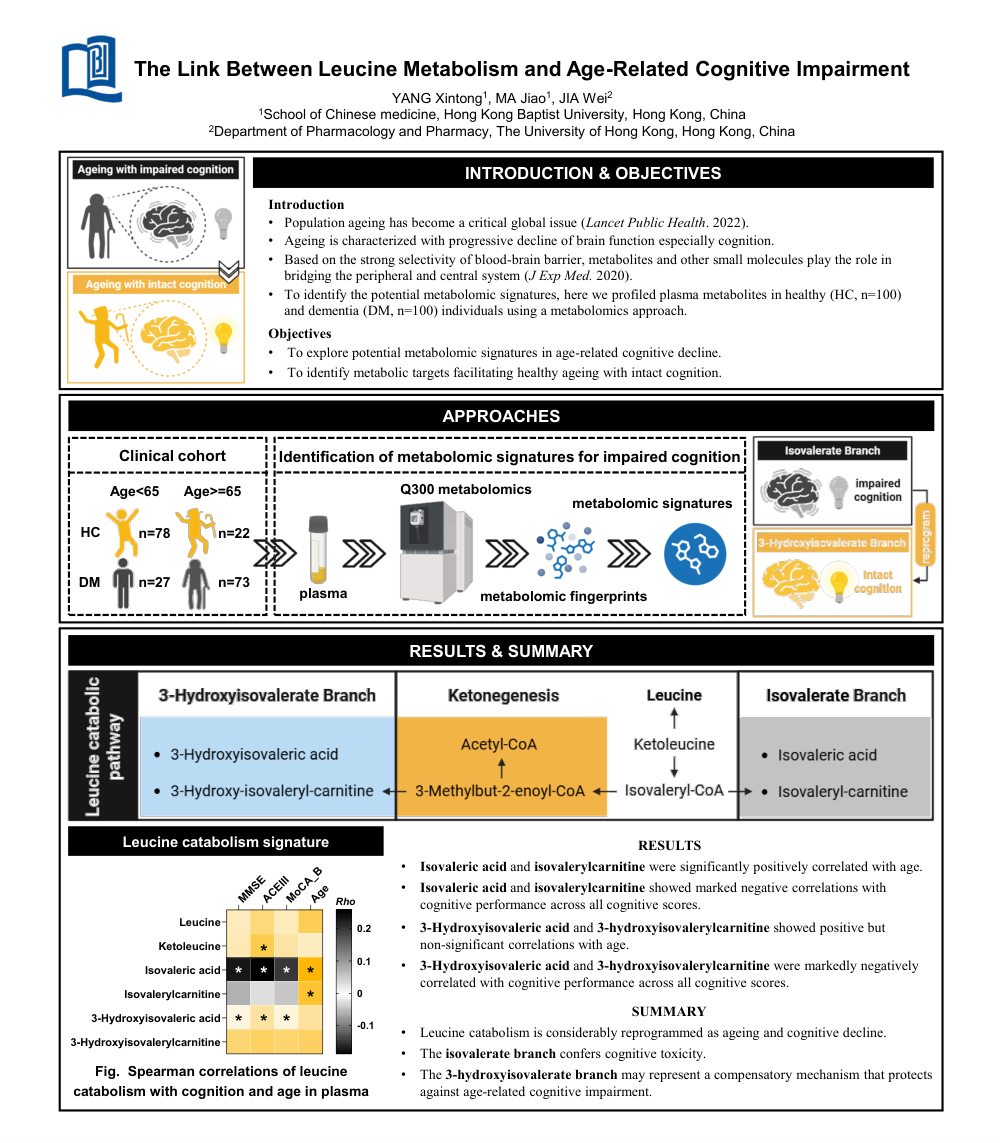
The Link Between Leucine Metabolism And Age-related Cognitive Impairment
Poster Presenter
Authors
Affiliations
Part of Topic
Introduction
•Population ageing has become a critical global issue (Lancet Public Health. 2022).
•Ageing is characterized with progressive decline of brain function especially cognition.
•Based on the strong selectivity of blood-brain barrier, metabolites and other small molecules play the role in bridging the peripheral and central system (J Exp Med. 2020).
•To identify the potential metabolomic signatures, here we profiled plasma metabolites in healthy (HC, n=100) and dementia (DM, n=100) individuals using a metabolomics approach.
Objectives
•To explore potential metabolomic signatures in age-related cognitive decline.
To identify metabolic targets facilitating healthy ageing with intact cognition
RESULTS
•Isovaleric acid and isovalerylcarnitine were significantly positively correlated with age.
•Isovaleric acid and isovalerylcarnitine showed marked negative correlations with cognitive performance across all cognitive scores.
•3-Hydroxyisovaleric acid and 3-hydroxyisovalerylcarnitine showed positive but non‑significant correlations with age.
•3-Hydroxyisovaleric acid and 3-hydroxyisovalerylcarnitine were markedly negatively correlated with cognitive performance across all cognitive scores.
SUMMARY
•Leucine catabolism is considerably reprogrammed as ageing and cognitive decline.
•The isovalerate branch confers cognitive toxicity.
•The 3-hydroxyisovalerate branch may represent a compensatory mechanism that protects against age-related cognitive impairment.
Comments
Email is required but is not shown publicly.
Loading comments...