4,068 posters, 219 videos, 101 topics, 69 sessions, 14,365 authors, 6,128 institutions
ePostersLive by SciGen Technologies S.A. All rights reserved.
Alzheimer's Association International Conference 2026
July 12-15, 2026 | London, United Kingdom, and Online

9277
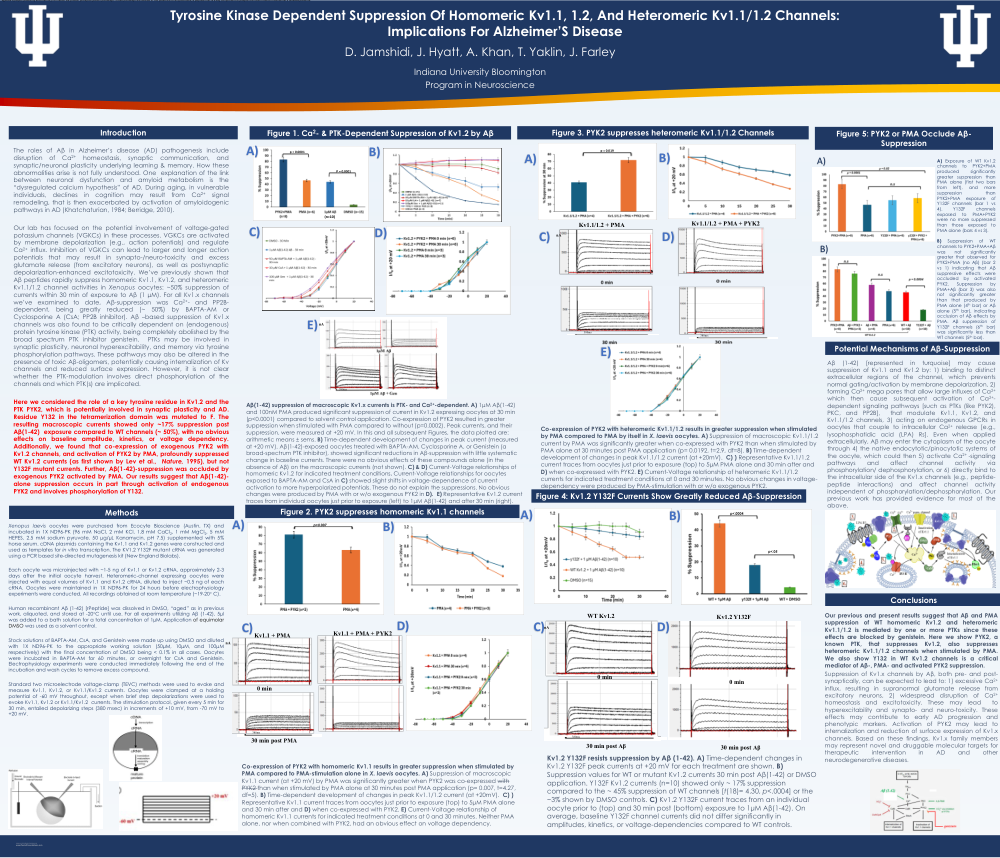
Tyrosine Kinase Dependent Suppression Of Homomeric Kv1.1, 1.2, And Heteromeric Kv1.1/1.2 Channels: Implications For Alzheimer’S Disease
Poster Presenter
Authors
Dina Jamshidi, Jack Hyatt, Aiza Khan, Tristan Yaklin, Joseph Farley
Affiliations
null,
Part of Topic
The roles of Aβ in Alzheimer’s disease (AD) pathogenesis include disruption of Ca2+ homeostasis, synaptic communication, and synaptic/neuronal plasticity underlying learning & memory. How these abnormalities arise is not fully understood. One explanation of the link between neuronal dysfunction and amyloid metabolism is the “dysregulated calcium hypothesis” of AD. During aging, in vulnerable individuals, declines in cognition may result from Ca2+ signal remodeling, that is then exacerbated by activation of amyloidogenic pathways in AD (Khatchaturian, 1984; Berridge, 2010).
Our lab has focused on the potential involvement of voltage-gated potassium channels (VGKCs) in these processes. VGKCs are activated by membrane depolarization (e.g., action potentials) and regulate Ca2+ influx. Inhibition of VGKCs can lead to larger and longer action potentials that may result in synapto-/neuro-toxicity and excess glutamate release (from excitatory neurons), as well as postsynaptic depolarization-enhanced excitotoxicity. We’ve previously shown that Aβ peptides rapidly suppress homomeric Kv1.1, Kv1.2, and heteromeric Kv1.1/1.2 channel activities in Xenopus oocytes: ~50% suppression of currents within 30 min of exposure to Aβ (1 μM). For all Kv1.x channels we’ve examined to date, Aβ-suppression was Ca2+- and PP2B-dependent, being greatly reduced (~ 50%) by BAPTA-AM or Cyclosporine A (CsA; PP2B inhibitor). Aβ –based suppression of Kv1.x channels was also found to be critically dependent on (endogenous) protein tyrosine kinase (PTK) activity, being completely abolished by the broad spectrum PTK inhibitor genistein. PTKs may be involved in synaptic plasticity, neuronal hyperexcitability, and memory via tyrosine phosphorylation pathways. These pathways may also be altered in the presence of toxic Aβ-oligomers, potentially causing internalization of Kv channels and reduced surface expression. However, it is not clear whether the PTK-modulation involves direct phosphorylation of the channels and which PTK(s) are implicated.
Here we considered the role of a key tyrosine residue in Kv1.2 and the PTK PYK2, which is potentially involved in synaptic plasticity and AD. Residue Y132 in the tetramerization domain was mutated to F. The resulting macroscopic currents showed only ~17% suppression post Aβ(1-42) exposure compared to WT channels (~ 50%), with no obvious effects on baseline amplitude, kinetics, or voltage dependency. Additionally, we found that co-expression of exogenous PYK2 with Kv1.2 channels, and activation of PYK2 by PMA, profoundly suppressed WT Kv1.2 currents (as first shown by Lev et al., Nature, 1995), but not Y132F mutant currents. Further, Aβ(1-42)-suppression was occluded by exogenous PYK2 activated by PMA. Our results suggest that Aβ(1-42)-alone suppression occurs in part through activation of endogenous PYK2 and involves phosphorylation of Y132.
Comments
Email is required but is not shown publicly.
Loading comments...