4,068 posters, 219 videos, 101 topics, 69 sessions, 14,365 authors, 6,128 institutions
ePostersLive by SciGen Technologies S.A. All rights reserved.
Alzheimer's Association International Conference 2026
July 12-15, 2026 | London, United Kingdom, and Online

2234
Beyond the plasma membrane: subcellular distribution of ADAM10 in human cortical neurons
Poster Presenter
Authors
Part of Topic
Title:Beyond the plasma membrane: subcellular distribution of ADAM10 in human cortical neurons
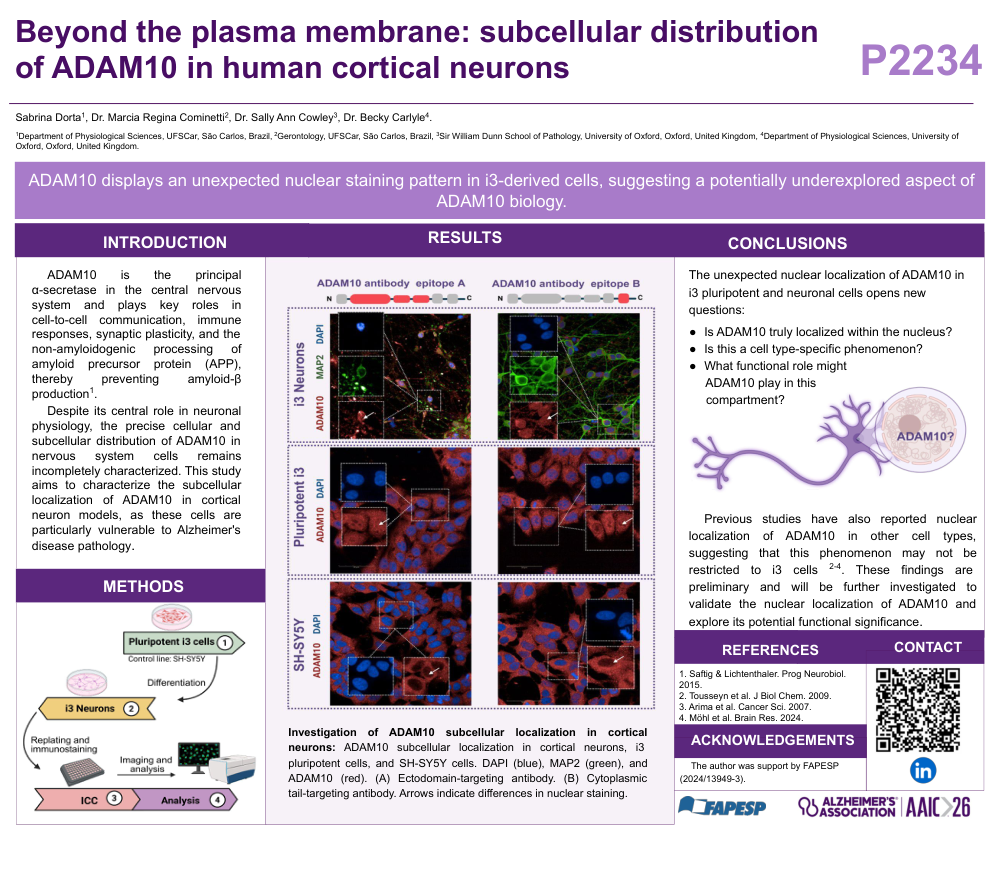
Background:ADAM10 is the principal α-secretase in the central nervous system, regulating the proteolytic shedding of numerous membrane proteins involved in neurogenesis, synaptic plasticity, and neuroinflammation. Its non-amyloidogenic cleavage of the amyloid precursor protein (APP) has positioned ADAM10 as a key molecule of interest in Alzheimer’s disease (AD). However, despite extensive investigation, evidence for consistent alterations in ADAM10 expression in AD remains inconclusive, suggesting that factors beyond protein abundance may critically modulate its function. ADAM10 activity is tightly regulated by intracellular trafficking and subcellular localization, and its mislocalization at postsynaptic compartments has been linked to synaptic dysfunction in other neurodegenerative conditions. Nevertheless, the cellular and subcellular distribution of ADAM10 across the brain regions and neural cell types remains incompletely characterized. This study aims to characterize the subcellular localization of ADAM10 in cortical neuron models, as these cells are particularly vulnerable to Alzheimer's disease pathology.
Results: Preliminary analyses revealed that ADAM10 exhibited a widespread intracellular distribution in iPSCs and 7-day-old iPSC-derived i3 cortical neurons, extending across the soma and including nuclear compartments. In contrast, SH-SY5Y cells showed a more restricted pattern, with ADAM10 primarily detected at the plasma membrane and within the cytoplasm.
Conclusion: Together, these findings demonstrate cell type–specific ADAM10 subcellular localization, supporting a potential nuclear role in iPSCs and cortical neurons. Ongoing studies combining ADAM10 knockout and C-terminal deletion models with proteomic approaches will assess how this domain influences substrate profiles and downstream mechanisms. In parallel, mass spectrometry–based analyses will be used to evaluate whether ADAM10 is present in nuclear compartments; if confirmed, this may expand understanding of context-dependent ADAM10 functions.
Comments
Email is required but is not shown publicly.
Loading comments...