4,068 posters, 219 videos, 101 topics, 69 sessions, 14,365 authors, 6,128 institutions
ePostersLive by SciGen Technologies S.A. All rights reserved.
Alzheimer's Association International Conference 2026
July 12-15, 2026 | London, United Kingdom, and Online

3770
AppSAA Mice With Amyloid Plaques Have Blood Brain Barrier Dysfunction, Glial Activation, And Cognitive Impairment By 8 Months Of Age.
Poster Presenter
Part of Topic
Video
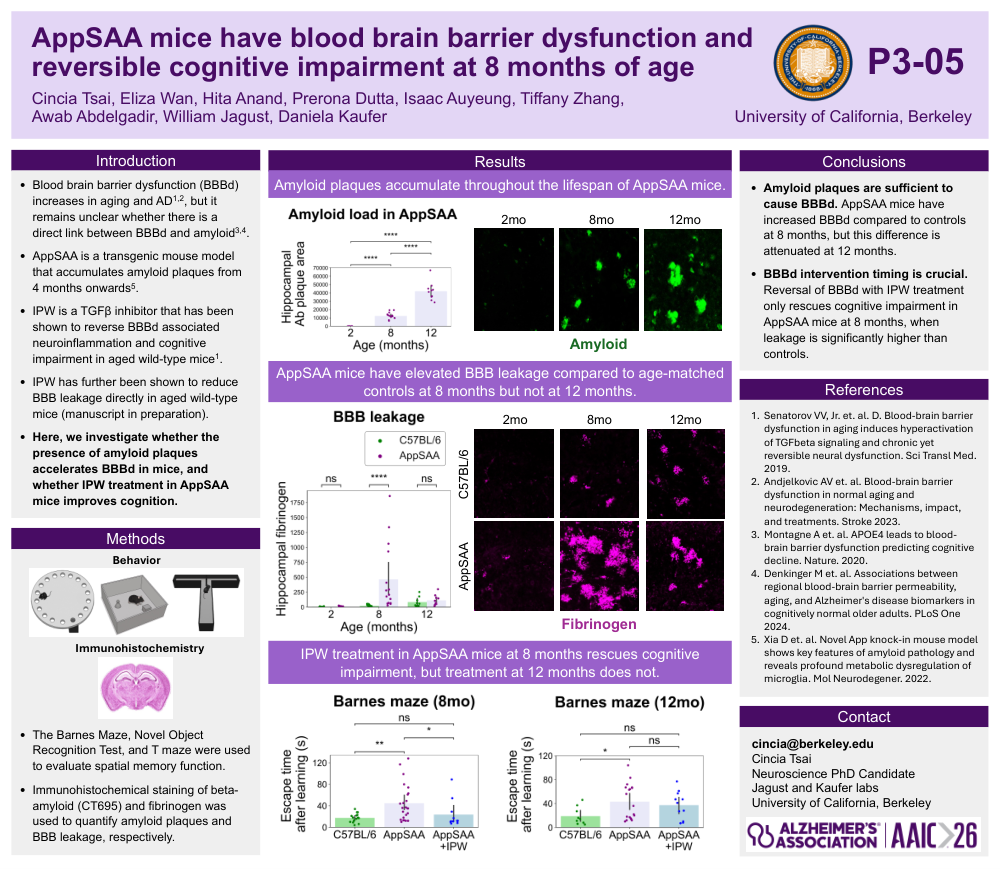
Title: AppSAA mice have blood brain barrier dysfunction and reversible cognitive impairment at 8 months of age
Authors: Cincia Tsai, Eliza Wan, Hita Anand, Prerona Dutta, Isaac Auyeung, Tiffany Zhang, Awab Abdelgadir, William Jagust, Daniela Kaufer
Introduction: Blood brain barrier dysfunction (BBBd) increases in aging and AD, but it remains unclear whether there is a direct link between BBBd and amyloid. AppSAA is a transgenic mouse model that accumulates amyloid plaques from 4 months onwards. IPW is a TGFβ inhibitor that has been shown to reverse BBBd associated neuroinflammation and cognitive impairment in aged wild-type mice. IPW has further been shown to reduce BBB leakage directly in aged wild-type mice. Here, we investigate whether the presence of amyloid plaques accelerates BBBd in mice, and whether IPW treatment in AppSAA mice improves cognition.
Methods: The Barnes Maze, Novel Object Recognition Test, and T maze were used to evaluate spatial memory function. Immunohistochemical staining of beta-amyloid (CT695) and fibrinogen was used to quantify amyloid plaques and BBB leakage, respectively.
Results:
1. Amyloid plaques accumulate throughout the lifespan of AppSAA mice.
2. AppSAA mice have elevated BBB leakage compared to age-matched controls at 8 months but not at 12 months.
3. IPW treatment in AppSAA mice at 8 months rescues cognitive impairment, but treatment at 12 months does not.
Conclusions: Amyloid plaques are sufficient to cause BBBd. AppSAA mice have increased BBBd compared to controls at 8 months, but this difference is attenuated at 12 months. BBBd intervention timing is crucial. Reversal of BBBd with IPW treatment only rescues cognitive impairment in AppSAA mice at 8 months, when leakage is significantly higher than controls.
References:
cincia@berkeley.edu
Cincia Tsai
Neuroscience PhD Candidate
Jagust and Kaufer labs
University of California, Berkeley
Comments
Email is required but is not shown publicly.
Loading comments...