4,068 posters, 219 videos, 101 topics, 69 sessions, 14,365 authors, 6,128 institutions
ePostersLive by SciGen Technologies S.A. All rights reserved.
Alzheimer's Association International Conference 2026
July 12-15, 2026 | London, United Kingdom, and Online

10575
A Composite Vascular Burden Score (Vcing-Lite Proxy) Modifies Apoe And Alzheimer’S Neuropathology Associations
Poster Presenter
Authors
Part of Topic
Video
A Composite Vascular Burden Score (VCING-Lite Proxy) Modifies APOE and Alzheimer’s Neuropathology Associations
Alice B. S., Nono Djotsa1,2, Rebecca Bernal3, Obed Apochi4, Yannick N. Wadop3,5, Angelique Gonzalez3, Shahroo Etemadmoghadam3, Crystal Wiedner3, Biniyam A. Ayele6,7,8, Murali Sargurupremraj3, Xueqiu Jian3, Alfred K. Njamnshi9,10, Cyrille Nkouonlack11,12,Jose E. Cavazos3, Sudha Seshadri3,13,14,15, Alfred Fonteh16, Bernard Fongang3,5,17, Jayandra Jung Himali3,14,15,22,23*, Agustin Ruiz3,18,19,20,21*, and Margaret E. Flanagan3,24* on behalf of the African Initiative on Bioinformatics Online Training in Neurodegenerative Diseases (AI-BOND)
* Joint senior authors
Authors affiliations:
1VA HSR&D Center for Innovations in Quality, Effectiveness and Safety, Michael E. DeBakey VA Medical Center, Houston, TX 77030, USA.
2Section of Health Services Research, Department of Medicine, Baylor College of Medicine, Houston, TX 77030, USA.
3Glenn Biggs Institute for Alzheimer's & Neurodegenerative Diseases, UT Health San Antonio, 7703 Floyd Curl Drive, San Antonio, TX 78299, USA.
4International Graduate School of Neuroscience IGSN, Ruhr University, Bochum, Germany.
5Department of Biochemistry and Structural Biology, The University of Texas Health Science Center at San Antonio, San Antonio, Texas, United States of America.
6John P. Hussman Institute for Human Genomics, University of Miami Miller School of Medicine, 1501 NW 10th Avenue, Miami, FL 33136 USA.
7Department of Neurology, College of Health Science, Addis Ababa University, Yared St. Addis Ababa, Ethiopia PoBox 1171.
8Global Brain Health Institute (GBHI), University of California San Francisco (UCSF), 675 Nelson Rising Lane, San Francisco, CA 94143.
9Brain Research Africa Initiative (BRAIN), Geneva, Switzerland & Yaoundé, Cameroon.
10Neuroscience Lab, Faculty of Medicine & Biomedical Sciences, The University of Yaoundé I, Yaoundé, Cameroon.
11Faculty of Health Sciences, University of Buea, Buea, Cameroon
12Brain Research Africa Initiative, Yaoundé, Cameroon
13Department of Neurology, UT Health San Antonio, 7703 Floyd Curl Drive, San Antonio, TX, USA.
14Department of Neurology, Boston University Chobanian & Avedisian School of Medicine, 72 East Concord Street, Boston, MA 02118, USA.
15The Framingham Heart Study, 73 Mt. Wayte Avenue, Framingham, MA 01702, USA.16Neuroscience Department, Huntington Medical Research Institutes, Pasadena, USA.
17Department of Population Health Sciences, UT Health San Antonio, 7703 Floyd Curl Drive, San Antonio, TX, USA.
18Joe R. & Teresa Lozano Long School of Medicine, UT Health San Antonio, 7703 Floyd Curl Drive, San Antonio, TX, USA.
19Department of Microbiology Immunology and Molecular Genetics. UT Health San Antonio, 7703 Floyd Curl Drive, San Antonio, TX, USA.
20Ace Alzheimer Center Barcelona-Universitat Internacional de Catalunya, Barcelona, Spain
21Networking Research Center on Neurodegenerative Diseases (CIBERNED), Instituto de Salud Carlos III, Madrid, Spain
22Department of Biostatistics, Boston University School of Public Health, 715 Albany Street, Boston, MA 02118, USA.
23Graduate School of Biomedical Sciences, UT Health San Antonio, 7703 Floyd Curl Drive, San Antonio, TX, USA.
24Department of Pathology, UT Health San Antonio, San Antonio, Texas
Abstract
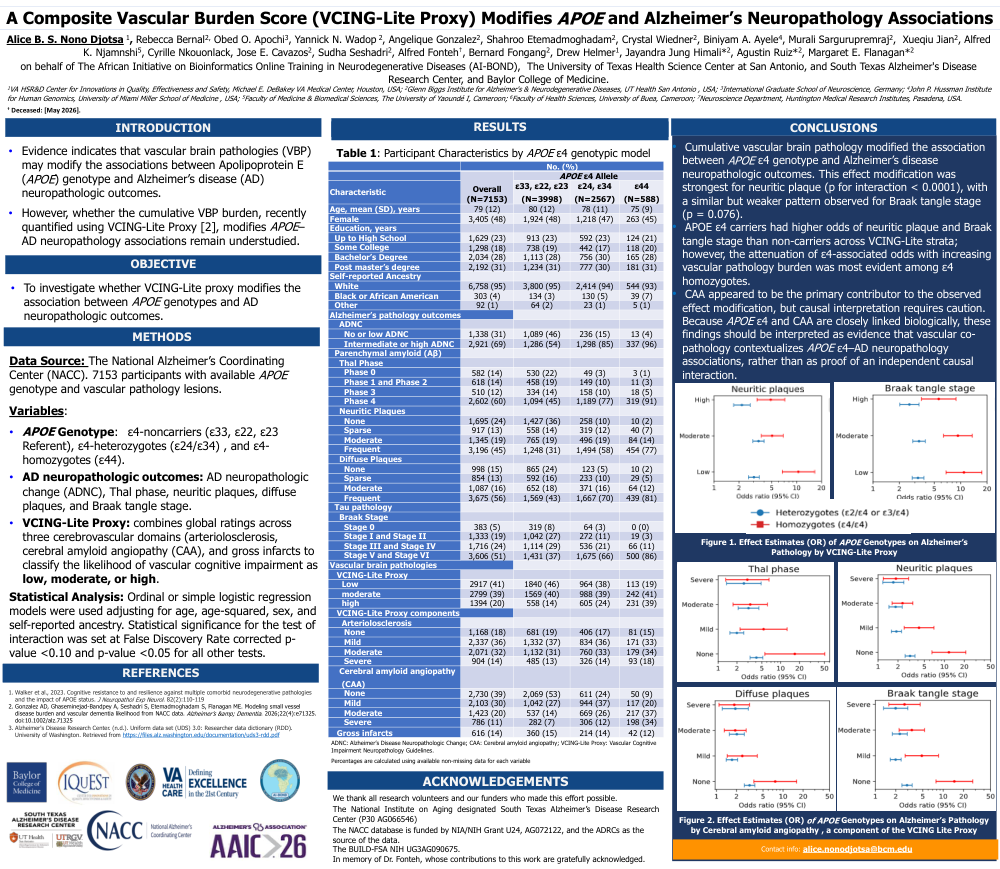
Background: Evidence indicates that vascular brain pathologies (VBP) may modify associations between APOE genotype and Alzheimer’s disease (AD) neuropathologic outcomes including AD neuropathologic change (ADNC), Thal phase, neuritic plaques, diffuse plaques, and Braak tangle stage. However, whether cumulative VBP burden, recently quantified using Gonzalez’s VCING-Lite Proxy, modifies APOE–AD neuropathology associations remain understudied. We therefore examined effect modification by VCING-Lite Proxy on associations between APOE genotypes and AD neuropathologic outcomes in the National Alzheimer’s Coordinating Center (NACC) dataset.
Methods: Participants were grouped as ε4-noncarriers (ε33/ε22/ε23), ε4-heterozygotes (ε24/ε34), or ε4-homozygotes (ε44). The VCING-Lite Proxy combines global ratings across three cerebrovascular domains—arteriolosclerosis, cerebral amyloid angiopathy (CAA), and gross infarcts—to classify the likelihood of vascular cognitive impairment as low, moderate, or high. We used logistic regression adjusted for age, age-squared, sex, self-reported ancestry, and education. Significance was set at FDR α=0.05, with interaction terms evaluated at p<0.10.
Results: The sample consisted of 7153 participants from the NACC database with autopsy data available (mean age 79±12 years, 48% female). We observed that VCING-Lite Proxy significantly modified the associations between APOE genotype and neuritic plaques (p<.0001); a similar but weaker pattern observed for Braak tangle stage (p = 0.076). Across VCING-Lite proxy strata, ε4-heterozygotes and ε4-homozygotes had higher odds of neuritic plaques compared with ε4 noncarriers; however, the magnitude of this association was attenuated at higher cumulative vascular pathology burden (Table 2). Specifically, odds ratios were highest in the low VCING-Lite proxy group (ε24/ε34 (OR[95% CI],p: 3.03[2.61,3.52],<.0001); ε44 (10.50[6.69,16.50],<.0001) and were lower in the high burden group (ε24/ε34 (2.17[1.72,2.74],<.0001); ε44 (4.86[3.30,7.16],<.0001)), consistent with effect modification by VCING-Lite proxy. No significant APOE × VCING-Lite proxy interaction was observed for ADNC, Thal phase, or diffuse plaques. Analyses of components of VCING-Lite proxy (Figure 1) showed that across AD neuropathologic outcomes, increasing CAA severity attenuated APOE ε4 associations and flattened the ε4 gene-dose gradient, shifting from a multiplicative pattern without CAA to near-nominal differences between ε24/ε34 and ε4/ε4 under severe CAA.
Conclusions: Higher VCING-Lite proxy scores attenuated the association between APOE genotype and neuritic plaques, and this effect was mainly driven by CAA. Given shared etiologic pathways between APOE and CAA, these interactions warrant careful causal interpretation.
Keywords: Alzheimer’s disease, APOE genotype, neuropathology, vascular pathology lesions, VCING-Lite proxy
Table 1. Participant Characteristics by APOE ε4 genotype
|
|
No. (%) |
|||
|
|
Overall |
APOE ε4 Allele |
||
|
Characteristic |
ε33, ε22 ε23 (N=3998) |
ε24, ε34 (N=2567) |
ε44 (N=588) |
|
|
Age, mean (SD), years |
79 (12) |
80 (12) |
78 (11) |
75 (9) |
|
Systolic Blood Pressure, mean (SD) |
131 (20) |
131 (20) |
131 (20) |
130 (19) |
|
Diastolic Blood Pressure, mean (SD) |
73 (11) |
73 (11) |
73 (11) |
74 (10) |
|
Female |
3,405 (48) |
1,924 (48) |
1,218 (47) |
263 (45) |
|
Education, years |
|
|
|
|
|
Up to High School |
1,629 (23) |
913 (23) |
592 (23) |
124 (21) |
|
Some College |
1,298 (18) |
738 (19) |
442 (17) |
118 (20) |
|
Bachelor’s Degree |
2,034 (28) |
1,113 (28) |
756 (30) |
165 (28) |
|
Post master’s degree |
2,192 (31) |
1,234 (31) |
777 (30) |
181 (31) |
|
Self-reported Ancestry |
|
|
|
|
|
White |
6,758 (95) |
3,800 (95) |
2,414 (94) |
544 (93) |
|
Black or African American |
303 (4) |
134 (3) |
130 (5) |
39 (7) |
|
Other |
92 (1) |
64 (2) |
23 (1) |
5 (1) |
|
Hispanic or Latino |
225 (3) |
140 (4) |
69 (3) |
16 (3) |
|
Smoking Status |
3,207 (46) |
1,835 (47) |
1,127 (46) |
245 (44) |
|
Lipid Lowering Medication Use |
2,425 (35) |
1,296 (33) |
911 (36) |
218 (37) |
|
Hypertension Treatment |
193 (3) |
109 (3) |
70 (3) |
14 (2) |
|
Alzheimer’s pathology outcomes |
|
|
|
|
|
Alzheimer's Disease Global Score |
|
|
|
|
|
Alzheimer's Disease Neuropathologic Change (ADNC) |
|
|
|
|
|
No or low ADNC |
1,338 (31) |
1,089 (46) |
236 (15) |
13 (4) |
|
Intermediate or high ADNC |
2,921 (69) |
1,286 (54) |
1,298 (85) |
337 (96) |
|
Parenchymal amyloid (Aβ) |
|
|
|
|
|
Thal Phase |
|
|
|
|
|
Phase 0 |
582 (14) |
530 (22) |
49 (3) |
3 (1) |
|
Phase 1 and Phase 2 |
618 (14) |
458 (19) |
149 (10) |
11 (3) |
|
Phase 3 |
510 (12) |
334 (14) |
158 (10) |
18 (5) |
|
Phase 4 |
2,602 (60) |
1,094 (45) |
1,189 (77) |
319 (91) |
|
Neuritic Plaques |
|
|
|
|
|
None |
1,695 (24) |
1,427 (36) |
258 (10) |
10 (2) |
|
Sparse |
917 (13) |
558 (14) |
319 (12) |
40 (7) |
|
Moderate |
1,345 (19) |
765 (19) |
496 (19) |
84 (14) |
|
Frequent |
3,196 (45) |
1,248 (31) |
1,494 (58) |
454 (77) |
|
Diffuse Plaques |
|
|
|
|
|
None |
998 (15) |
865 (24) |
123 (5) |
10 (2) |
|
Sparse |
854 (13) |
592 (16) |
233 (10) |
29 (5) |
|
Moderate |
1,087 (16) |
652 (18) |
371 (16) |
64 (12) |
|
Frequent |
3,675 (56) |
1,569 (43) |
1,667 (70) |
439 (81) |
|
Tau pathology |
|
|
|
|
|
Braak Stage |
|
|
|
|
|
Stage 0 |
383 (5) |
319 (8) |
64 (3) |
0 (0) |
|
Stage I and Stage II |
1,333 (19) |
1,042 (27) |
272 (1) |
19 (3) |
|
Stage III and Stage IV |
1,716 (24) |
1,114 (29) |
536 (21) |
66 (11) |
|
Stage V and Stage VI |
3,606 (51) |
1,431 (37) |
1,675 (66) |
500 (86) |
|
Vascular brain pathologies |
|
|
|
|
|
VCING-Lite Proxy |
|
|
|
|
|
Low |
2917 (41.03) |
1840 (46.0) |
964 (38.0) |
113 (19.0) |
|
moderate |
2799 (39.37) |
1569 (40.0) |
988 (39.0) |
242 (41.0) |
|
high |
1394 (19.61) |
558 (14.0) |
605 (24.0) |
231 (39.0) |
|
VCING-Lite Proxy components |
|
|
|
|
|
Arteriolosclerosis |
|
|
|
|
|
None |
1,168 (18) |
681 (19) |
406 (17) |
81 (15) |
|
Mild |
2,337 (36) |
1,332 (37) |
834 (36) |
171 (33) |
|
Moderate |
2,071 (32) |
1,132 (31) |
760 (33) |
179 (34) |
|
Severe |
904 (14) |
485 (13) |
326 (14) |
93 (18) |
|
Cerebral amyloid angiopathy (CAA) |
|
|
|
|
|
None |
2,730 (39) |
2,069 (53) |
611 (24) |
50 (9) |
|
Mild |
2,103 (30) |
1,042 (27) |
944 (37) |
117 (20) |
|
Moderate |
1,423 (20) |
537 (14) |
669 (26) |
217 (37) |
|
Severe |
786 (11) |
282 (7) |
306 (12) |
198 (34) |
|
Gross infarcts |
616 (14) |
360 (15) |
214 (14) |
42 (12) |
Abbreviations: APOE, apolipoprotein E
Comments
Email is required but is not shown publicly.
Loading comments...