4,068 posters, 219 videos, 101 topics, 69 sessions, 14,365 authors, 6,128 institutions
ePostersLive by SciGen Technologies S.A. All rights reserved.
Alzheimer's Association International Conference 2026
July 12-15, 2026 | London, United Kingdom, and Online

5294
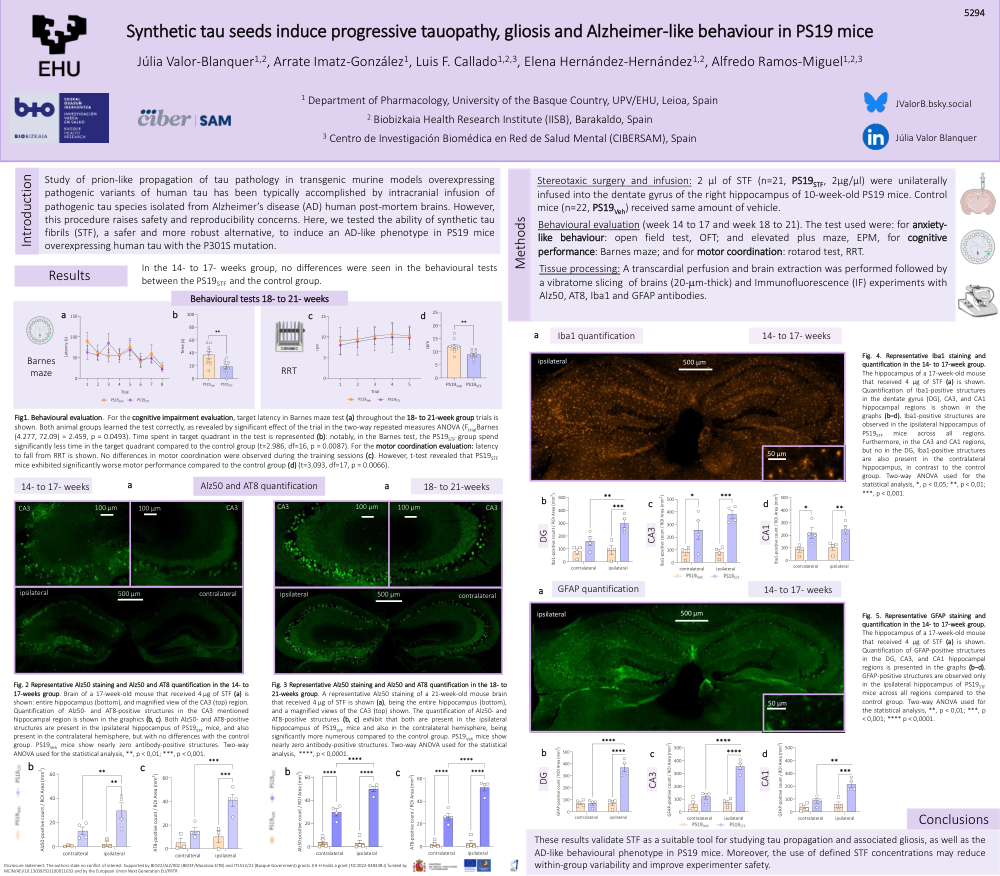
Synthetic Tau Seeds Induce Progressive Tauopathy, Gliosis And Alzheimer-like Behavior In PS19 Mice.
Poster Presenter
Authors
Affiliations
Part of Topic
INTRODUCTI: Study of prion-like propagation of tau pathology in transgenic murine models overexpressing
pathogenic variants of human tau has been typically accomplished by intracranial infusion of
pathogenic tau species isolated from Alzheimer’s disease (AD) human post-mortem brains. However,
this procedure raises safety and reproducibility concerns. Here, we tested the ability of synthetic tau
fibrils (STF), a safer and more robust alternative, to induce an AD-like phenotype in PS19 mice
overexpressing human tau with the P301S mutation.
METHODS: Stereotaxic surgery and infusion: 2 μl of STF (n=21, PS19STF, 2μg/μl) were unilaterally
infused into the dentate gyrus of the right hippocampus of 10-week-old PS19 mice. Control
mice (n=22, PS19Veh) received same amount of vehicle.
Behavioural evaluation (week 14 to 17 and week 18 to 21). The test used were: for anxietylike
behaviour: open field test, OFT; and elevated plus maze, EPM, for cognitive
performance: Barnes maze; and for motor coordination: rotarod test, RRT.
Tissue processing: A transcardial perfusion and brain extraction was performed followed by
a vibratome slicing of brains (20-m-thick) and Immunofluorescence (IF) experiments with
Alz50, AT8, Iba1 and GFAP antibodies.
CONCLUSIONS:
These results validate STF as a suitable tool for studying tau propagation and associated gliosis, as well as the
AD-like behavioural phenotype in PS19 mice. Moreover, the use of defined STF concentrations may reduce
within-group variability and improve experimenter safety.
Comments
Email is required but is not shown publicly.
Loading comments...