4,068 posters, 219 videos, 101 topics, 69 sessions, 14,365 authors, 6,128 institutions
ePostersLive by SciGen Technologies S.A. All rights reserved.
Alzheimer's Association International Conference 2026
July 12-15, 2026 | London, United Kingdom, and Online

868
Mechanosensory Regulation Of Cortical Interneuron Migration By Trpm7 Gene During Neurodevelopment
Poster Presenter
Authors
Part of Topic
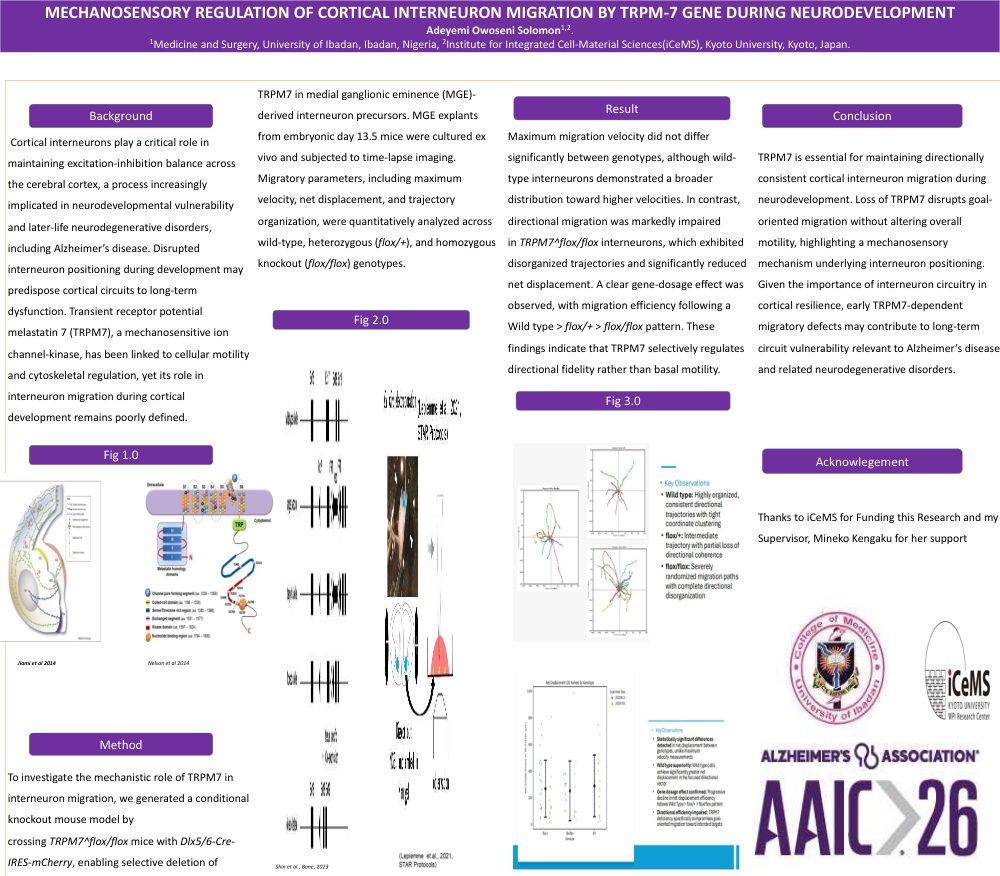
Background: Cortical interneurons play a critical role in maintaining excitation-inhibition balance across the cerebral cortex, a process increasingly implicated in neurodevelopmental vulnerability and later-life neurodegenerative disorders, including Alzheimer’s disease. Disrupted interneuron positioning during development may predispose cortical circuits to long-term dysfunction. Transient receptor potential melastatin 7 (TRPM7), a mechanosensitive ion channel-kinase, has been linked to cellular motility and cytoskeletal regulation, yet its role in interneuron migration during cortical development remains poorly defined.
Methods: To investigate the mechanistic role of TRPM7 in interneuron migration, we generated a conditional knockout mouse model by crossing TRPM7^flox/flox mice with Dlx5/6-Cre-IRES-mCherry, enabling selective deletion of TRPM7 in medial ganglionic eminence (MGE)-derived interneuron precursors. MGE explants from embryonic day 13.5 mice were cultured ex vivo and subjected to time-lapse imaging. Migratory parameters, including maximum velocity, net displacement, and trajectory organization, were quantitatively analyzed across wild-type, heterozygous (flox/+), and homozygous knockout (flox/flox) genotypes.
Results: Maximum migration velocity did not differ significantly between genotypes, although wild-type interneurons demonstrated a broader distribution toward higher velocities. In contrast, directional migration was markedly impaired in TRPM7^flox/flox interneurons, which exhibited disorganized trajectories and significantly reduced net displacement. A clear gene-dosage effect was observed, with migration efficiency following a Wild type > flox/+ > flox/flox pattern. These findings indicate that TRPM7 selectively regulates directional fidelity rather than basal motility.
Conclusion: TRPM7 is essential for maintaining directionally consistent cortical interneuron migration during neurodevelopment. Loss of TRPM7 disrupts goal-oriented migration without altering overall motility, highlighting a mechanosensory mechanism underlying interneuron positioning. Given the importance of interneuron circuitry in cortical resilience, early TRPM7-dependent migratory defects may contribute to long-term circuit vulnerability relevant to Alzheimer’s disease and related neurodegenerative disorders.
Comments
Email is required but is not shown publicly.
Loading comments...