4,068 posters, 219 videos, 101 topics, 69 sessions, 14,365 authors, 6,128 institutions
ePostersLive by SciGen Technologies S.A. All rights reserved.
Alzheimer's Association International Conference 2026
July 12-15, 2026 | London, United Kingdom, and Online

2400
Does Hearing Loss Promote The Onset And Progression Of Alzheimer’S Disease?
Poster Presenter
Authors
Robert J. Fuentes, Mi-Jung Kim, Raisa Monteiro Monteiro, Xiaodong Tan, Hongxin Dong, Jing Zheng
Affiliations
Department of Otolaryngology - Head and Neck Surgery, Feinberg School of Medicine, Northwestern University, Chicago, IL USA., Mi-Jung, Stephen M. Stahl Center for Psychiatric Neuroscience, Department of Psychiatry and Behavioral Sciences, Feinberg School of Medicine, Northwestern University, Chicago, IL USA., Stephen M. Stahl Center for Psychiatric Neuroscience, Department of Psychiatry and Behavioral Sciences, Feinberg School of Medicine, Northwestern University, Chicago, IL USA
Part of Topic
Does hearing loss promote the onset and progression of Alzheimer's disease?
Background
Clinical studies have identified a significant correlation between hearing loss and the progression of Alzheimer's disease (AD)1,2. However, the causal relationship between the two remains poor understood. Amyloid-beta (Aβ), a hallmark of AD, may affect neurons responsible for hearing2,3. Conversely, impaired cochlear function might also play a role in advancing AD4.
APP/PS1 mice are among the most frequently used transgenic mouse models in AD research. However, this model is on the C57BL/6 background, which suffers from early-onset hearing loss due to a mutation in Cdh23 expressed in both the cochlea and brain5. To exclude the influence of the Cdh23 mutation, we have "corrected" the Cdh23 mutant. We aim to use our modified mouse model to investigate the relationship between hearing loss and memory impairment.
Methods
Animals To eliminate the influence of the mutant Cdh23 (Cdh23753A) allele, we crossed APP/PS1 of C57BL6/J background mice (AA-APP/PS1) with the B6.CAST-Cdh23Ahl+/Kjn strain (GG-WT), which carries the WT allele of Cdh23. We genotyped the offspring to confirm that the APP/PS1 and their WT littermate carry one copy of the WT Cdh23 allele: GA-WT and GA-APP/PS1.
Hearing Mice had their hearing assessed with distortion product otoacoustic emission (DPOAE) to assess outer hair cell (OHC) and cochlear function and auditory brainstem response (ABR) to test neuron electrical signal transmission and function. Both tests are performed with the Tucker Davis Technologies system and analyzed in MATLAB. Testing began at 3 months of age and continued to be assessed at 5, 7,10, 12, and 15 months of age.
Behavior Behavior was assed with the use of the open field test (OFT) to measure general locomotion and acclimation to the testing environment. Novel object recognition (NOR) was used to test working memory ability. Y-maze testing was used to assess spatial memory ability. OFT and NOR testing began at 7 months of age and continued to 10, 12, and 15 months of age. Y-maze testing began at 15 months of age. The use of ANYmaze software was used to test and analyze results of OFT, Y-maze, and NOR. NOR was additionally manually scored via use of a stopwatch timer to determine time spent investigating objects to prevent false positive results. Investigation criteria was defined as touching, pressing against, smelling, and looking at the object.
Results
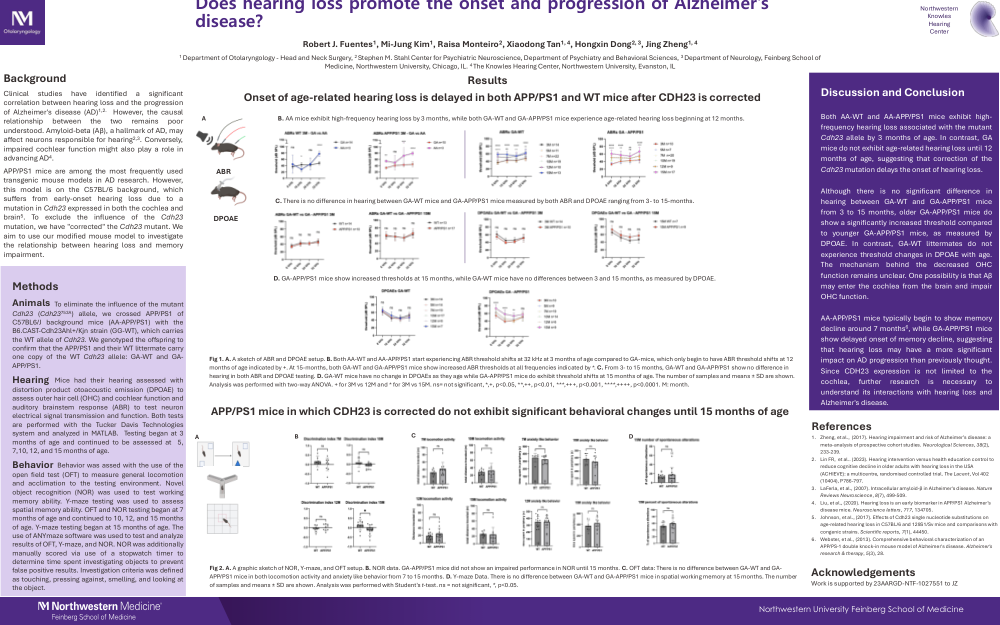
1. Onset of age-related hearing loss is delayed in both APP/PS1 and WT mice after CDH23 is corrected
2. APP/PS1 mice in which CDH23 is corrected do not exhibit significant behavioral changes until 15 months of age
Discussion and Conclusion
Both AA-WT and AA-APP/PS1 mice exhibit high-frequency hearing loss associated with the mutant Cdh23 allele by 3 months of age. In contrast, GA mice do not exhibit age-related hearing loss until 12 months of age, suggesting that correction of the Cdh23 mutation delays the onset of hearing loss.
Although there is no significant difference in hearing between GA-WT and GA-APP/PS1 mice from 3 to 15 months, older GA-APP/PS1 mice do show a significantly increased threshold compared to younger GA-APP/PS1 mice, as measured by DPOAE. In contrast, GA-WT littermates do not experience threshold changes in DPOAE with age. The mechanism behind the decreased OHC function remains unclear. One possibility is that Aβ may enter the cochlea from the brain and impair OHC function.
AA-APP/PS1 mice typically begin to show memory decline around 7 months6, while GA-APP/PS1 mice show delayed onset of memory decline, suggesting that hearing loss may have a more significant impact on AD progression than previously thought. Since CDH23 expression is not limited to the cochlea, further research is necessary to understand its interactions with hearing loss and Alzheimer's disease.
References
Acknowledgements
Work is supported by 23AARGD-NTF-1027551 to JZ
Comments
Email is required but is not shown publicly.
Loading comments...