4,068 posters, 219 videos, 101 topics, 69 sessions, 14,365 authors, 6,128 institutions
ePostersLive by SciGen Technologies S.A. All rights reserved.
Alzheimer's Association International Conference 2026
July 12-15, 2026 | London, United Kingdom, and Online

9275
Intracerebral Viral Expression Of APOE4-Ch Variant Modulates Amyloid And Tau Pathology And Associated Glial Response In Transgenic AD Mice
Poster Presenter
Authors
Minwoo Kim, Josslen Thieschafer, Kristina Fredriksen, Holly Korthas, Ling Li
Affiliations
null,
Part of Topic
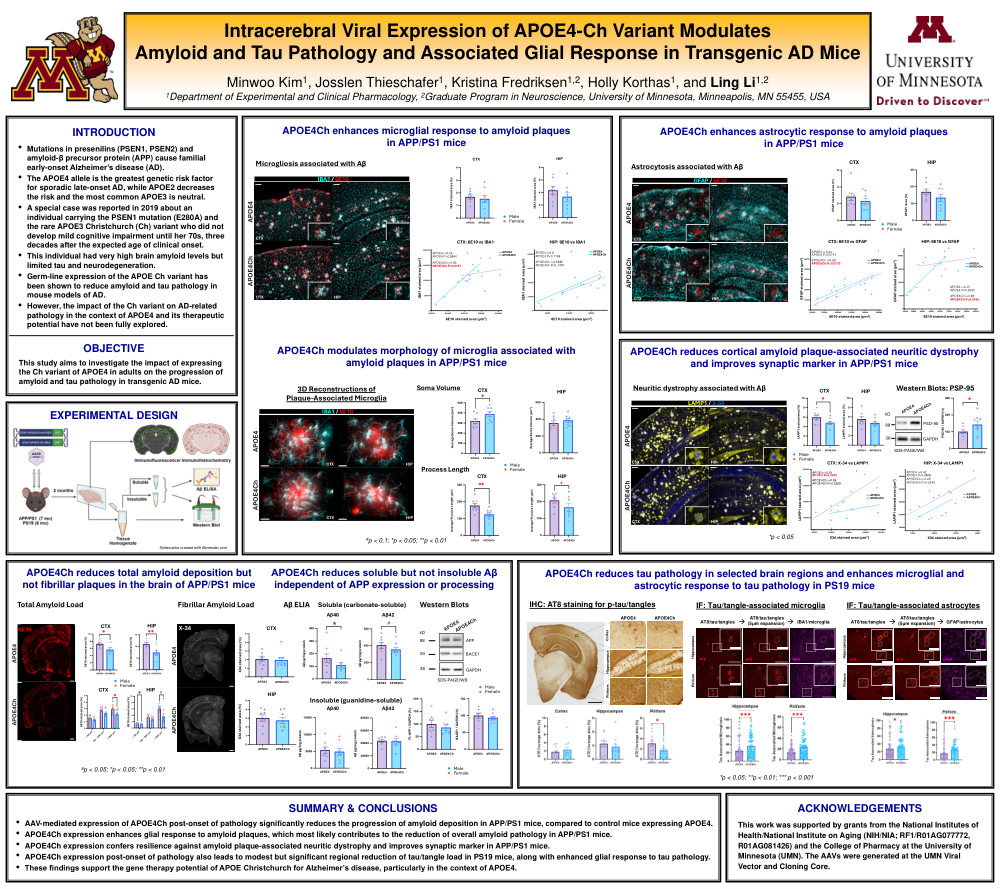
Mutations in presenilins (PSEN1, PSEN2) and amyloid-β precursor protein (APP) cause familial early-onset Alzheimer’s disease (AD). The APOE4 allele is the greatest genetic risk factor for sporadic late-onset AD, while APOE2 decreases the risk and the most common APOE3 is neutral. A special case was reported in 2019 about an individual carrying the PSEN1 mutation (E280A) and the rare APOE3 Christchurch (Ch) variant who did not develop mild cognitive impairment until her 70s, three decades after the expected age of clinical onset. This individual had very high brain amyloid levels but limited tau and neurodegeneration. Germ-line expression of the APOE Ch variant has been shown to reduce amyloid and tau pathology in mouse models of AD. However, the impact of the Ch variant on AD-related pathology in the context of APOE4 and its therapeutic potential have not been fully explored. This study aims to investigate the impact of expressing the Ch variant of APOE4 in adults on the progression of amyloid and tau pathology in transgenic AD mice. The results show that AAV-mediated expression of APOE4Ch post-onset of pathology significantly reduces the progression of amyloid deposition in APP/PS1 mice, compared to control mice expressing APOE4. APOE4Ch expression enhances glial response to amyloid plaques, which most likely contributes to the reduction of overall amyloid pathology in APP/PS1 mice. APOE4Ch expression confers resilience against amyloid plaque-associated neuritic dystrophy and improves synaptic marker in APP/PS1 mice. APOE4Ch expression post-onset of pathology also leads to modest but significant regional reduction of tau/tangle load in PS19 mice, along with enhanced glial response to tau pathology. These findings support the gene therapy potential of APOE Christchurch for Alzheimer’s disease, particularly in the context of APOE4.
Comments
Email is required but is not shown publicly.
Loading comments...